
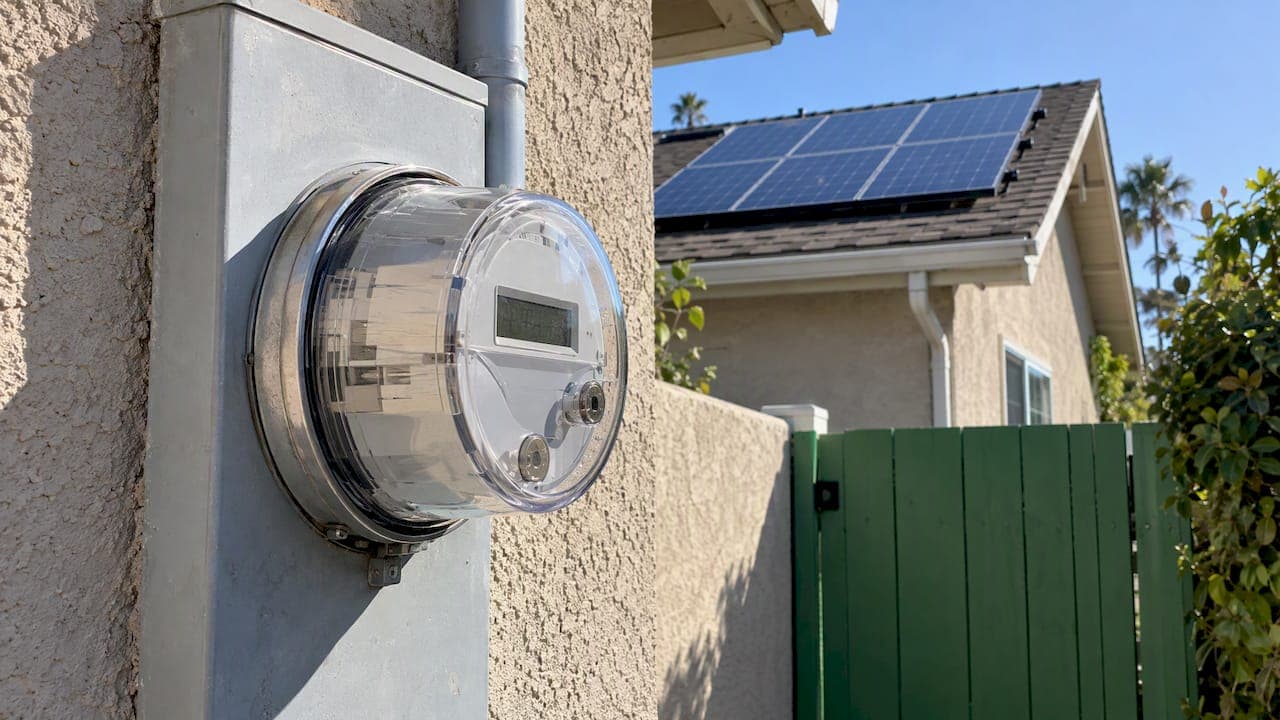

Net metering credits the solar power you send to the grid at, or close to, the retail rate you pay for electricity. Net billing records your imports and exports separately and credits exports at a different, usually lower, rate set by the tariff. The difference decides how much a system saves, how it should be sized, and whether a battery pays for itself. In San Diego County, new solar customers are on net billing, so that is the math your project has to beat.
TL;DR
- Net metering offsets what you import with what you export over a billing period, generally at retail value. Net billing values exports separately, at a rate that is usually below retail.
- In California, applications submitted on or after April 15, 2023 fall under the Net Billing Tariff (NBT), which the large utilities call the Solar Billing Plan. That includes San Diego Gas & Electric (SDG&E) territory.
- Under net billing, every kilowatt-hour you use on site is worth more than one you export. Self-consumption, load shifting and battery storage drive the savings.
- Existing NEM customers generally keep their legacy tariff. Never judge a new project with legacy NEM numbers.
- A feed-in tariff is a third model: a set price paid for production, separate from your own consumption.
Table of Contents
- The core difference in one paragraph
- Net metering vs. net billing at a glance
- How net metering works
- How net billing works
- Why regulators moved from one to the other
- What this means in San Diego County
- A worked comparison, in principle
- Designing a system for net billing
- “Zero net energy” does not mean a zero bill
- Where feed-in tariffs fit
- Perspective: what we tell San Diego customers
- Work with a team that models net billing first
- Questions to ask before you sign
- FAQ
- Sources
The core difference in one paragraph
Both systems start the same way. Your panels power your building first. Surplus flows to the grid, and the utility supplies power when your panels fall short. The Department of Energy describes this flow and notes that compensation rules, eligible system size, and credit design depend on the state and utility.
The split comes at the point where exports are valued. According to the International Energy Agency’s policy guide, net metering typically values surplus at retail prices, while net billing schemes often value it somewhere between retail and wholesale. That one design choice changes the economics of everything else.
Net metering vs. net billing at a glance
| Feature | Net metering | Net billing |
|---|---|---|
| Export value | Generally retail rate | Tariff-defined rate, usually below retail |
| Imports and exports | Netted against each other over a period | Recorded and valued separately |
| Best-fit system | Large daytime surplus is rewarded | Self-consumption and timing are rewarded |
| Role of a battery | Mostly backup | Can shift production to higher-value hours |
| Sizing logic | Often annual production vs. annual usage | Interval load profile and export value |
| Where it applies in San Diego County | Legacy NEM customers | New applications since April 15, 2023 |
How net metering works
Under traditional net metering, the utility subtracts your generation from your consumption. The Department of Energy’s homeowner guide describes it as an arrangement in which system owners are compensated for solar power they export to the grid. In practice, a kilowatt-hour sent out offsets a kilowatt-hour you would otherwise buy.
The netting period matters. A U.S. Department of Energy national laboratory analysis, published through OSTI, explains that a longer interval can make the grid function like seasonal storage, while expired credits or shorter settlement periods reduce that benefit. So “net metering” is not one product. Two utilities can both offer it and deliver very different results depending on the interval and the rollover rules.
California’s earlier versions, NEM 1.0 and NEM 2.0, credited exports using the applicable import rates before the annual true-up, according to the California Public Utilities Commission (CPUC). That is why a system sized to cover 100% of annual usage worked so well in those years.

How net billing works
Net billing treats the two flows as separate transactions. You pay for imports at your rate plan. You receive credits for exports at a value the tariff defines. The two are combined on the bill, but they are not valued the same.
In California, the CPUC states that NBT export credits use values from its Avoided Cost Calculator, which are usually lower than retail import rates. The same page notes that NBT export value can exceed the retail rate at some late-summer evening hours. Your solar still offsets onsite consumption first under both structures, and that onsite use is where the strongest value sits.
Two other NBT features matter when you plan a budget:
- Monthly billing. The CPUC says NBT customers pay bill charges monthly, and unused credits roll forward until the annual true-up. That avoids a large surprise at the end of the year.
- A required rate. NBT requires specified electrification time-of-use rates. For SDG&E customers that is EV-TOU-5, according to the CPUC summary.
The CPUC also describes a nine-year NBT legacy period for the original customer, and customers moving from a previous NEM tariff are not eligible for it. Confirm your own status with the utility before you plan around it.
Why regulators moved from one to the other
The IEA policy guide explains the logic. Retail credits can include network and policy costs that exceed the system value of exported electricity. As more distributed solar connects, that creates cost-recovery and cross-subsidy concerns for regulators. The CPUC’s design reflects that judgment: power you use on site avoids a retail purchase, so it earns the most. Exports are paid by their estimated value to the grid.
You do not have to agree with the policy to plan around it. What matters is that it changes the question from “how many kilowatt-hours will I produce?” to “how many of them will I use, and when?”
What this means in San Diego County
For SDG&E customers, the practical question is not “NEM or net billing.” New interconnection applications fall under the NBT, called the Solar Billing Plan by the investor-owned utilities, and existing NEM customers generally keep their legacy tariff rather than being automatically moved. The CPUC page covers PG&E, Southern California Edison and SDG&E territories.
If you are a business or a homeowner comparing quotes, check three things:
- Which tariff the quote assumes. A proposal built on legacy NEM economics overstates savings for a new system.
- How exports are valued. Ask for the hourly or interval assumptions, not just an annual average.
- Which rate plan you will be on. For SDG&E, the required time-of-use rate changes what each imported hour costs. Our guide to SDG&E time-of-use rates shows when power is cheapest.
Businesses should also read our NEM 3.0 guide for San Diego businesses, which covers how the change affects commercial projects.
A worked comparison, in principle
The numbers below are illustrative and not a quote or a rate. They show how the logic works, not what you will pay.
Imagine a building that makes surplus power every sunny midday while its owners are away, and draws from the grid every evening.
- Under net metering, the midday surplus offsets evening imports at roughly equal value. The building can export a lot and still come out ahead.
- Under net billing, the midday surplus earns a lower export credit, while the evening imports are bought at the full time-of-use price. The same building ends up with a bigger bill, because the exports and imports are no longer worth the same.
Now add storage, or move some load into the sunny hours. The midday power is used on site or held until evening instead of being sold cheaply. The CPUC specifically identifies storage as a way to maximize bill savings, and notes that a battery can shift production from lower-value daytime exports to higher-value late-summer evening periods.
The lesson: under net billing, the same panels can produce very different savings depending on the load and storage around them. That is why a simple production-to-usage ratio no longer tells the full story.
Designing a system for net billing
Raise self-consumption first
Every kilowatt-hour you use while the sun shines avoids a retail purchase. Practical ways to do that include running pool pumps, water heating and pre-cooling during production hours. Reducing afternoon cooling demand also lowers what you buy. Measures such as solar control window film cut heat gain through glass, which trims the load your system has to cover.
Add storage where timing matters
A battery moves solar production into hours when electricity is worth more, and it can provide backup depending on system design, as the Department of Energy notes. We cover the design side on our battery storage page.
Plan EV charging around the sun
An EV is flexible load. Charging in daylight, or from stored solar, turns exports into self-consumption. Our guide on covering an EV with solar panels and smart charging explains how many panels a typical vehicle needs, and the EV charging and solar integration page shows how we put it together. If a charger risks a panel upgrade, read about EV load management.
Model commercial sites by interval
Commercial projects require interval-aware modeling. The CPUC comparison distinguishes residential one-hour metering intervals from nonresidential 15-minute intervals under NEM 2.0. Under NBT, exports are credited using the tariff’s export value and imports are billed monthly. A production-only estimate can overstate savings for a facility with daytime excess generation, such as an office that is empty on weekends. Our commercial solar cost guide walks through what drives those numbers.
“Zero net energy” does not mean a zero bill
A common surprise is that offsetting all your kilowatt-hours does not zero out the bill. The Department of Energy notes that utilities may still apply fixed charges or other non-energy charges. Under SDG&E’s plan, some charges are not nettable. Budget for them, and ask your installer to show them in the proposal.
Where feed-in tariffs fit
Readers often ask how net metering compares with a feed-in tariff. A feed-in tariff pays a fixed price for the electricity you generate, and the price is not tied to what you pay to buy power. The U.S. Energy Information Administration explains that feed-in tariffs are most similar to the federal Qualifying Facility incentives in place since the late 1970s. Net metering and net billing instead settle your production against your own consumption. In the U.S., these two are the common residential and commercial mechanisms, and which one you have depends on your state and utility.
Perspective: what we tell San Diego customers
We see the same mistake in proposals from other sources: a quote that sizes the system to annual usage and uses legacy NEM savings. Under net billing, that produces a payback that looks better on paper than on your bills.
Our approach starts with the load. We look at when your home or building uses power, which rate plan applies, and what a battery or EV charger changes. Then we size the solar. We also put the pricing and ROI analysis in front of you, including the charges that do not net out, so you can compare options on the same footing.
Net billing is not a reason to avoid solar. It is a reason to design it more carefully. Projects that match production to use, and add storage where it earns its place, still make a strong financial case, and the details are specific to each site.
— Curtis Williamson
Work with a team that models net billing first
Indigo Energy designs and installs solar, battery storage and EV charging for homes and commercial properties in San Diego County, including site assessment, permitting, ROI analysis and ongoing monitoring. If you want your system modeled under the tariff you will actually be on, see our services, start with residential solar installation, or look at current California solar incentives first. Businesses can review commercial solar incentives in San Diego.
Questions to ask before you sign
The Department of Energy’s guidance points to the questions worth asking any installer: whether the utility offers net metering, which customer and system sizes qualify, what rate applies, how credits work, and what happens at true-up. Add these:
- Which tariff does this proposal assume, and what is the application date?
- What export value did you use, and at what hours?
- How does the estimate change with and without a battery?
- What non-nettable charges remain on my bill?
- Who handles interconnection and permitting?
FAQ
Is net metering or net billing better?
For the customer, net metering is usually more favorable because exports earn retail-level credit. Net billing pays less for exports, so it rewards using your own power. Which one you get depends on your state and utility, and in San Diego County new systems are on net billing.
What is the difference between net metering and net billing?
Net metering offsets imports with exports, generally at the retail rate. Net billing records them separately and values exports at a tariff-defined rate, typically lower than retail. The difference is the value and timing assigned to exported electricity, according to the CPUC.
Do I keep my old NEM tariff if I add panels?
Existing NEM customers generally retain their legacy tariff. Changes to an existing system, or a new system at a new address, can alter which tariff applies. Confirm with SDG&E and your installer before you expand.
Is solar still worth it under net billing?
Often yes, but the case rests on self-consumption, rate plan and storage, not on exporting as much as possible. The only reliable answer comes from modeling your interval load data under the applicable tariff.
Sources
- CPUC: Net Energy Metering and Net Billing
- Department of Energy: Homeowner’s Guide to Solar
- Department of Energy: Solar Integration, Distributed Energy Resources and Microgrids Basics
- IEA policy guide: Distributed generation and self-consumption
- OSTI: Alternative Approaches to Traditional Net Energy Metering
- U.S. EIA: Feed-in tariff