
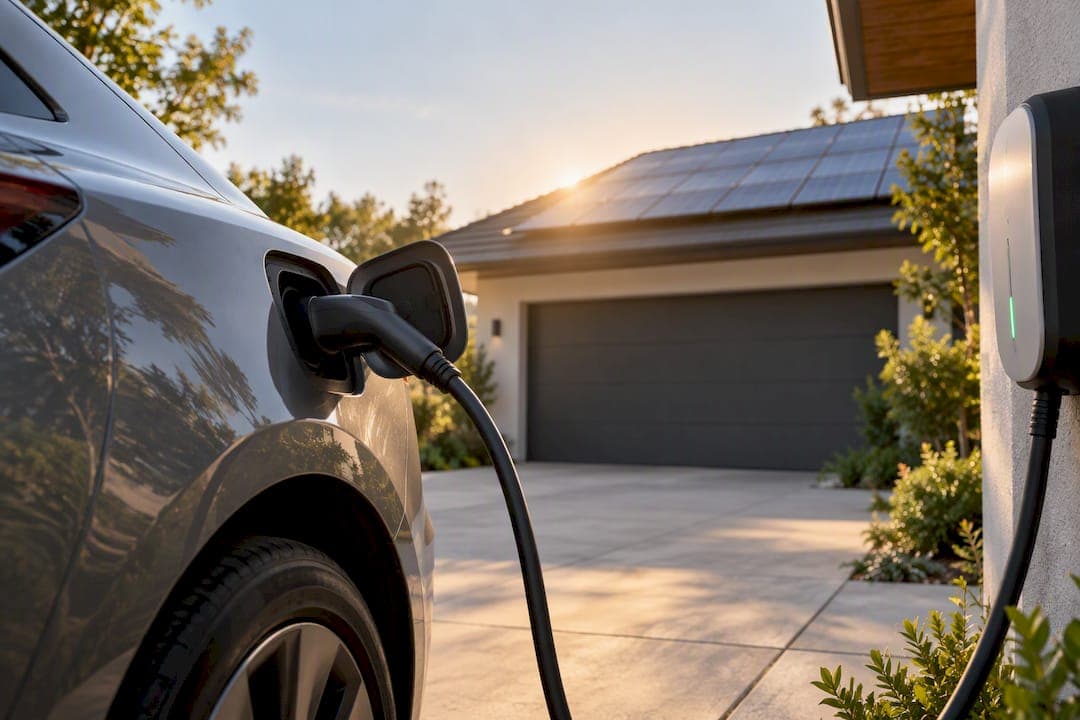

Yes, you can charge an electric vehicle with solar, but for nearly every home system that means your panels offset the electricity your charger pulls from the grid rather than feeding your car directly. Getting the most value out of that setup depends on two levers: a smart charger that schedules charging around midday production and, in some cases, a modest battery. Before you commit to either, check whether the federal Alternative Fuel Vehicle Refueling Property Credit still applies to your installation.
TL;DR:
- Most home solar systems offset EV charging through excess energy fed into your home grid, not direct DC connection, due to system design.
- Sizing your solar array to cover your EV’s annual energy use depends on your driving habits, local sunlight, and system buffers, typically needing seven to twelve panels.
- Smart chargers with adjustable amperage and scheduling can significantly improve solar self-consumption by aligning charging with peak sunlight hours.
- Batteries can be cost-effective if you want to charge overnight, reduce demand charges, or improve backup power, but they aren’t necessary for all households.
- Confirm utility incentives, your electrical capacity, and future expansion plans with a qualified installer to optimize system performance and avoid costly upgrades.
Table of Contents
- How solar and EV chargers actually work together
- Sizing an array for EV charging: panels, kWh, and realistic mileage
- Smart chargers and scheduling that boost solar self-consumption
- When battery storage makes sense (and when it doesn’t)
- Costs, incentives and payback: what to check now
- Installer checklist and questions to ask on a site visit
- Installer perspective: lessons from the field
- How Indigo Energy helps you get solar and EV charging right
- Where to check incentives, technical guides, and calculators
- Sources
- FAQ
How solar and EV chargers actually work together
Rooftop solar does not send direct current straight from your panels into your car’s battery. Your array generates DC power, your inverter converts it to AC, and that AC feeds your home’s electrical panel alongside grid power. Your Level 2 charger draws from that same panel, so when the sun is out and your panels are producing more than your house is using, your car draws on that surplus instead of grid electricity. When it is not, your charger pulls from the grid like any other appliance.
This is why “solar-powered charging” usually means offsetting rather than a dedicated wire from roof to car. A home can credibly claim solar-powered charging when its annual production covers the electricity the EV consumes over a year, even if the actual electrons charging the car at 9 p.m. came from the grid. Direct DC-coupled charging setups do exist, but they are specialized, typically found in commercial fleet or off-grid installations like a mobile PV-BESS power station, and rarely make sense for a single-family home.
Key distinctions worth understanding:
- Grid-tied offset: your solar production and EV charging are netted against each other over a billing period, not matched minute to minute.
- Direct DC coupling: a rare, purpose-built system that skips the inverter step for select applications, mostly commercial or off-grid.
- True solar-following charging: your charger actively increases or decreases the amperage sent to the car based on real-time solar output, which is achievable with the right equipment.
Sizing an array for EV charging: panels, kWh, and realistic mileage
Start with how much you drive. Multiply your typical annual mileage by your vehicle’s efficiency (in kWh per mile) to get your annual charging load, then divide by your region’s expected annual production per panel to estimate array size. AAA’s consumer guidance puts the common estimate at seven to 12 panels to cover EV charging needs for many households, though your actual number depends on your driving habits, local sun hours, and panel wattage.
| Array size | Approximate panels | Typical daily driving covered |
|---|---|---|
| Small | 4 panels | Short commutes, light daily use |
| Medium | 7 to 10 panels | Average commuter driving most days |
| Large | More than 10 panels | Higher mileage or a second EV in the household |
Production varies by season and geography, so a system sized for a sunny climate in July will underperform in December. Most installers build in a buffer rather than sizing to the exact annual average, which keeps your offset closer to full coverage even during shorter winter days.
Smart chargers and scheduling that boost solar self-consumption
The single biggest lever for aligning charging with solar production is often the charger itself, not the array. Adjustable-amperage chargers let you throttle charging speed to match available surplus power instead of drawing a fixed load regardless of what your panels are producing. Scheduling features let you set charging windows around midday, when production typically peaks, rather than overnight when your panels are dark.
Whole-home energy monitors add another layer: some systems track your real-time production and consumption and automatically adjust charging amperage to consume the surplus without pulling from the grid. According to Emporia Energy’s guidance, reliable solar-only charging generally requires a minimum amount of excess production, often around 1.4 kilowatts, before the system will run without drawing grid backfeed.
- Adjustable amperage: lets the charger scale output to match available solar surplus instead of a fixed draw.
- Scheduled windows: shifts charging into your production peak hours automatically.
- Automatic load management (ALMS): shares limited electrical capacity between the charger and other high-draw appliances.
Pro Tip: Set your charger’s default amperage a notch below your panel’s peak output rather than at its maximum, so the system has room to run on solar surplus without dipping into grid power on partly cloudy days.
When battery storage makes sense (and when it doesn’t)
A battery earns its cost in three scenarios: shifting daytime solar production to charge your EV overnight, providing backup power during outages, and, for some rate structures, reducing demand charges. DOE and AFDC guidance on battery-buffered charging notes that appropriately sized battery systems can reduce the grid service capacity needed for high-power charging while still supporting fast charge sessions, because the battery absorbs peak demand instead of the grid alone.
Sizing depends on how many charge sessions you want to cover and your typical nightly charging load, and oversizing adds cost without proportional benefit.
- Prioritize a battery if you charge mostly overnight, live somewhere with frequent outages, or face steep demand charges.
- Prioritize charger scheduling first if you can shift most charging to daylight hours without a battery.
- Consider array upsizing before storage if your production simply falls short of your annual charging load.
Costs, incentives and payback: what to check now
The federal government currently allows a tax credit worth 30% of qualified EV charging equipment costs, up to $1,000 per port for a primary residence, according to the IRS Alternative Fuel Vehicle Refueling Property Credit, which applies to property placed in service between January 1, 2023, and June 30, 2026. That window is closing, so confirming eligibility before you sign a contract matters.
Beyond the credit, your local net metering or export compensation rules materially change how much solar-plus-EV charging actually saves you. A system that exports surplus at a low rate and buys back power at a high rate behaves very differently on your bill than one with favorable one-to-one credit. The simplest way to frame payback is comparing avoided gasoline costs and avoided grid electricity purchases against your installed cost, then running a site-level ROI analysis with an installer who can factor in your actual utility rate structure and usage pattern.

Installer checklist and questions to ask on a site visit
A site visit should answer more than “can you install this.” Walk through these questions before signing anything:
- Confirm your electrical service capacity and ask whether a panel or service upgrade is needed to support both solar and a Level 2 charger.
- Ask about future-proofing, including whether the installer will run extra conduit now to avoid a costly retrofit if you add a second EV or a battery later.
- Request equipment specs and warranty terms in writing for the charger, inverter, and any battery, not just the panels.
- Ask for a written ROI analysis that reflects your actual driving and utility rate, not a generic estimate.
- Clarify permitting, interconnection steps, and timeline so you know what documentation you will need from your utility and local building department.
Installer perspective: lessons from the field
The most common mistake we see is homeowners sizing a system for their house alone and bolting on EV charging as an afterthought, which leads to undersized arrays and disappointing offset numbers. Scheduling charging for midday, choosing an adjustable-amperage charger, and running extra conduit during installation are small decisions that pay off for years. Getting these right the first time avoids a second service call and a second invoice.
— Curtis Williamson
How Indigo Energy helps you get solar and EV charging right
Sizing an array, choosing the right charger, and deciding whether a battery makes sense are decisions worth making with someone who designs these systems for a living.  Indigo Energy handles EV charging plus solar integration alongside residential solar design, battery storage, permitting, and system monitoring, with every project built around your actual driving and electricity use rather than a generic template. A site visit can include an assessment of your electrical service capacity, a ROI analysis, and a breakdown of equipment and warranty terms before you commit to anything. If you are ready to see what a solar-plus-EV setup looks like for your home, get a quote through our services page.
Where to check incentives, technical guides, and calculators
For deeper detail, see the IRS credit page, AFDC’s parking PV case study, and AAA’s charging guidance.
Sources
- Alternative Fuel Vehicle Refueling Property Credit — IRS
- Charging your EV with solar panels — AAA
- Battery-buffered help sheet — AFDC/DOE
FAQ
Can you charge an EV directly with solar panels?
Not typically. Most home systems convert solar DC to AC through an inverter and feed it into your home panel, where your charger draws power alongside the rest of the house, rather than wiring panels directly to the car.
Can you get a solar-powered EV charger?
Yes, though “solar-powered” usually means a charger paired with a home solar system that offsets its electricity use rather than a charger that only runs on solar. Adjustable-amperage and scheduling features help maximize how much of that charging actually happens during solar production hours.
Can an EV charging station be powered by solar?
Yes, and AFDC case study research on parking-area solar found that co-located arrays can produce enough annual electricity to offset a vehicle’s driving energy in many cases, though they usually cannot meet demand during fast charging without added storage.
Can you charge an EV with portable solar?
Portable solar panels can contribute a small amount of charge but are not a practical primary charging method. A small folding panel produces only enough energy for a few miles of range on a good day, according to consumer guidance from Amp and Adapter, far short of what a home system delivers.