
Healthcare
Scripps Memorial Hospital Encinitas is among the city's largest employers. Healthcare campuses carry constant loads that cannot be shed, so both the cost case and the resilience case from paired storage are unusually strong.
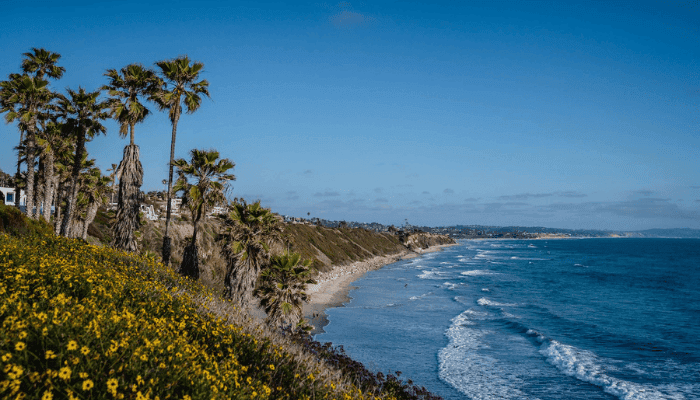
Encinitas supports around 8,200 businesses employing more than 41,000 people, spread across five distinct commercial districts — Cardiff, Leucadia, downtown Encinitas, the El Camino Real corridor and North Coast Business Park. It is also one of the most design-conscious cities in the county, which shapes how an array gets specified here.
Yes. Encinitas is design-conscious, particularly along the Coast Highway 101 corridor, but that shapes how an array is specified rather than whether it can be installed. Low-profile all-black modules, careful plane selection and carport structures all address it.
Indigo Energy and Solar Inc provides commercial solar installation, battery storage and EV charging in Encinitas, California. Licensed electrical contractor, IBEW Local 569 signatory, with nine completed school installations across San Diego County ranging from 109.6 kW to 487.7 kW.
Encinitas's commercial base is spread across several distinct districts rather than concentrated in one park, and each presents a different installation question.
Scripps Memorial Hospital Encinitas is among the city's largest employers. Healthcare campuses carry constant loads that cannot be shed, so both the cost case and the resilience case from paired storage are unusually strong.
Encinitas Union School District is a major local employer. Districts can now access the federal credit through direct pay, and school buildings typically offer large, simple roofs plus parking suitable for carport arrays. Our completed county work is predominantly schools.
The city's main concentration of light industrial and flex space. Flat roofs, straightforward structure and industrial electrical service make this the most cost-effective commercial solar in Encinitas.
Office and larger-format retail. Single-storey retail roofs are often substantially larger than the building's own load requires, which makes sizing to consumption rather than roof area particularly important here.
The Cardiff, downtown and Leucadia districts. Smaller footprints, higher design sensitivity and, for food service, evening-weighted load that usually points toward solar plus storage.
Encinitas has deep flower-growing and horticultural roots. Greenhouse and nursery operations carry pumping, lighting and climate loads that align with daytime generation, and often have land for ground-mount.
Encinitas cares about how buildings look, and along the coastal corridor that is reflected in how development is reviewed. In practice this affects specification rather than feasibility.
All-black low-profile modules read as a continuous dark plane rather than a grid of equipment. Placement can favour roof faces not visible from the street. On sites with parking, a well-designed carport structure takes the array off a sensitive roofline entirely.
We would rather raise this at assessment than have it surface at permitting.
Cardiff, downtown Encinitas and Leucadia all sit close enough to the ocean that salt-laden air is a genuine material consideration for mounting hardware, fasteners and enclosure ratings.
It does not make solar inadvisable — it makes specification matter. The consequence of getting it wrong appears years later, which is precisely why it should be settled in writing at the design stage.
Section 48E provides a 30% federal credit on qualifying commercial solar, and facilities below 1 MW are exempt from prevailing-wage and apprenticeship requirements, so they reach the full rate automatically. Nothing here is tax advice — we work alongside your accountant.
For the school district, nonprofits and faith communities, the position changed significantly and is not widely understood. Elective pay, commonly called direct pay, lets eligible tax-exempt and governmental organisations receive the value of that credit as a payment from the IRS rather than as an offset against tax owed.
Note also that the residential credit under Section 25D was terminated for expenditures after 31 December 2025. The commercial credit was not — the two genuinely diverged.
In most cases yes — design sensitivity shapes how the array is specified rather than whether it is permitted. Low-profile all-black modules, careful plane selection and carport structures all address the appearance question. We raise it at assessment rather than at permitting.
Yes. Within a few miles of the ocean, mounting hardware, fasteners and enclosure ratings need specifying for salt exposure. It is straightforward to get right and expensive to get wrong, because the consequence appears years later.
Yes, through direct pay. Eligible tax-exempt and governmental entities receive the value of the Section 48E credit as a payment from the IRS rather than as an offset against tax owed.
Usually not. Under NEM 3.0 exported energy earns far less than imported energy costs, so a system sized to your consumption is worth more per dollar than one sized to your roof. Storage is generally a better use of the budget than extra panels.
Pumping, lighting and climate loads align well with daytime generation, and horticultural sites often have land available for ground-mount where roof area is limited or unsuitable.
It varies, and it plus SDG&E interconnection is the part of the programme least within our control. We submit the interconnection application early rather than at completion for that reason.
Federal tax positions checked against IRS guidance in August 2026. Rules change; nothing on this page is tax advice.
We will look at the roof, the setting, your electrical service and twelve months of SDG&E bills — and tell you plainly what is feasible, what it would produce and what the credit is worth.