
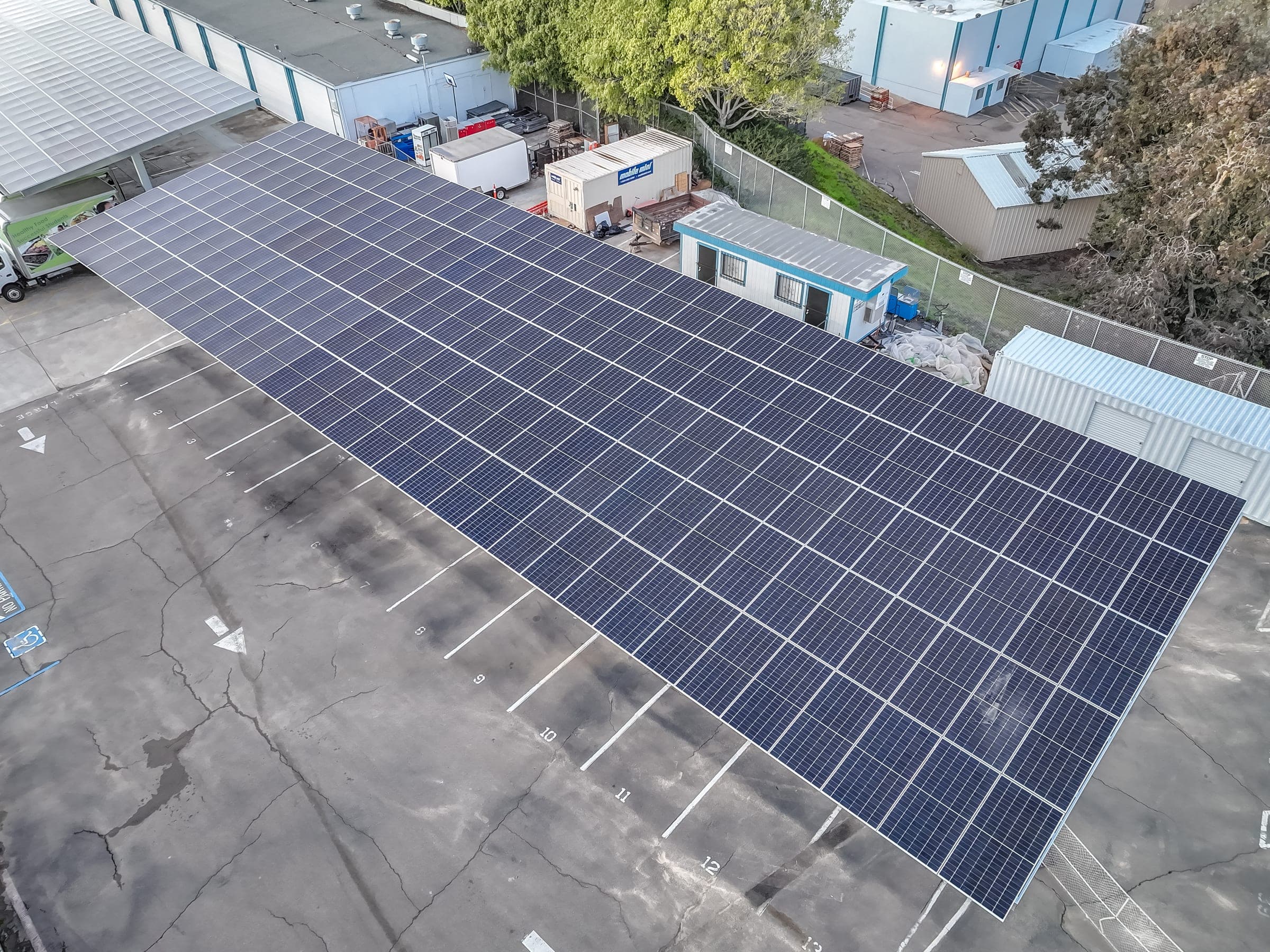
Commercial battery energy storage system
Financial Incentives & Solar Financing

SGIP Rebate Guide for California Businesses

2026 Update

California’s Self-Generation Incentive Program (SGIP) is one of the most valuable and underutilized clean energy incentives available to San Diego businesses. If your company is considering battery storage, whether as a standalone project or paired with solar — understanding SGIP can mean the difference between a marginal investment and an exceptional one.

This guide explains how SGIP works in 2026, who qualifies, how much you can receive, and how to navigate the application process.

01

What Is SGIP?

SGIP is a California Public Utilities Commission (CPUC) program administered by the state's major utilities, including SDG&E in San Diego, that provides cash rebates for qualifying distributed energy resources. For most commercial applicants in 2026, the primary eligible technology is battery energy storage systems (BESS) paired with solar or other renewable generation.

SGIP has been operating since 2001 and has funded over $1.3 billion in rebates. It remains one of California's most active and well-funded clean energy programs, with ongoing budget allocations under the CPUC's distributed energy resource dockets.

02

Who Qualifies for SGIP in San Diego?

SGIP eligibility for San Diego businesses is straightforward:

  • You must be an SDG&E ratepayer (commercial, industrial, agricultural, or nonprofit account).
  • Your battery system must be at least 10 kWh in capacity (for commercial applicants).
  • The system must meet California Electrical Code and NFPA 855 fire code requirements.
  • The system must be permanently installed — portable generators and temporary systems do not qualify.
  • The system must be paired with solar or other qualifying generation source (for most commercial tiers).

Importantly, nonprofits, churches, schools, and government agencies are eligible for SGIP; often at enhanced rebate levels.

03

2026 SGIP Budget Categories and Rebate Rates

2026 SGIP Budget Categories and Rebate Rates
Budget CategoryWho QualifiesRebate Rate100 kWh System Example
Equity ResiliencyCustomers in High Fire Threat Districts or with medical baselineUp to $1.00/WhUp to $100,000
Equity BudgetCustomers in disadvantaged communities (SB 535)$0.85–$1.00/Wh$85,000–$100,000
Large Generator BudgetNon-residential systems > 10 kW (standard commercial)$0.25–$0.60/Wh$25,000–$60,000
Small Generator BudgetResidential and small commercial (< 10 kW)$0.20–$0.35/WhN/A (< 10 kWh)
Note

SGIP rebate rates decrease as each budget step fills. Early applicants receive higher rebates. Rates current as of early 2026. Contact Indigo Energy to confirm current step availability.

04

SGIP Application Process: Step by Step

1

Step 1: Pre-Application Eligibility Check

Confirm your property address qualifies for the budget tier you're targeting. Equity Resiliency and Equity Budget tiers require documentation of HFTD designation or disadvantaged community status. Indigo Energy checks eligibility for every client before application.

2

Step 2: Incentive Reservation Application

The SGIP application is submitted to SDG&E before installation begins. You'll need: property information, proposed system specifications, contractor license information, and documentation of the paired generation source. SDG&E typically reviews applications within 30–60 days.

3

Step 3: Installation

Once your reservation is approved, you have 18 months to complete installation. Indigo Energy manages permitting, installation, and inspections in parallel.

4

Step 4: Incentive Claim (Post-Installation)

After installation and inspection, submit the Incentive Claim Application with: PTO documentation from SDG&E, as-built drawings, equipment specifications, and monitoring system verification. SDG&E typically processes claims within 60–90 days.

5

Step 5: Rebate Payment

SGIP rebates are paid as a single lump sum after the claim is verified. For a 200 kWh commercial system at $0.40/Wh, that's an $80,000 check, mailed to your business address or applied as a bill credit.

Pro tip

SGIP reservations are approved on a first-come, first-served basis within each budget step. When a new step opens, there's often a rush of applications. Indigo Energy monitors SGIP step openings and notifies clients immediately to secure reservations at current rates.

05

SGIP and ITC: Stacking Incentives

San Diego businesses can stack SGIP with the federal Investment Tax Credit (ITC) and California's property tax exclusion. However, the IRS requires that SGIP rebates reduce your depreciable basis for ITC purposes:

  • If you receive a $100,000 SGIP rebate on a $400,000 BESS, your depreciable ITC basis is $300,000 (not $400,000).
  • The 30% ITC on $300,000 is $90,000 — still a substantial federal benefit.
  • MACRS depreciation also applies to the reduced basis.

Even after the ITC basis reduction, stacking SGIP + ITC + MACRS can reduce your effective net cost of a commercial BESS to 20–35% of gross cost. Consult your tax advisor for project-specific analysis.

06

SGIP for Nonprofits and Churches

Tax-exempt organizations cannot use the ITC directly, but they can claim IRA Direct Pay (described in detail in our Church Solar guide). And they are fully eligible for SGIP rebates, which are not tax-based and do not require tax liability.

For a church or nonprofit, a SGIP rebate + IRA Direct Pay combination can cover 60–80% of a combined solar + storage project cost, making solar genuinely transformative for budget-constrained organizations.

07

Common SGIP Application Mistakes to Avoid

  • Applying after installation: SGIP requires a reservation application before installation begins. Post-installation applications are rejected. This is the single most common and costly mistake.
  • Incorrect equipment specifications: System specifications in the application must match what is installed. Changes require an amendment that can delay rebate processing.
  • Missing paired generation documentation: Most commercial SGIP tiers require a qualified generation source. Ensure your solar interconnection is documented.
  • Missing CPUC maintenance requirements: SGIP recipients must operate and maintain the system for a 5-year performance period. Failure to comply can result in rebate clawbacks.

Frequently Asked Questions About SGIP

As soon as possible. SGIP budget steps fill on a first-come, first-served basis. In 2025 and early 2026, some commercial steps filled within weeks of opening. Indigo Energy monitors SGIP availability and submits applications immediately when the new budget opens.

Yes. Existing solar customers can add battery storage and apply for SGIP. Your existing solar installation serves as the qualifying paired generation source. An amended SDG&E interconnection application may be required.

From application submission to rebate payment typically takes 8–14 months: 30–60 days for reservation approval, up to 18 months for installation, and 60–90 days for post-installation claim processing. Indigo Energy manages all milestones to keep your project on track.

For businesses, SGIP rebates received as a reduction in the purchase price of a qualifying energy property are generally not included in gross income under IRS guidance. However, they reduce the depreciable basis for ITC and MACRS purposes. Confirm treatment with your tax advisor.

In the highest-tier Equity Resiliency budget, SGIP can cover 100% or more of battery cost for qualifying customers. For standard commercial customers in the Large Generator budget, SGIP typically covers 25–60% of battery system cost depending on the step. Combining SGIP with ITC and MACRS depreciation can bring effective net cost to 20–35% of gross cost.

SGIP includes a 5-year performance and ownership period. If you sell the property or business within 5 years of receiving the rebate, you may be required to repay a prorated portion. SGIP equipment can transfer to a new owner if they assume the performance obligations.

Get Expert SGIP Application Support

Indigo Energy has managed dozens of SGIP applications for San Diego commercial and nonprofit clients. We handle every step, from eligibility verification and reservation application to post-installation claim submission. This is at no additional charge as part of our project services.