
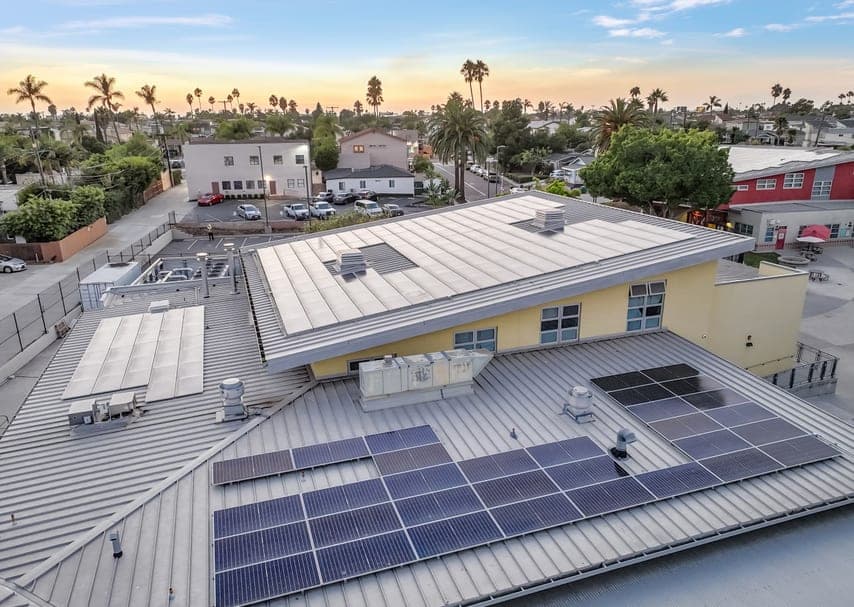
Close-up of commercial rooftop solar panels
Financial Incentives & Solar Financing

Solar PPA vs. Ownership: Which Is Better for Your San Diego Business?

Commercial Solar Incentives in San Diego: The Complete 2026 Guide

The most important decision in your commercial solar project is not which panels to use or who to hire, it is how you structure the financial transaction. Choosing between a Power Purchase Agreement (PPA) and outright ownership fundamentally changes who captures the tax benefits, what happens to your balance sheet, and what your long-term savings will be.

This guide explains both models in plain language, walks through the financial differences, and identifies which structure typically wins for different types of San Diego businesses.

01

What Is a Solar PPA?

A Power Purchase Agreement is a financing arrangement in which a third-party developer, not your business, installs, owns, and maintains the solar system on your property. Your business agrees to purchase the electricity generated by that system at a fixed or escalating contract rate, typically for 15–25 years.

The developer owns the system. They claim the federal ITC. They claim the depreciation. They maintain the equipment. Your business simply buys cheaper power than it would from SDG&E and avoids any upfront capital outlay.

PPA FeatureDetail
Who owns the system?Third-party developer
Who claims the ITC?Developer
Upfront cost to business?None
What business receivesCheaper electricity (usually 10–30% below SDG&E rate at signing)
Contract length15–25 years
End of contract optionsRenew, extend, purchase system, or have it removed
02

What Is Solar Ownership?

Under solar ownership, whether funded by cash, a commercial loan, or an equipment finance agreement, your business purchases the solar system and owns it outright. You are the system owner and therefore the party eligible to claim the 30% federal Investment Tax Credit and accelerated MACRS depreciation.

The upfront cost is higher (or you take on debt), but the financial benefits are also substantially greater over time.

Ownership FeatureDetail
Who owns the system?Your business
Who claims the ITC?Your business (30% of total cost)
Upfront costFull system cost (or loan payments)
What business receivesElimination of energy costs + ITC + depreciation + increased asset value
Maintenance responsibilityOwner (or included in installer warranty)
End of useful lifeBusiness retains or disposes of asset
03

The Financial Comparison: PPA vs Ownership

FactorPPAOwnership (Purchased/Financed)
Upfront capital requiredNone$0 (loan) to full cost (cash)
Federal ITC (30%)Developer keeps itBusiness keeps it
MACRS DepreciationDeveloper keeps itBusiness keeps it
Long-term savings (25 yr)Lower (developer profits from system)Higher (all savings to business)
Balance sheet impactOff-balance-sheet (operating expense)Asset + liability (if financed)
Energy cost certaintyContract rate (may escalate 1–3%/yr)Fixed (loan) or eliminated (cash)
System performance riskDeveloper's responsibilityOwner's responsibility
Roof transfer complexityPPA transfers with property (complicates sale)Asset can be included in property sale
Best forLimited capital, no tax appetite, nonprofits (pre-IRA)Businesses with tax liability + capital access
04

When a PPA Makes Sense

Despite the lower long-term financial return, PPAs are genuinely the right tool for some San Diego businesses:

  • No upfront capital: Businesses that cannot access financing and have no reserves may benefit from immediate PPA savings with zero investment.
  • No tax liability: Businesses with minimal or no federal tax liability cannot use the ITC directly. (Note: since the IRA, nonprofits can now use Direct Pay instead — making ownership viable for them too.)
  • Aversion to maintenance responsibility: Some business owners prefer to contract out system performance risk entirely.
  • Short planning horizon: Businesses uncertain about their location in 5+ years may prefer avoiding a capital commitment.
Important

If your business has federal tax liability and access to financing, a PPA almost always leaves significant money on the table compared to ownership. The developer capturing your ITC and depreciation is the cost of a PPA.

05

When Ownership Is Clearly Superior

For the majority of San Diego commercial solar buyers, ownership, whether cash or financed, delivers dramatically better long-term results:

  • Full ITC: Your business captures the full 30% federal tax credit (up to 50% with bonus adders).
  • MACRS depreciation: Additional tax savings of 20–25% of system cost over five years.
  • Higher 25-year savings: All electricity savings accrue to you — not split with a developer.
  • Asset value: The solar system is a business asset that can increase property value.
  • Clean property transfer: No PPA assignability complications when selling or refinancing.
06

The Rise of Commercial Solar Loans

One major development in 2024–2026 is the expansion of commercial solar lending. Dedicated solar lenders and traditional banks now offer commercial solar loans with competitive terms — often 5–20 year terms at 6–9% interest rates. Many San Diego businesses are discovering that a commercial solar loan delivers positive cash flow from day one: loan payment < electricity bill savings, even in year one.

This 'cash flow positive from day one' structure has eliminated one of the primary advantages PPAs historically held; the no-upfront-cost, immediate-savings argument.

Frequently Asked Questions: PPA vs Ownership

PPAs transfer with the property, which means the buyer must either assume your PPA contract or you must buy it out. This can complicate commercial real estate transactions. Ownership avoids this entirely, the system is an asset you can include in or exclude from the sale.

Most PPAs include a purchase option at specific contract anniversary points, allowing you to buy the system at fair market value. By that point, the developer has already collected ITC and depreciation benefits, so you are buying a depreciated asset. It is nearly always more financially advantageous to own from the start.

Indigo Energy specializes in commercial solar ownership — we sell and install systems that our clients own. We can connect businesses with PPA providers if that structure is the right fit, but our expertise is in helping businesses maximize the financial returns of ownership.

A solar lease and a PPA are both third-party ownership structures, but they differ in how you pay. A lease charges a fixed monthly payment. A PPA charges per kilowatt-hour consumed from the system. Both result in the developer retaining the ITC and depreciation.

Compare Your PPA vs Ownership Outcome

Indigo Energy helps San Diego businesses evaluate both structures with full financial modeling. Contact us for a no-obligation comparison showing your 25-year outcome under PPA vs ownership for your specific situation.