
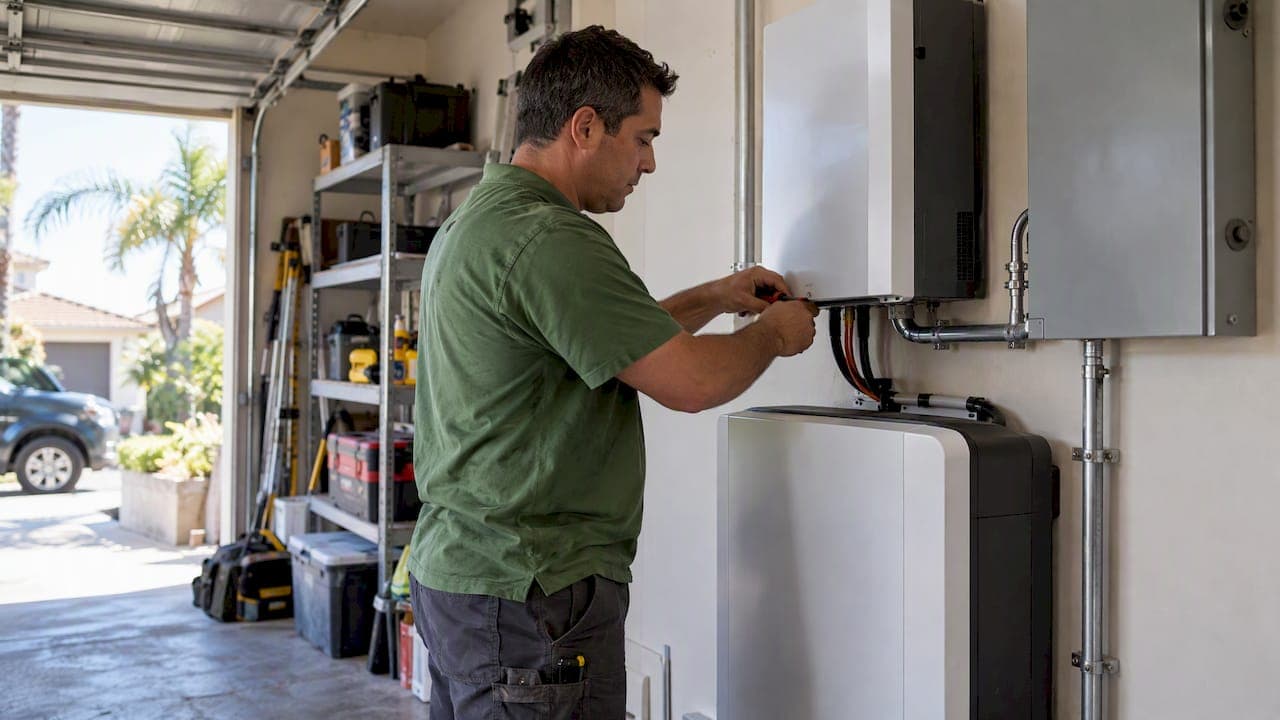

The biggest California solar incentive for homeowners is gone. The federal Residential Clean Energy Credit, which paid back 30% of system costs, does not apply to property placed in service after December 31, 2025. California has no broad state rebate or state income tax credit to replace it. What remains is narrower: income-qualified programs, battery incentives, a property tax exclusion, and the savings you get from designing a system around today’s billing rules.
This guide separates what is real from what is expired or misleading, so you can decide whether solar, battery storage or an EV charger still pencils out for your home or building in San Diego County.
TL;DR
- The 30% federal credit for homeowners covered only systems placed in service through December 31, 2025. Check the IRS page for your tax situation.
- California offers no general-market state rebate for solar. Direct financial help is aimed at low-income and disadvantaged communities.
- The Self-Generation Incentive Program (SGIP) supports batteries and, through equity budgets, paired solar and storage.
- Under the Solar Billing Plan (NEM 3.0), the value of a system now depends on how much power you use yourself, which makes battery sizing the main financial decision.
- Businesses and developers face different tax rules than homeowners. Get a project-specific ROI analysis before you sign.
Table of Contents
- What changed for California solar incentives
- The federal credit: what it was and what it means now
- State and utility programs that still exist
- Who qualifies for free solar? Almost no one
- Why NEM 3.0 matters more than any rebate
- A simple framework for judging a solar quote now
- Commercial properties, builders and developers
- Our perspective: incentives should not be the reason you go solar
- How Indigo Energy can help
- Steps to take before you sign
- FAQ
- Sources
What changed for California solar incentives
For years, a typical quote leaned on three things: a 30% federal credit, generous net metering, and a state that rewarded exports. In 2026 none of those work the same way.
| Incentive | Status in 2026 | Who it affects |
|---|---|---|
| Federal Residential Clean Energy Credit (30%) | Ended for property placed in service after Dec. 31, 2025 | Homeowners buying with cash or a loan |
| State solar tax credit | Does not exist | Everyone |
| State general-market rebate | Not offered | Everyone |
| SGIP battery and equity incentives | Available, with eligibility rules and budgets | Qualifying battery and income-qualified customers |
| DAC-SASH and other low-income programs | Available to income-qualified households | Specific communities |
| Property tax exclusion for solar | In effect | Owners adding solar |
Older articles still rank for this topic and repeat the 30% figure as if it applied today. Some say it runs through 2032. The IRS page describing the credit for 2022 through 2025 is the one to trust for homeowners, and it says the credit is unavailable for property placed in service after the end of 2025. If an installer promises you 30% back on a residential system installed now, ask them to show you the tax code section and the date.
The federal credit: what it was and what it means now
The residential credit was not a rebate. It was a non-refundable tax credit, so it only reduced the federal income tax you owed. Unused credit could be carried forward to later years.
If your system was placed in service in 2025 or earlier, you may still be claiming it on your return. Talk to a tax professional (a CPA or enrolled agent) about Form 5695 and your carryforward. If you are buying a new system in 2026, plan your budget without it.
Business owners should not read the homeowner rule as the whole story. Commercial projects fall under separate federal provisions with their own deadlines and construction-start rules. Those depend on your entity, your timeline and your tax position, so we cover them separately on our commercial solar incentives page for San Diego and in our California solar tax credit update. Confirm any commercial credit with your tax advisor before you commit.

State and utility programs that still exist
SGIP for batteries
The CPUC’s Self-Generation Incentive Program provides incentives for qualifying distributed energy systems installed on the customer’s side of the meter, including storage. Budgets, step levels and waitlists change, so check the program administrator for your utility territory before counting on a specific dollar amount. In San Diego County, that means looking at the SDG&E territory.
We do not quote an SGIP amount in this article because rates and availability move. When we prepare a proposal, we check the current posted incentive and show the result as a separate line, so you can see the system cost with and without it.
Income-qualified solar
The CPUC’s low-income solar programs offer financial assistance to income-qualified residential customers for panels and batteries. The best known is DAC-SASH, which serves single-family homes in disadvantaged communities. These programs are administered by established nonprofits such as GRID Alternatives. If you think you qualify, start with the CPUC page and apply through the program administrator, not through a sales lead.
Property tax exclusion
California’s Active Solar Energy System Exclusion keeps the added value of a solar installation from raising your property tax assessment. Summaries of California incentives describe it as in effect through 2026, so confirm the current end date with your county assessor if you are planning a later install. It is not cash in hand, but it protects your property taxes and supports the case that solar adds value to a home or building without a tax penalty.
Local utility and community choice programs
Some local programs offer battery rebates or bill-credit arrangements through community choice energy providers and utilities. These come and go and often have limited funding. Ask your installer which local programs are open when you request a quote, and check the provider’s own website before you rely on them.
Who qualifies for free solar? Almost no one
The CPUC is blunt on this point: solar is rarely free, and for most customers there is no such thing as free solar from the government. The exceptions are the income-qualified programs above.
Watch for these warning signs:
- A promise of “free” government-funded solar for a standard household.
- A suggestion to form an LLC so a residential project can claim business tax credits.
- Pressure to sign the same day, or vague contracts without a clear price and payment schedule.
Before signing anything, check the contractor’s license on the Contractors State License Board website. A legitimate contractor shows you a clear contract and full financial disclosures.
Why NEM 3.0 matters more than any rebate
With the federal credit gone for homeowners, the value of your system rests on how much it reduces your utility bill. That is where the Solar Billing Plan, commonly called NEM 3.0, comes in.
Under this plan, export compensation is tied to avoided-cost values and is significantly lower than retail rates. Sending power to the grid at midday earns far less than buying it back in the evening. The practical result:
- Size for your own use, not for exports. Oversizing panels without storage often leads to poor financial outcomes.
- Add a battery. Stored energy covers your evening peak, when grid power is most expensive, instead of being exported for low credit.
- Design the whole system at once. Adding storage later can be harder and costlier than planning it from the start.
For a detailed breakdown by customer type, see our NEM 3.0 guide for San Diego businesses and our commercial battery storage guide.
A simple framework for judging a solar quote now
Without a large rebate, quotes can look similar and still perform very differently. Ask for these five things in writing:
- Total installed cost before and after any incentive, with each incentive listed separately and its source named.
- Annual production and your estimated self-consumption. A system that produces a lot but exports most of it is worth less than one matched to your load.
- Battery capacity and what it is meant to cover, such as evening peak hours or backup during an outage.
- Warranty terms for panels, inverters, batteries and workmanship.
- Payback and ROI under current rates, with the assumptions behind them, including utility rate escalation.
If an installer cannot explain how each number was reached, keep looking. Transparency on pricing and ROI is how we build our proposals, and it is the reason we show incentives as separate lines rather than folding them into a headline price.
Commercial properties, builders and developers
If you manage a building or develop property, incentives are only one part of the picture. Demand charges, rate schedules, roof condition and lease terms often move the numbers more than a single credit.
For new construction, Title 24 solar rules can require solar or solar readiness. Bringing your solar contractor in early prevents costly retrofits. Designers working on new homes can also find a useful overview of California’s solar mandate and plan review for what to settle before you build. Our own guide to new construction solar for builders and buyers walks through the steps and timing.
If you lease your space, solar can still make sense. See our page on solar for leased commercial property.
Our perspective: incentives should not be the reason you go solar
We have watched the California market shift from “get the credit and export everything” to “design for your own consumption.” Our view is that this change is healthier for customers, even if it is less exciting in a sales pitch.

A project built around a rebate falls apart when the rebate does. A project built around your load profile, your utility rate and a correctly sized battery holds up. That is why we start with a site assessment and a custom ROI analysis before talking about equipment, and why we involve ourselves early in building projects, when design decisions are cheap to change.
We also believe you should know exactly which incentives apply to you and which do not. If a program is waitlisted or has an income limit, we say so. If solar without storage does not make financial sense for your usage, we say that too.
— Curtis Williamson
How Indigo Energy can help
Indigo Energy & Solar is a full-service contractor in San Diego County. We handle design, permitting, installation and ongoing monitoring for homes and commercial properties, including solar, battery storage and EV chargers. Our pricing and ROI analysis shows what you pay, what you save and which incentives, if any, apply to your situation.
Start with residential solar installation if you own a home, or see all of our solar, storage and EV charging services if you manage a business or property. You can also look at our battery storage options and EV charging and solar integration.
Steps to take before you sign
- Pull 12 months of utility bills and note your rate plan and evening usage.
- Talk to your tax professional about any credit you may still claim, especially if your project began before the end of 2025 or is commercial.
- Check the income-qualified programs if your household income might meet the limits.
- Ask each installer for an itemized quote and the current SGIP status for your battery.
- Verify the license with the Contractors State License Board.
- Plan for maintenance and monitoring, so the system performs for its full life. See our solar maintenance service.
FAQ
Is there still a California solar rebate for homeowners?
There is no broad state rebate for homeowners in 2026. The CPUC points to targeted help for low-income and disadvantaged communities, and SGIP can support batteries. Availability depends on your income, location and the current budget.
Can I still get the 30% federal solar tax credit?
For homeowners, the credit applies to property placed in service through 2025, per the IRS. A system installed in 2026 does not qualify under that rule. Businesses are covered by different provisions, so check with your tax advisor.
Is solar still worth it in California without the credit?
Often yes, but only when the system is designed well. Under NEM 3.0, a properly sized system paired with a battery that serves your own evening usage is the strongest approach. A quote that relies on large exports is the one to question.
Does solar raise my property taxes in California?
Not if the exclusion applies. The Active Solar Energy System Exclusion keeps the added value of the system out of your reassessment. Confirm the details with your county assessor.
Sources
- IRS: Residential Clean Energy Credit (2022 through 2025)
- IRS: Residential Clean Energy Credit
- CPUC: California Solar Consumer Protection Guide
- CPUC: Low Income Solar Programs
- CPUC: Self-Generation Incentive Program
- EnergySage: California solar rebates and incentives