
Under the 2025 Energy Code, effective for permit applications submitted on or after January 1, 2026, most new single-family homes, multifamily buildings, and qualifying nonresidential projects in California must install a solar photovoltaic system sized to one of two prescriptive methods. Battery storage requirements and solar-ready infrastructure apply to a broader set of building types than the outgoing code, with some documented exceptions. Get the permit date and building classification right first. Everything else in your compliance strategy follows from those two facts.
TL;DR:
- Most new residential and nonresidential buildings permitted after January 1, 2026, must install a solar system sized by the smaller of the Equation or SARA methods, with SARA often limiting system size due to roof obstructions.
- Battery storage is now mandatory for certain high-rise and nonresidential buildings, while most low-rise projects only need to be prepared for future battery installation to qualify for a 25% PV system size reduction.
- Small roof areas under 80 square feet, low system capacity below 1.8 kWdc, and certain documented conditions qualify for narrow solar exceptions, but require proper documentation before permit submittal.
- Solar-ready infrastructure, including clear labeling of solar zones and reserved conduit pathways, must be shown on plans to meet code, with 200-amp busbars required to allow future system additions.
- Early verification of roof shading, infrastructure, and calculation methods during schematic design prevents expensive rework at framing inspection, emphasizing the importance of coordinated, staged compliance planning.
Table of Contents
- What Buildings Must Meet Title 24 Solar Requirements?
- How Do You Calculate Required Solar System Size?
- Which Projects Qualify for a Title 24 Solar Exception?
- When Is Battery Storage Required Under Title 24?
- What Solar-Ready Documentation Do Inspectors Require?
- What’s the Best Compliance Workflow for Title 24 Solar?
- An Indigo Energy Perspective on Title 24 Compliance
- Get a Title 24 Compliance Estimate for Your Project
- Primary Code and CEC Resources
- Sources
- FAQ
What Buildings Must Meet Title 24 Solar Requirements?
The applicable code edition depends entirely on when you submit your permit application, not when you break ground or finish design. Projects permitted before January 1, 2026 fall under the outgoing 2022 code; anything permitted on or after that date falls under the 2025 Energy Code, which broadens both the PV mandate and battery expectations.
Coverage under the new code includes:
- New single-family homes, including townhouses with individual roof access
- Low-rise and high-rise multifamily buildings
- Nonresidential building types listed in Table 140.10-A, including hotels, offices, retail, schools, and grocery stores, when they make up a large majority of a project’s total floor area
Additions and alterations to existing buildings generally do not trigger the new-construction PV mandate. A kitchen remodel or a room addition won’t force a solar retrofit on its own, though it can trigger other Title 24 energy compliance measures depending on the scope. That distinction matters when developers are phasing projects across two permit cycles, since a project split into an initial shell permit and a later tenant-improvement permit could land in different code editions entirely.
How Do You Calculate Required Solar System Size?
California builders size PV systems using two separate methods, then install whichever result is smaller. That “smaller of the two” rule, laid out in Chapter 7 of the CEC compliance manual, is the single most consequential detail in the entire code for anyone doing early-stage massing studies.
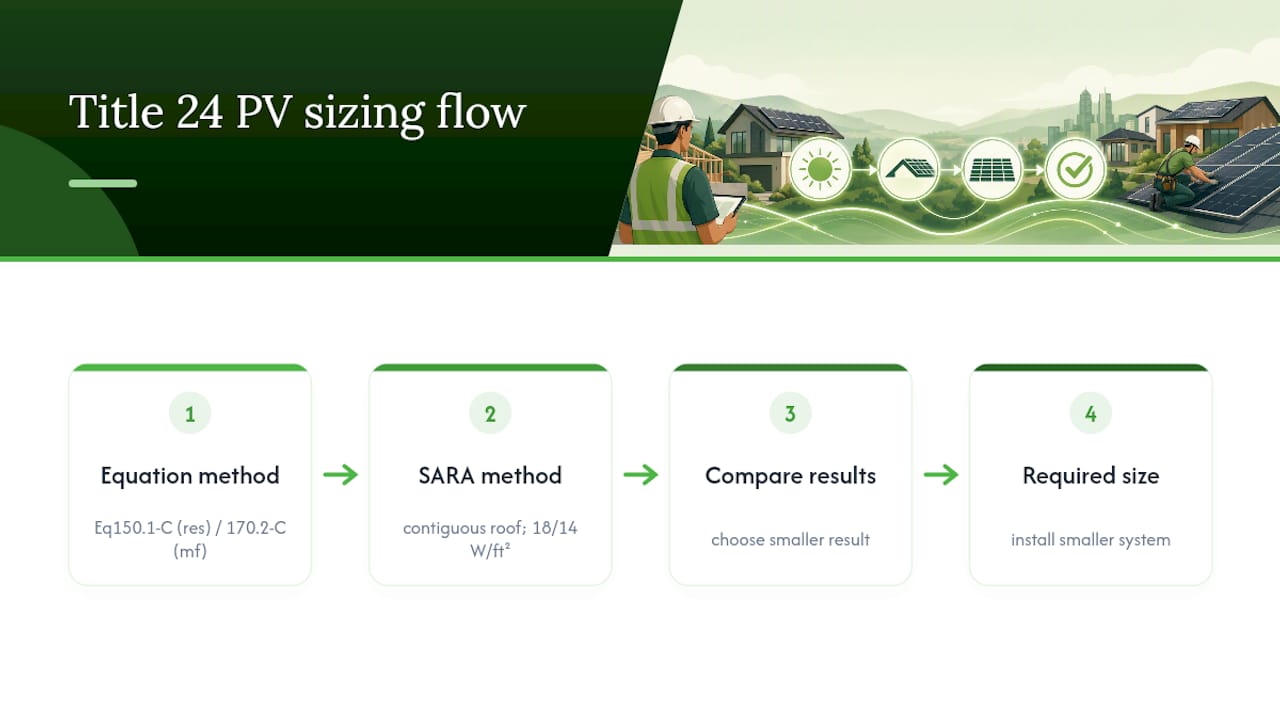
The Equation method calculates a baseline PV requirement using Equation 150.1-C for residential projects and Equation 170.2-C for multifamily and nonresidential buildings. The inputs are conceptually simple: climate zone, conditioned floor area (CFA), and, for multifamily, the number of dwelling units. A larger home in a hotter climate zone generally needs more panels than a compact unit in a coastal zone with lower cooling loads.
The Solar Access Roof Area (SARA) method caps the system based on how much usable roof actually exists. SARA counts only contiguous roof surfaces of at least 80 square feet, excludes areas shaded by obstructions or adjacent structures, and applies azimuth restrictions on steep-sloped roofs facing away from south.
Sizing multipliers: SARA converts available roof area into a capacity limit using 18 watts per square foot for steep-slope roofs and 14 watts per square foot for low-slope roofs.
Picture a two-story infill townhouse on a narrow urban lot in San Diego. The Equation method might call for a 4.5 kWdc system based on conditioned floor area. But if the roof is broken up by a rooftop deck, HVAC equipment, and a chimney, the remaining contiguous solar zone might only support 2.8 kWdc under SARA. In that case, SARA controls, and the builder installs the smaller system, documenting why the reduction applies.
Which Projects Qualify for a Title 24 Solar Exception?
The code carves out specific, narrow exceptions rather than a broad hardship waiver, and enforcement staff will expect documentation for any of them. According to CEC guidance on multifamily and nonresidential requirements, the recognized exceptions include:
- SARA-eligible roof area totaling less than 80 contiguous square feet
- A minimum calculated PV system smaller than 1.8 kWdc
- SARA less than 3% of conditioned floor area for certain nonresidential building types
- Documented snow-load conditions that make roof-mounted PV impractical
- Planning or building permit approvals granted before January 1, 2020
Most exceptions apply per building rather than per unit, which matters for multifamily projects with mixed roof conditions across a site. Some small-system thresholds also apply at the individual dwelling level. Whichever exception you claim, bring the calculation package, photos of the roof obstruction, or the snow-load engineering report to your local building department before permit submittal, not after plan check comments come back.
When Is Battery Storage Required Under Title 24?
Mandatory battery energy storage system (BESS) requirements now extend beyond the residential edge cases most builders remember from earlier code cycles. Certain nonresidential building types and high-rise multifamily projects face mandatory BESS installation outright, while most single-family and low-rise multifamily projects only need to be “BESS-ready:” wired and spatially prepared for a future battery, without installing one now.
The financial incentive to install a battery voluntarily is built into the code itself. A battery that qualifies under Reference Joint Appendix JA12, with a minimum cycling capacity of 7.5 kWh, lets a builder reduce the Equation-based PV requirement by 25%.
Pro Tip: The JA12 battery reduction cannot be combined with the small-system PV exception. Run both scenarios before committing to a battery strategy, since combining them on paper will get flagged in plan check.
- Confirm whether your building type falls under mandatory BESS versus BESS-ready
- Model the 25% reduction scenario against your baseline Equation result before finalizing panel counts
- Coordinate battery placement and time-of-use control strategy with your electrical engineer early, since net billing economics shift the value of storage significantly
What Solar-Ready Documentation Do Inspectors Require?
Plan checkers and field inspectors look for specific, measurable items on your drawings, not general statements of intent. Section 110.10 of the California Energy Code spells out exactly what has to appear on the plan set.
- Solar zone callout. Show a clearly labeled, contiguous solar zone meeting the minimum area threshold, free of vents, skylights, and equipment that would create shading obstructions.
- Reserved electrical infrastructure. Reserve a location for the inverter and meters, and show a dedicated conduit pathway from the roof to that location, sized before drywall goes up.
- Panel capacity. Main electrical panels need a busbar rating sufficient to accommodate future or current PV systems, along with reserved space for necessary circuit breakers.
- Fire access and structural notes. Roof pathways, array setbacks, and structural load notes should reference applicable fire-access standards and ASCE structural provisions, keeping firefighter access paths clear of panel placement.
Statistic to remember: the code sets that 200-amp busbar minimum specifically so a future PV or battery addition never requires a costly panel upgrade down the line.
What’s the Best Compliance Workflow for Title 24 Solar?
Missing a solar-ready item at framing inspection is far more expensive to fix than catching it at schematic design. A staged workflow keeps that from happening.
- Confirm the code edition immediately. Check your anticipated permit submittal date against the January 1, 2026 threshold before any energy modeling begins.
- Measure SARA early. Run a shading and roof-area analysis during schematic design, not construction documents, since it often caps your system size below what the Equation method suggests.
- Model both sizing methods. Calculate Equation and SARA results side by side, and decide whether a JA12-qualified battery makes financial and design sense.
- Reserve infrastructure on the drawings. Lock in solar zone, conduit pathway, inverter location, and panel busbar capacity before structural and MEP drawings finalize.
- Loop in a compliance consultant. Bring someone who models Title 24 energy compliance daily into design meetings, not just at permit submittal.
Pro Tip: Architects most often lose time on electrical pathway planning that gets added after framing is set. Treat the conduit run as a structural decision, not an electrical afterthought, and you avoid the change order.
An Indigo Energy Perspective on Title 24 Compliance
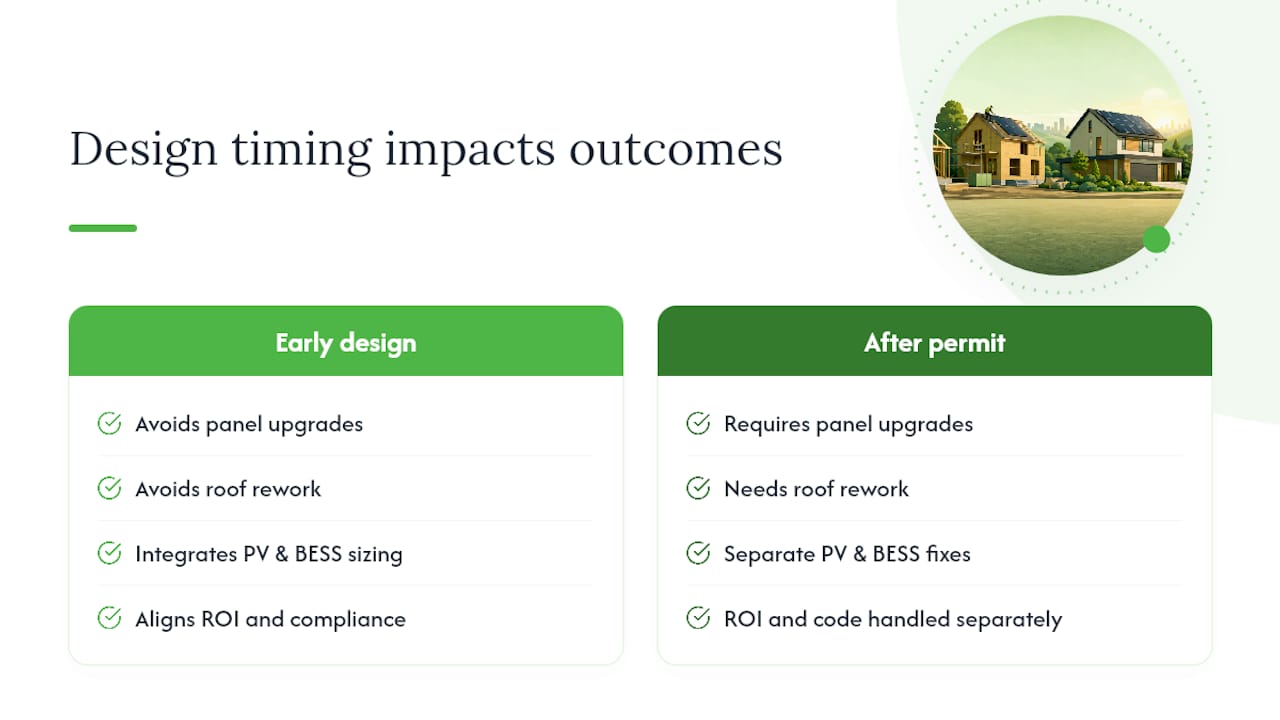
Builders who bring us in during schematic design, rather than after permit submittal, consistently avoid the panel upgrades and roof rework that eat into margins. Our design-to-permit process handles PV and BESS sizing alongside local permitting, so ROI numbers and code compliance get resolved together instead of in separate conversations.
— David
Get a Title 24 Compliance Estimate for Your Project
A local alternative to guessing your way through Equation-versus-SARA sizing is available. We run both calculations against your actual site conditions instead of a generic climate-zone estimate, so the system you permit is the system that fits your roof.
Our team handles design integration for architects, permit coordination, and combined PV and battery sizing under one contract, backed by manufacturer partnerships and warranty programs that hold up over the life of the system. For builders working on commercial projects across San Diego County, that means one point of contact from schematic design through final inspection.
Send us your anticipated permit submittal date, conditioned floor area, and available roof area, and we’ll return an initial sizing estimate before your next design meeting. Start by visiting our solar and battery storage services page to request a Title 24 compliance consult.
Primary Code and CEC Resources
- CEC Solar PV, Solar Ready, and BESS Program Overview
- Chapter 7 Compliance Manual (CEC-400-2025-005)
- Section 110.10 Solar-Ready Code Excerpt
- California Energy Commission
Confirm any enforcement-specific interpretation with your local building department before permit submittal.
This article is general information, not a substitute for advice from a qualified lawyer. Consult a qualified legal professional about your own circumstances before acting on anything here.
Sources
- Solar PV, Solar Ready, Battery Energy Storage System (BESS) & BESS-Ready — CEC
- CEC-400-2025-005 Chapter 7 — Solar PV and BESS overview
- 2022 California Energy Code, Title 24, Part 6 — Solar-ready code excerpt
FAQ
What Are Title 24 Requirements?
Title 24 is the California Building Standards Code, and the Energy Code sets mandatory energy efficiency and solar requirements for new construction, including PV system sizing, battery storage, and solar-ready infrastructure.
What Are the Title 24 Window Requirements for 2026?
Window requirements under the 2025 Energy Code focus on U-factor and Solar Heat Gain Coefficient (SHGC) limits by climate zone rather than a single statewide standard; check local code requirements for your specific climate zone with your energy consultant.
What Is the 33% Rule for Solar Panels?
There is no official “33% rule” defined in the California Energy Code; this term isn’t part of Title 24’s Equation or SARA sizing methods, so confirm your actual sizing requirement using the Equation and SARA calculations described above rather than relying on that figure.
What Are the Exemptions to Title 24 Solar Requirements?
Recognized exceptions include SARA-eligible roof area under 80 contiguous square feet, a calculated PV system below 1.8 kWdc, SARA under 3% of conditioned floor area for some nonresidential buildings, documented snow-load conditions, and planning approvals granted before January 1, 2020.