
Install owned solar, or make the home fully solar-ready, during construction, not after. This is the cheapest, easiest window you will ever have to capture tax incentives and design a system that actually performs. Prioritize three things before drywall goes up: system ownership, 200-amp electrical service with battery conduit, and confirmed roof orientation with minimal shading.
TL;DR:
- Installing solar during construction reduces costs by eliminating rework of roofing and walls, and allows for optimal roof orientation and shading considerations.
- The federal Investment Tax Credit depends on the system’s Permission to Operate date, making timing of completion crucial for maximizing incentives.
- California’s Title 24 energy code mandates solar on most new homes, but the requirements vary locally and depend on roof size, shading, and whether batteries are installed.
- Pre-planning during framing should include shading analysis, conduit pre-run, panel and breaker reserving, and installation of mounting backing to streamline future grid connection.
- Ownership type affects tax credits and financing; owning the system outright offers full tax benefits, while leasing or PPAs transfer that value elsewhere.
Table of Contents
- Why New Construction Solar Saves Money and Simplifies Installation
- What Does New Construction Solar Cost, and What Incentives Apply?
- How Does California’s Title 24 Solar Mandate Affect New Builds?
- How Do You Make a New Home Solar-Ready During Framing?
- Equipment Placement, Battery Rough-Ins, and EV Charging
- Financing, Ownership, and Your Closing Checklist
- Builder Specs to Add to Construction Plans
- Environmental Benefits of Solar in New Construction
- Combining Solar With Other Renewable Technologies in New Builds
- Indigo Energy & Solar’s Approach to New-Construction Projects
- Ready to Build Solar Into Your New Home?
- Sources
- FAQ
Why New Construction Solar Saves Money and Simplifies Installation
Adding solar during construction avoids the two biggest retrofit costs: removing finished roofing to install mounts and opening finished walls to run conduit. Crews already on site for framing and roofing can integrate racking and electrical runs in the same trip, which cuts labor hours compared to a standalone retrofit crew mobilizing later.
Design benefits stack on top of the labor savings. Builders can orient the roof plane for solar exposure from the start, choose a pitch close to optimal, and route vents, chimneys, and skylights away from the array. Electrical work done at rough-in, conduit runs and breaker space, costs a fraction of what the same work costs once walls are finished, according to DOE’s guide for homebuilders.
- No roof penetration rework or re-flashing after the fact
- Combined crews reduce mobilization and scheduling costs
- Conduit and panel space installed at rough-in labor rates
- Solar cost rolled into the mortgage, often at a lower rate than a separate solar loan
Pro Tip: Ask your builder for a line-item breakdown separating solar hardware from installation labor. Rolling both into the mortgage typically beats financing solar separately, since mortgage rates are usually lower and amortized over 30 years.
What Does New Construction Solar Cost, and What Incentives Apply?
Installed cost per watt for new-construction solar tends to run lower than retrofit pricing because labor, permitting, and mobilization are shared with the broader build. The exact number depends on system size, panel choice, and whether battery storage is bundled in, but the gap versus retrofit pricing comes almost entirely from avoided demolition and duplicate labor.
The timing of the federal Investment Tax Credit matters more than most buyers realize. The IRS ties the credit to the tax year the system receives Permission to Operate (PTO) from the utility, not the year construction finishes or the year you move in, according to IRS guidance on energy incentives. A system that finishes construction in December but doesn’t get PTO until February pushes the credit into the following tax year.
- Confirm your builder’s estimated PTO date in writing, not just the construction completion date
- Ask whether your project qualifies for the Energy Community bonus, an additional credit tied to specific geographic and economic criteria
- Check state and utility-level rebate programs separately. These vary widely by jurisdiction and stack differently with the federal credit
- Get the ITC math from a tax professional, not the sales team, since ownership structure changes eligibility
Buyers often assume the tax credit applies the moment panels go on the roof. It applies the moment the utility flips the switch, and that distinction can shift a credit into a different filing year.
How Does California’s Title 24 Solar Mandate Affect New Builds?
California’s Title 24 energy code requires solar PV on most new single-family homes, with sizing tied to the home’s Solar Access Roof Area and reductions available when battery storage is installed, per the California Energy Commission’s Title 24 summary. Exceptions exist for homes with insufficient usable roof area or excessive shading, so not every lot triggers the full requirement.
Energy codes are adopted at the state level, but enforcement and interpretation happen locally. Two counties can apply the same base code with different documentation requirements or inspection timelines, so ask your building department which code version and local amendments apply to your permit.
- Ask whether the base home price includes owned panels, or whether solar is offered as a lease or power purchase agreement (PPA)
- Confirm the compliance method used to size the system (prescriptive vs. performance-based)
- Verify whether a battery is required or optional under the local code interpretation
- Get the Title 24 compliance documents at closing, not just a sales brochure
Builders outside California face different rules entirely. Some states have no solar mandate at all, while others offer strong incentive stacking without any requirement. Confirm your local energy code before assuming Title 24 style rules apply.
How Do You Make a New Home Solar-Ready During Framing?
- Run a shading study before finalizing the roof plan. Use the EPA’s Renewable Energy Ready Home Solar Site Assessment Tool (SSAT) to compare your proposed array site against an optimal one, targeting at least 75% of optimal resource potential where the lot allows.
- Document the Solar Access Roof Area (SARA). Record azimuth and tilt for each candidate roof plane and mark them directly on the architectural drawings.
- Pre-run 1-inch EMT conduit from the roof to within 8 feet of the main electrical panel, and cap both ends so it’s ready for wire pulls later.
- Reserve a dual-pole breaker slot in the main panel, even if solar isn’t installed at move-in.
- Install 4x4-foot plywood backing for the inverter and mounting hardware, placed away from bedrooms and living spaces to reduce noise complaints.
- Specify a 200-amp main panel with room for a dedicated solar or battery subpanel.
Pro Tip: Print the DOE PV-Ready Checklist and hand it directly to your framing and electrical subcontractors. Verbal instructions get lost between trades; a checklist attached to the plans doesn’t.
Equipment Placement, Battery Rough-Ins, and EV Charging
Inverters are heavy and vibrate slightly during operation, which is why finished plywood backing matters more than it sounds. Mounting an inverter to bare studs or drywall alone risks cracks and warranty disputes down the road.
Battery storage is worth planning for even if you’re not installing one at move-in. Pre-sizing conduit and reserving subpanel space for a battery saves substantial retrofit labor later, particularly relevant given that newer net metering structures pay less for exported solar power than earlier programs did, which increases the financial case for storing power on-site rather than exporting it.
- Reserve dedicated circuit capacity for a Level 2 EV charger, even if you’re not buying an EV yet
- Confirm your main panel has headroom for solar, battery, and EV charging simultaneously, not just one at a time
- Coordinate roofing and solar subcontractors directly so flashing and penetrations happen once, protecting both warranties
- Ask whether the inverter location interferes with future attic or HVAC work
Financing, Ownership, and Your Closing Checklist
Ownership structure changes everything about the financial outcome. Homeowners who own their system outright can claim the federal ITC directly. Homeowners with a leased system or a power purchase agreement do not; the tax benefit stays with the leasing company, not the homeowner.
Lenders also treat leased systems differently during underwriting, sometimes complicating appraisals or resale. Before closing, get these documents in writing:
- Permission to Operate (PTO) documentation or an estimated PTO timeline
- Full warranty transfer details, including manufacturer and workmanship warranties
- Monitoring system login access and proof of system registration
- Written confirmation of whether solar cost was rolled into the mortgage or financed as a separate loan
Builder Specs to Add to Construction Plans
Concrete specs prevent disputes later. Add these directly to drawings and contract documents:
- Document SARA, azimuth, and roof pitch for every proposed array location
- Record dead, live, snow, and wind loads for the roof, and include them in the homeowner’s document pack
- Reserve panel space for a dual-pole breaker; pre-run and cap conduit to the main panel
- Label the inverter and mounting backing location on both electrical and architectural diagrams
Two sample contract phrases worth requesting: “Builder shall install a minimum 1-inch conduit path from roof to main panel, capped at both ends,” and “Builder shall reserve a minimum 200-amp main panel with dual-pole breaker space designated for future solar installation.” Specific language like this holds up better than a vague promise to make the home “solar-ready.”
Environmental Benefits of Solar in New Construction
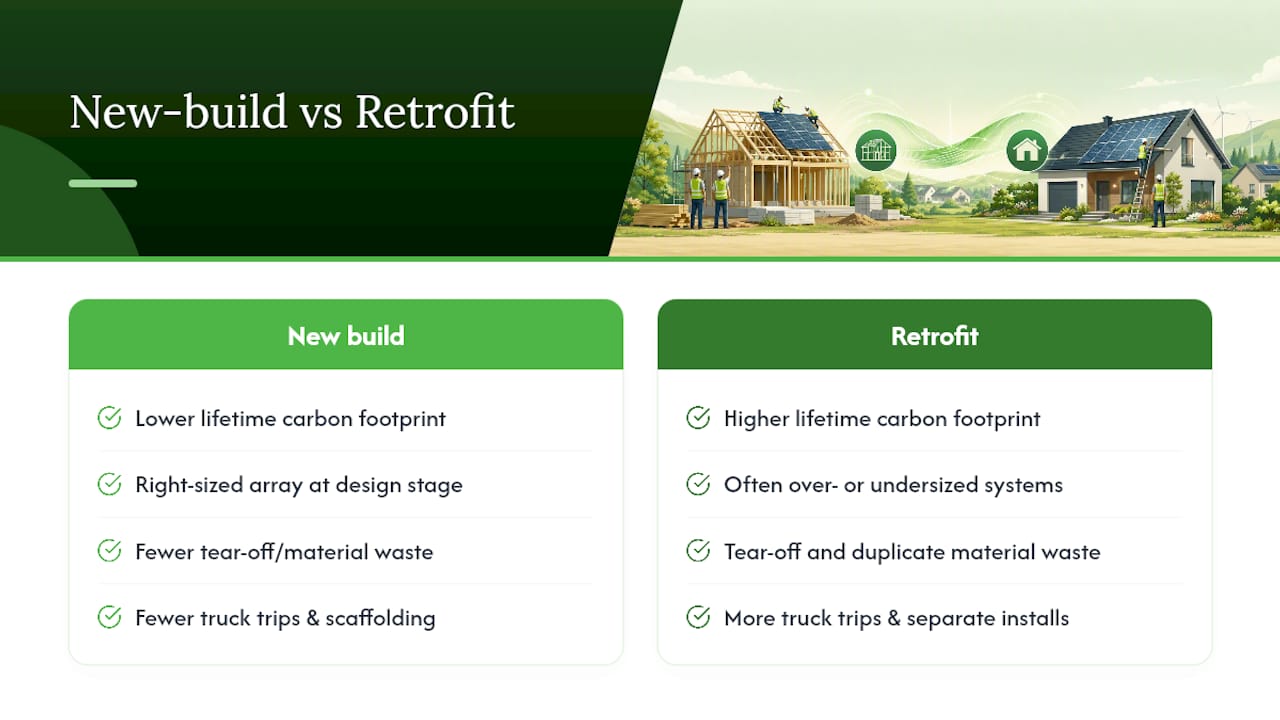
New construction offers something a retrofit never can: the chance to pair solar with a high-efficiency building envelope from day one. A Zero Energy Ready home combined with rooftop solar produces a lower net carbon footprint over its lifetime than adding panels to a home with average insulation and older windows, because the panels aren’t working to offset unnecessary heat loss or inefficient HVAC cycling.
Sizing the array correctly at the design stage also avoids a common waste problem: retrofit installations often oversize or undersize systems because they’re constrained by whatever roof space and electrical capacity happen to already exist. New construction lets the system match actual household energy use, avoiding both under-production and the embodied carbon cost of manufacturing more panels than a home needs.
There’s a manufacturing and materials angle too. Coordinating roofing and solar installation in a single construction phase means fewer truck trips, less duplicate scaffolding, and no tear-off waste from removing existing shingles to accommodate racking. On a per-home basis, that’s a meaningfully smaller construction footprint than a comparable retrofit project.
For builders working on multiple homes annually, this efficiency compounds. A development that standardizes solar-ready framing across dozens of homes reduces per-unit material waste and installation emissions compared to homeowners retrofitting independently years apart.
Combining Solar With Other Renewable Technologies in New Builds
Pairing solar with heat pumps, battery storage, or geothermal systems in a new build introduces coordination challenges that don’t exist when each system is installed separately over time. The most common problem is electrical capacity: a heat pump, an EV charger, a battery, and a solar inverter all competing for panel space and amperage can exceed what a standard 200-amp service comfortably supports.
The fix is sequencing the load calculation before framing, not after. An electrician should size the panel based on the full intended load, solar, battery, heat pump, and EV charging combined, rather than adding each system as an afterthought. This is exactly the kind of calculation that belongs in the pre-construction planning phase alongside the solar-ready checklist.
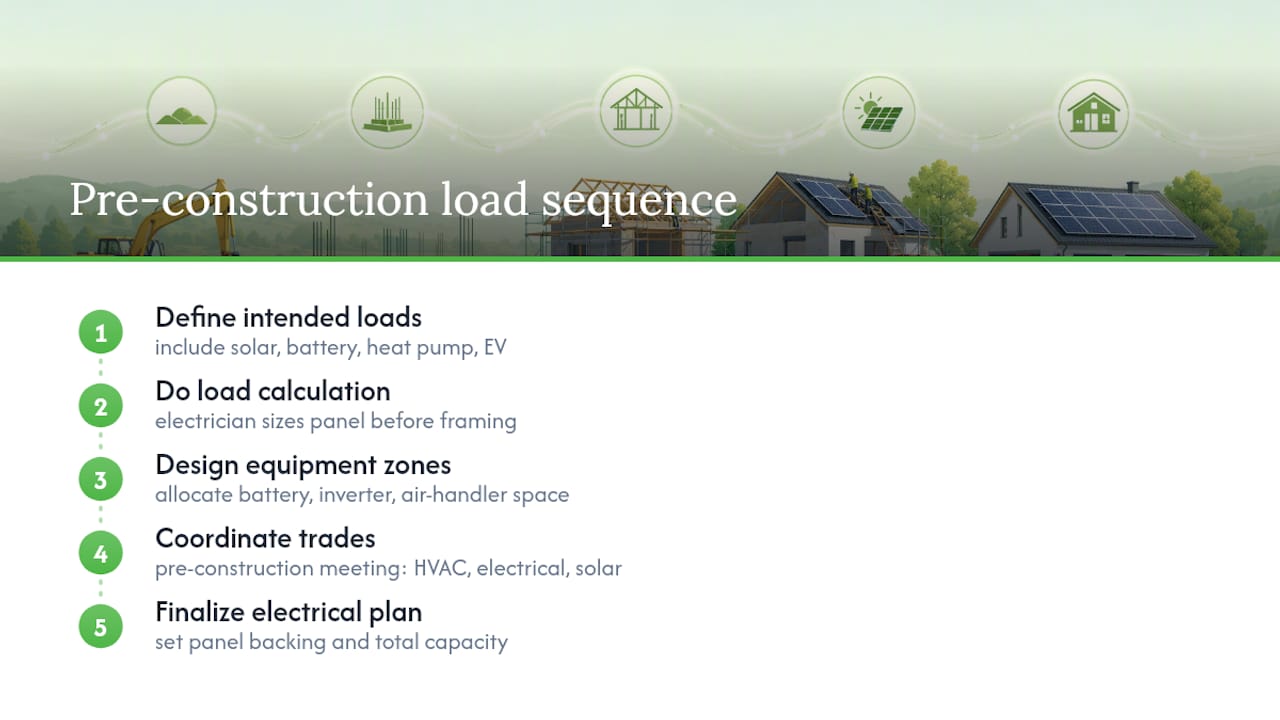
A second friction point is physical space. Battery cabinets, inverters, and heat pump air handlers all compete for the same utility closet or garage wall. Solving this means designating equipment zones on the electrical plan early, the same way you’d designate panel backing for an inverter.
Communication between trades is the last piece. HVAC contractors, electricians, and solar installers often work in silos unless the general contractor explicitly coordinates them. A pre-construction meeting that puts all three trades in the same room, reviewing the same electrical plan, catches conflicts that would otherwise surface as expensive change orders mid-build.
Indigo Energy & Solar’s Approach to New-Construction Projects
A local solar contractor designs and installs solar, battery storage, and EV charging systems for homeowners and property developers, with projects often accompanied by ROI analysis instead of generic sales estimates. Our 243.5 kW installation at Washington Elementary School shows how carefully planned array sizing and electrical integration play out on a large, real project. For builders and buyers, we get involved at contract and framing stages to document PTO timelines, confirm warranty terms, and make sure the electrical rough-in actually supports the system you’re planning to add.
— David
Ready to Build Solar Into Your New Home?
A solar provider can give you a direct path to owned solar during construction, handling design, permitting, ROI analysis, and installation as one coordinated process, avoiding the need to reconcile separate contracts for panels, battery, and EV charging later.

If you’re framing a new home or negotiating a contract right now, this is the moment to lock in system ownership and confirm your solar-ready specs on paper. Ask your builder or Indigo Energy directly for documented PTO timelines and system ownership terms before you sign. Start with a consultation through our residential solar installation page and get a system designed around your actual roof, panel capacity, and budget, not a generic package.
This article is general information, not a substitute for advice from a qualified financial advisor. Consult a qualified financial professional about your own circumstances before acting on anything here.
Sources
FAQ
Does New Construction Require Solar?
Only in states or municipalities with a solar mandate, most notably California’s Title 24, which requires solar PV on most new single-family homes with defined sizing rules and exceptions. Outside those jurisdictions, solar remains optional, though it’s still the cheapest time to install it.
Is There Still a 30% Solar Tax Credit in 2026?
The federal residential clean energy credit exists, but eligibility and rate details depend on current law and the system’s ownership structure; confirm current terms with a tax professional. What’s certain is the timing rule: the credit applies in the tax year your system receives Permission to Operate, not the year it’s built.
What Is the 75% Rule for Solar Panels?
The EPA’s RERH specification recommends a proposed solar site achieve at least 75% of an optimal site’s solar resource potential, based on the Solar Site Assessment Tool, accounting for orientation, tilt, and shading, before a roof plane is considered solar-ready.
How Much Does Solar Cost for a 2,000 Sq Ft House?
Cost depends heavily on system size, panel choice, and whether it’s installed during new construction versus as a retrofit, with new-construction pricing typically running lower per watt due to shared labor and avoided demolition. For a project-specific estimate, Indigo Energy & Solar provides a full ROI analysis based on your actual roof and energy use through a residential consultation.