
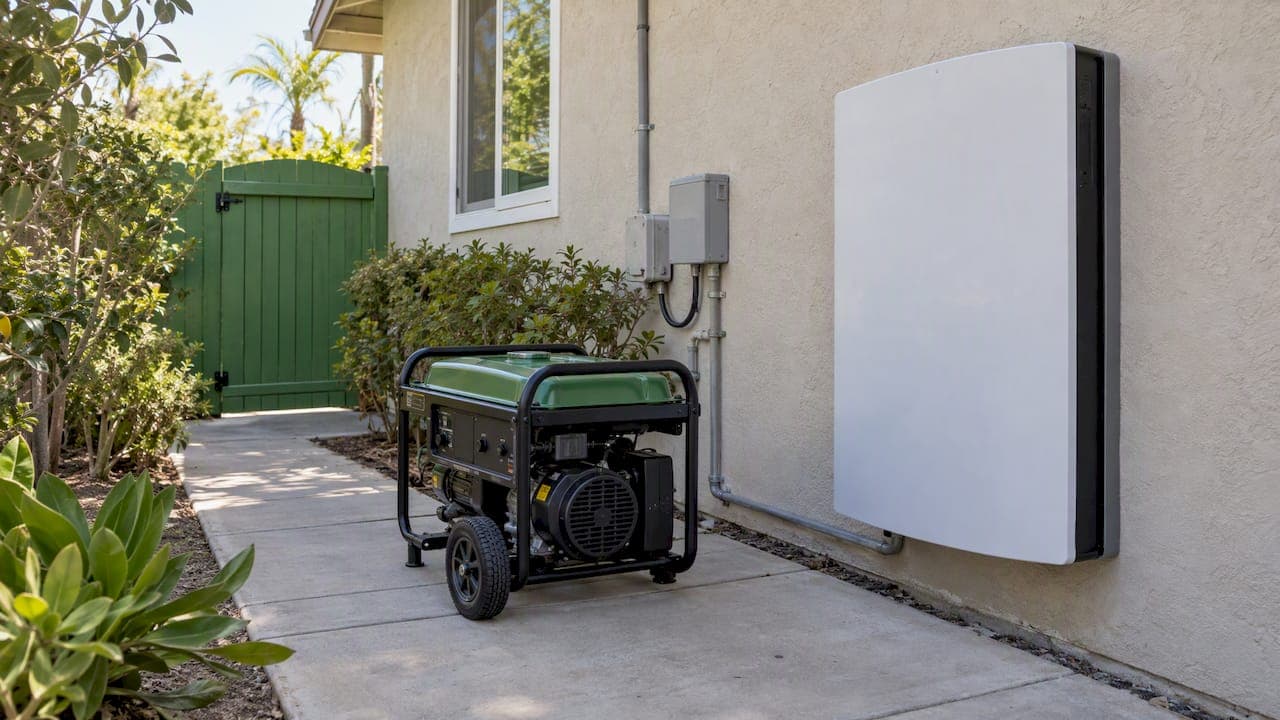

A home battery is the better fit if you want backup power that switches on automatically, runs quietly, and can be recharged by solar panels. A fueled generator is the better fit if you need to run heavy loads for days with no sun and no grid. Most San Diego County homes and small businesses that already have solar, or plan to, are best served by a battery. Properties with large loads and long outage exposure sometimes pair a battery with a generator.
The rest of this guide compares the two on the points that decide the purchase: cost, runtime, safety, maintenance, and how each behaves when the grid goes down. It also shows how to size a system so you buy what you need.
TL;DR
- Battery backup switches over automatically, is quiet, produces no exhaust, and can recharge from solar. Its runtime is limited by the stored energy (kWh).
- Generators can run as long as fuel is available and cost less upfront, but they need fuel, regular maintenance, and outdoor placement because of carbon monoxide.
- Typical U.S. ranges reported in 2025: about $10,000 to $20,000 for a home battery system and about $7,000 to $15,000 for a standby gas generator.
- Rooftop solar alone will not keep your lights on in an outage. You need a properly configured inverter and storage.
- Size either option around your critical loads and the number of hours or days you want to cover, not around the whole house by default.
Table of Contents
- The core difference: stored energy vs. burned fuel
- Side-by-side comparison
- How each option behaves during an outage
- Safety: the part people underestimate
- Why outages in San Diego County favor batteries
- Sizing: start with critical loads, not the whole house
- Which one to choose: a decision guide
- Cost and ownership over time
- What we recommend and why
- Plan your backup power with Indigo Energy
- FAQ
- Sources
The core difference: stored energy vs. burned fuel
A home battery is a large rechargeable unit connected to your breaker panel. A generator is an internal-combustion engine that makes electricity, as Wirecutter describes the two. That one difference drives almost everything else.
A battery holds a fixed amount of energy. When it is full, you have that much and no more, unless something recharges it. A generator holds no energy itself. It converts fuel, so its runtime depends on how much fuel you have and whether you can keep it running.
The U.S. Department of Energy frames the resilience side this way: solar generation can be stored and used without fuel deliveries, unlike conventional diesel generators. That matters in a long regional event, when fuel supply and delivery are not guaranteed.
Side-by-side comparison
| Factor | Battery backup | Standby or portable generator |
|---|---|---|
| Typical installed cost (U.S., 2025) | About $10,000 to $20,000 for an average home system | About $7,000 to $15,000 for a standby gas unit |
| Runtime | Limited by stored kWh, sometimes only hours without solar | As long as fuel is available |
| Noise | Near silent | Engine noise |
| Exhaust | None | Carbon monoxide and emissions |
| Maintenance | Minimal | Scheduled engine service, fuel management |
| Solar recharging | Yes, with a compatible inverter | No |
| Typical lifespan | About 10 years | 20 years or more if maintained |
| Daily usefulness | Can reduce high-cost electricity use | Idle until an outage |
The cost and lifespan figures come from pv magazine USA’s 2025 comparison. They are general expectations, not quotes. Your price depends on battery capacity, panel upgrades, the transfer equipment, and site conditions.
How each option behaves during an outage
Battery: automatic and silent
A properly configured solar-plus-storage system detects that the grid has failed and switches to islanded mode, as the Department of Energy explains. You usually do not have to do anything. There is no fuel to fetch and no cord to run.
The common misunderstanding is that solar panels alone provide backup. The DOE notes that ordinary grid-tied rooftop panels generally shut off when the grid fails. Safety standards prevent them from feeding power into lines that crews may be working on. To keep running, you need a properly configured inverter and storage.
A battery paired with solar can also restart itself after depleting. The Building America Solution Center notes that many grid-tied systems lack this ability, but hybrid or multi-modal inverters can use solar to charge batteries and restart without a grid signal. If you are choosing a battery, ask the installer whether the system you are quoted can do this.
The way the battery connects to your solar also matters. Our guide to AC-coupled vs. DC-coupled solar batteries explains how that choice affects retrofits and efficiency.
Other storage-equipped equipment can contribute too. If you drive an electric truck, a vehicle-to-home backup kit can turn the vehicle’s pack into a supplementary power source, though a stationary battery remains the more predictable foundation.

Generator: continuous runtime, with conditions
A fueled standby generator can run for an extended period as long as fuel is available. That is its real advantage over a battery without solar. Duke Energy notes that batteries are typically quiet and maintenance-free but have a finite energy supply, sometimes only a few hours unless paired with solar.
A generator also needs the right connection. The Building America Solution Center states that both battery and generator systems must prevent backfeeding the grid, typically with an automatic transfer switch, and may use a critical-loads subpanel when they are not sized for the whole home.
Safety: the part people underestimate
This is where the two options differ most, and the guidance is specific.
- Carbon monoxide. The EPA says fuel-powered portable generators produce carbon monoxide, an invisible, odorless gas that can kill in minutes. Run them outside, at least 20 feet from buildings, and never in enclosed areas.
- Distance from openings. Ready.gov advises keeping generators and fuel outdoors at least 20 feet from windows, doors, and attached garages. It also warns about electrical shock, wet equipment, fire, and refueling hazards.
- Grounding. Emergency generators should be properly grounded, according to the Virginia Department of Health, which points readers to an OSHA grounding fact sheet.
- Batteries. The EPA notes that battery-powered generators and power stations, unlike fuel-burning models, do not produce toxic fumes, so they are safer in or near indoor spaces.
If you or a family member relies on powered medical equipment, talk to your doctor and your utility about your outage plan before choosing. Have a licensed electrician or contractor handle any generator hookup to your panel. Improvised connections are a common cause of backfeed and shock.
Why outages in San Diego County favor batteries
Outages here are often not about a single storm. SDG&E may shut off power deliberately in communities facing high fire-weather conditions, which it calls a Public Safety Power Shutoff. These events can last until the fire risk passes.
That pattern suits solar plus storage. Sunny days are common in the region, so a battery can be topped up between events and, in a multi-day shutoff, recharged from the roof each day. A generator in the same situation depends on you having stored fuel. Fuel storage in fire-prone areas carries its own risks.
At the same time, a battery does something a generator cannot. The Building America Solution Center notes it can reduce high-cost electricity use year-round. In California, where solar export rates under NEM 3.0 reward self-consumption, shifting your solar into the evening is where a battery earns money before any outage happens. A generator sits idle and earns nothing.

Sizing: start with critical loads, not the whole house
The most common mistake with either system is sizing by habit. Generator buyers are used to thinking in watts. Battery buyers need to think in kilowatt-hours. Wirecutter says battery capacity, measured in kWh, is a key factor, and that you should calculate your critical loads and desired runtime rather than assume one size fits all.
A practical process:
- List what must stay on. Refrigerator, internet, lights, phone charging, well pump or sump pump if you have one, medical devices, garage door, and perhaps a few outlets.
- Add the rated power of each. This gives the power you need at any one moment, measured in kW.
- Estimate hours of use per day. Multiply each device’s power by its hours to get daily kWh.
- Decide your target. Overnight only? One full day? Several days with solar recharging?
- Decide on whole-home or critical-loads. A critical-loads subpanel keeps the battery smaller and the cost lower. Whole-home backup, including air conditioning and electric cooking, needs far more capacity.
For homeowners weighing the whole-home route, we cover size, cost, and installer vetting in our guide to 20 to 40 kWh whole-home backup.
Keep two numbers separate. Power (kW) is how much you can run at once. Energy (kWh) is how long you can run it. The DOE’s storage literature draws a similar line, separating energy applications that discharge over tens of minutes to hours from power applications that discharge quickly at high rates. A battery with plenty of kWh but low power output may still fail to start an air conditioner or a pump.
Which one to choose: a decision guide
Choose a battery if
- You have solar now or plan to install it.
- Your outages are usually hours to a few days, such as grid failures or fire-weather shutoffs.
- You want automatic switchover, no fuel handling, and no noise.
- You want the system to lower evening electricity costs every day, not only during outages.
- You live in a townhouse, condo, or dense neighborhood where an engine would be a problem.
Choose a generator if
- You have very high loads and no solar, and your budget is tight.
- You face long outages with no sun, such as a prolonged storm or a grid failure where fuel supply is dependable.
- You are comfortable with fuel storage, periodic engine servicing, and placement outdoors.
Consider both if
- You operate a business or have medical needs where running out is not acceptable.
- You are in a remote area with rare but very long outages.
For commercial properties, the equation also includes demand charges and the cost of downtime. Our commercial battery storage guide for San Diego covers how storage can cut peak demand and keep critical systems running.
Cost and ownership over time
The upfront gap favors generators. pv magazine USA reports about $7,000 to $15,000 for a standby gas generator versus $10,000 to $20,000 for an average home battery system. The same article notes that batteries typically have lower operating and refueling costs, though this depends on electricity and fuel prices.
Look past the sticker price:
- Fuel. A generator consumes fuel during every outage and during test runs. A battery draws on your own solar.
- Maintenance. Fossil-fuel generators need monthly and annual upkeep. Battery backup avoids those chores.
- Lifespan. Expect about 10 years from a battery and 20 years or more from a maintained generator, per the same pv magazine USA piece. Check the warranty terms on any battery you consider.
- Daily value. A battery can earn savings every day. A generator only pays off on outage days.
Because a battery works every day, it makes sense to judge it on return on investment, not on insurance value alone. We build that analysis into every proposal.
What we recommend and why
We install batteries far more often than generators in San Diego County, and it is not because batteries are fashionable. Most of our customers want three things: power that comes on without anyone touching it, lower evening bills, and no fuel to store near a fire-prone hillside. A battery paired with solar delivers all three.
We are equally direct about the limits. A battery has a finite supply, so the first conversation we have is about your critical loads and how many hours or days you want to cover. We would rather size a system honestly and show you the numbers, including the ROI, than sell more capacity than you need. On new construction and commercial projects, getting involved early lets us route critical loads onto a dedicated panel and avoid expensive rework later.
If your situation really calls for a generator, such as very heavy loads with no solar, we will tell you so.
— Curtis Williamson
Plan your backup power with Indigo Energy
Indigo Energy designs and installs solar, battery storage, and EV charging for homes and businesses across San Diego County. We handle the site assessment, permitting, system design, ROI analysis, and ongoing monitoring. Our pricing is transparent, so you see what you are paying for and what you should expect back.
If you want a straight answer on whether a battery covers your critical loads, start with our battery storage and outage protection page. If you are also planning solar, see our residential solar installation service, or contact us through our site to request an assessment.
FAQ
Can a home battery run my whole house?
Sometimes, but it depends on capacity and power output. Whole-home backup that includes air conditioning and electric cooking needs a large battery, while a critical-loads setup is smaller and more affordable. Your installer should size it from your actual usage and the loads you want covered.
How long will a battery last in an outage?
There is no single answer, because runtime is your stored kWh divided by what you are running. Duke Energy notes that batteries may last only a few hours unless paired with solar. With solar recharging each day and careful use of essential loads, a system can keep going much longer.
Do solar panels work without a battery during a blackout?
Generally not. Standard grid-tied panels shut off when the grid fails, so you need a properly configured inverter and storage system for outage operation.
Is a generator safe to run at home?
Only outdoors, away from the building. The EPA and Ready.gov both advise keeping fuel-burning generators at least 20 feet from windows, doors, and attached garages because of carbon monoxide. Never run one in a garage or enclosed space, even with the door open.
Can I use both a battery and a generator?
Yes. Many properties with long-outage exposure use the battery for everyday savings and automatic backup, and keep a generator as a last resort. A transfer switch must prevent backfeeding the grid, and a licensed professional should install it.
Sources
- Solar and Resilience Basics, U.S. Department of Energy
- How to Choose Backup Home Power Options, Wirecutter
- How to Pick a Solar Panel and Battery Backup System, Wirecutter
- Home battery versus generator, pv magazine USA
- PV Battery Storage for Power Outages, Building America Solution Center
- Batteries or Standby Generators, Duke Energy
- Flood Cleanup to Protect Indoor Air and Your Health, US EPA
- Power Outages and Indoor Air Quality, US EPA
- Power Outages, Ready.gov
- What You Need to Know About Generators, Virginia Department of Health
- Solar Energy Grid Integration Systems, Energy Storage, U.S. Department of Energy
- Public Safety Power Shutoff, 211 San Diego