
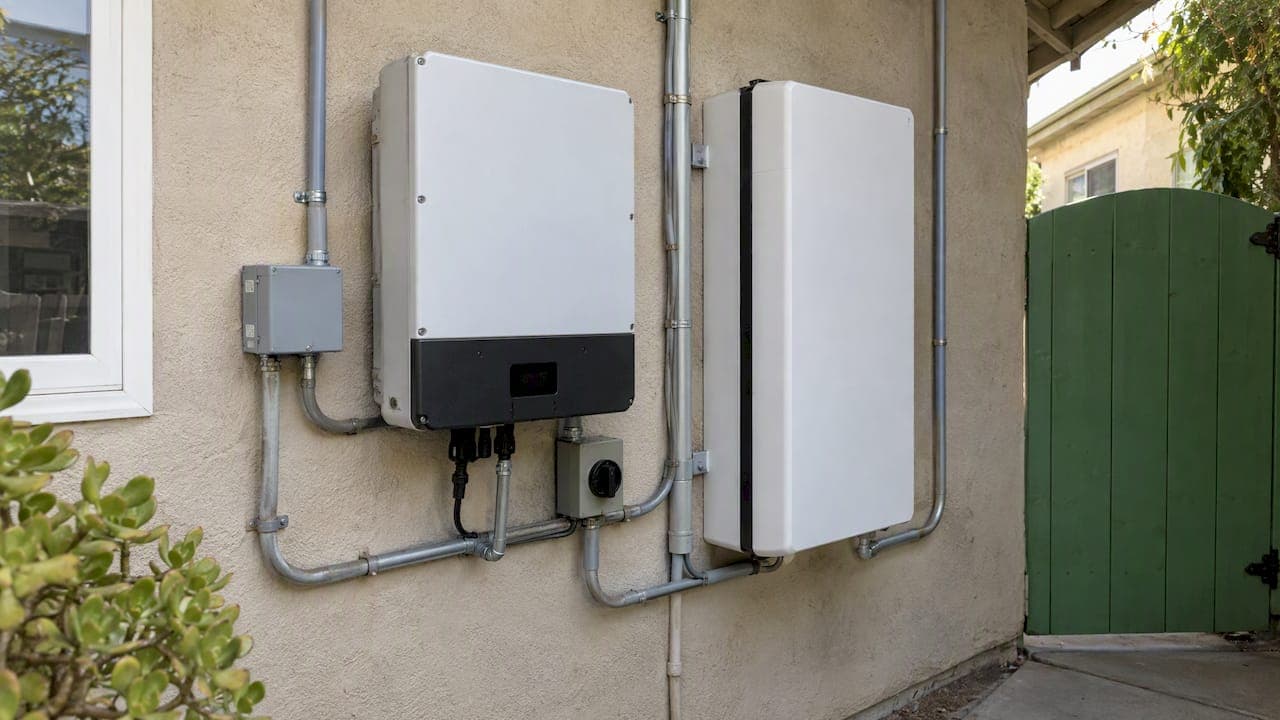

The difference comes down to where the battery connects to your system. A DC-coupled battery shares one hybrid inverter with your solar panels. An AC-coupled battery has its own inverter and connects on the alternating-current side. DC coupling is usually the better fit for a new solar-plus-storage system. AC coupling is usually the better fit when you add a battery to solar that already works. Backup behavior, site layout and the inverter you pick can change that answer, and this guide walks through each.
TL;DR
- New solar plus battery: a DC-coupled hybrid system is often the simpler, more efficient build, with fewer conversion steps and one inverter to install and maintain.
- Battery added to existing solar: AC coupling usually costs less, because your current panels and inverter stay in place.
- Efficiency gap: DC coupling wins on paper, but the difference is typically in the single digits, so it rarely decides a retrofit on its own.
- Outages: how your system restarts after a fully drained battery depends on the inverter and its software, not only on the coupling type. Ask for the exact behavior in writing.
Table of Contents
- What coupling means in a solar-plus-battery system
- How the power flows in each setup
- AC-coupled vs. DC-coupled at a glance
- Efficiency: real, but smaller than the marketing suggests
- Retrofit vs. new install: where the cost really sits
- Backup power and black start: the part to ask about
- Which one fits your situation
- Questions to settle before you sign
- Our perspective: the coupling choice is a design decision, not a product category
- Get a design built around your roof and your loads
- FAQ
- Sources
What coupling means in a solar-plus-battery system
Solar panels produce direct current (DC). Batteries store DC. Your home and the utility grid run on alternating current (AC). Every solar-plus-storage system has to convert between the two somewhere, and “coupling” describes where the battery sits relative to those conversions.
In a DC-coupled system, panels and battery feed the same hybrid inverter on the DC side. Solar power can charge the battery directly, and the inverter converts to AC only once, when the power goes to your loads or the grid.
In an AC-coupled system, the panels have their own inverter (a string inverter or microinverters on each panel). That inverter turns solar into AC. The battery has a separate inverter, so power going into the battery is converted back to DC, and power coming out is converted to AC again.

That is the whole distinction. Everything else, including cost, efficiency, installation work and outage behavior, follows from it.
How the power flows in each setup
| Step | DC-coupled | AC-coupled |
|---|---|---|
| Solar generation | Panels produce DC | Panels produce DC |
| Solar to battery | Stays DC, charges battery directly | Converted to AC, then back to DC to charge |
| Battery to home | One DC-to-AC conversion | Battery DC converted to AC |
| Inverters needed | One hybrid inverter | Solar inverter plus battery inverter (or an inverter built into the battery) |
| Typical use | New installations | Adding storage to existing solar |
When solar charges the battery in an AC-coupled system, the energy is converted to AC, then back to DC for storage, and then to AC again for household use. Each of those conversions loses some energy, with inverter losses in AC-based conversions typically falling between 2% and 10%. A DC-coupled hybrid avoids part of that chain for solar energy that goes through the battery.
Note what the loss applies to. Solar power used directly by your home as it is produced does not pass through the battery in either design. The extra conversion only affects the share of energy you store and use later, which, under time-of-use rates, is often a large share.
AC-coupled vs. DC-coupled at a glance
| Factor | DC-coupled | AC-coupled |
|---|---|---|
| Round-trip efficiency on solar-charged energy | Higher, fewer conversions | Lower, extra conversion stage |
| Best for | New solar plus battery | Adding a battery to working solar |
| Equipment on a new build | One hybrid inverter | Two inverter stages |
| Retrofit cost and disruption | Often requires replacing the existing inverter | Existing panels and inverter stay in place |
| Charging from the grid | Supported by hybrid inverters | Supported, battery inverter handles it |
| Flexibility to expand or swap | Tied to the hybrid inverter’s limits | Battery can be added or changed independently |
| Restart after full depletion | Often able to restart from solar, depending on the inverter | Often needs a grid signal, depending on the product |
Treat the last row as a tendency, not a rule. We come back to it below.
Efficiency: real, but smaller than the marketing suggests
DC coupling is generally more efficient because it avoids that extra conversion cycle. That is accurate. What gets lost in many comparisons is the size of the gain.
According to the UK trade body Solar Energy UK, the efficiency gain is typically in the single digits and rarely justifies replacing a working inverter just to add a battery. The same guidance says that if solar is not installed yet, a hybrid inverter is usually the cheaper route, while if it is already on the roof, adding a separate battery inverter usually beats replacing what you have. That source is UK-based, but the electrical logic is the same in California.
Here is a simple way to think about it. Say your battery cycles 10 kWh a day. A few percentage points of extra loss on that energy means a few tenths of a kilowatt-hour per day. Real money over a decade, but small next to what the battery does for you in the first place: shifting solar energy into the evening hours when your rates are highest.
Retrofit vs. new install: where the cost really sits
Most of the cost difference comes from the work, not the efficiency.
New solar plus battery. One hybrid inverter replaces two separate devices. You buy less hardware, run less wiring, and have one system to monitor and warranty. This is the strongest case for DC coupling.
Battery added to existing solar. Going DC-coupled would usually mean pulling out a functioning inverter, re-engineering the array’s electrical layout and going back through permitting. AC coupling keeps the original solar hardware, so it avoids that. For an array that is only a few years old, it is usually the more economical path.
An older inverter near the end of its life. If your inverter is already close to replacement age, the math can flip. Swapping it for a hybrid unit at that moment lets you do the replacement and the battery install in one visit.
Two more factors can matter in San Diego County:
- Panel-level electronics. If your array uses microinverters, each panel already outputs AC, so an AC-coupled battery is the natural match.
- Roof and shading. On arrays with partial shade or multiple roof planes, the way strings are designed influences whether a hybrid string inverter is a good fit at all.
Backup power and black start: the part to ask about
For many homeowners, the real reason for a battery is keeping the lights on when the grid goes down, not savings alone. Here the coupling type is only half the story.
A grid-tied solar system shuts down during an outage unless it is built to island from the grid safely. The Building America Solution Center explains that if a battery is completely depleted, some AC batteries need a signal from the grid before they can start charging again, while most DC batteries have a black-start capability that lets them restart from solar. In plain terms: after a long outage that drains the battery, a DC-coupled system with the right inverter can often wake up from sunlight alone. Many AC-coupled batteries cannot without the grid.
That said, black-start behavior is heavily dependent on the inverter technology, not only on the coupling method. Some AC-coupled products are designed with their own islanding and restart logic, and a DC-coupled system with a basic inverter may not offer it. So do not choose on the label. Ask the installer these questions:
- If the battery hits 0% during a multi-day outage, can the system restart from solar alone?
- Does the system form its own local grid, and which loads can it power?
- How is the array’s output managed when the battery is full and the home needs less power?
- What is the surge capacity for starting large loads such as an air conditioner, well pump or garage-door motor?
On the last point, research on inverter-based resources notes that all of them have less over-current capacity than similarly sized synchronous generators, which limits their ability to start high in-rush loads such as motors. Your installer should size the inverter for your actual loads.
If you are comparing batteries with a generator for long outages, this outage-length comparison of generator and battery backup lays out how runtime changes the answer. It was written for Maine, so adjust the details for San Diego’s mild climate and wildfire-driven shutoffs.
In high fire-threat areas, the research direction is toward grid-forming, bi-modal inverters that can run a home as a microgrid. That makes inverter intelligence and software management as important as where the battery connects.
Which one fits your situation
Choose DC coupling when
- You are installing solar and storage together.
- You are replacing an aging inverter anyway.
- You want a single inverter, single app and single warranty chain.
- Long-duration outage restart from solar is a priority, and the specific inverter supports it.
Choose AC coupling when
- You already have solar that performs well and the inverter is relatively new.
- Your array uses microinverters.
- You want to add storage in stages, or expand battery capacity later without touching the solar side.
- You want the lowest-disruption retrofit with the least re-permitting.
Commercial properties
For businesses, the question shifts from outage restart to load management. Batteries can reduce demand charges by discharging during your highest-demand intervals, and sizing depends on your interval data. Existing commercial arrays often use large string inverters, which makes AC-coupled retrofits common. New construction is different: designing storage in from the start, with the building’s electrical plan, usually lets you pick the cleanest architecture. Our commercial battery storage guide for San Diego goes deeper on the numbers.
Questions to settle before you sign
Whichever way you lean, get these answered in writing:
- Total installed cost, itemized, including inverter work, electrical upgrades and permitting.
- Projected savings under your actual rate plan, with the assumptions shown, not just a headline payback.
- Usable capacity and power rating of the battery, not only nameplate kWh.
- Warranty terms for the battery, the inverter and the workmanship, and what happens if you later change one component.
- Monitoring: can you see solar production, battery state of charge and home consumption in one place?
- Future plans: an EV charger, a larger array or a second battery can change which setup makes sense. See how EV charging and solar planning fits together.
Our perspective: the coupling choice is a design decision, not a product category
We design every system around the customer’s energy use, rate plan and site, and the coupling decision is a good example of why. People often arrive asking which type is “better.” The honest answer is that it depends on what is already on the roof and what you need the system to do on its worst day.
For a new build or a new installation, we start by looking at a hybrid, DC-coupled design, because one inverter means fewer parts, fewer failure points and cleaner monitoring. For an owner with a solid existing array, we are much more careful about recommending an inverter replacement just to gain a few points of efficiency. The savings rarely cover the cost and re-permitting, and a transparent ROI analysis shows that clearly.
We also push customers to look past the coupling label to the inverter’s software and outage behavior. A system that cannot restart cleanly after a long shutoff is a weak backup no matter how efficient it is the rest of the year. And on new construction, we encourage involvement early, because decisions about conduit, panel capacity and equipment location are cheap on paper and expensive after drywall.
Whatever we propose, you should see the pricing, the ROI assumptions and the tradeoffs laid out plainly, so you can judge the recommendation yourself.
— Curtis Williamson
Get a design built around your roof and your loads
If you are weighing a new solar-plus-battery system or adding storage to an existing array in San Diego County, our team can assess your site, model your savings and recommend the coupling approach that fits. See our solar and battery storage services or start from the full list of services. For homeowners focused on outage protection, our guide to sizing whole-home backup is a good next read.
FAQ
How do I know if my solar is AC-coupled or DC-coupled?
Look at your inverter setup. If your panels have microinverters or a standard string inverter and the battery has its own inverter, the battery is AC-coupled. If one hybrid inverter connects both panels and battery, it is DC-coupled. Your installation paperwork or monitoring app usually names the equipment, and an installer can confirm in a site visit.
What are the disadvantages of AC coupling?
The main one is the extra conversion step, which lowers efficiency on energy that goes through the battery. It also means two inverter stages and, in some products, a need for a grid signal to restart after full depletion. For retrofits these drawbacks are often outweighed by lower cost and less disruption.
Is DC coupling always better for backup power?
No. DC-coupled systems often have an advantage in restarting from solar after a battery is fully drained, but the outcome depends on the specific inverter and its software. Some AC-coupled systems are built with strong islanding features. Ask for the manufacturer’s documented outage behavior.
Can I add a DC-coupled battery to my existing solar?
Sometimes, but it usually means replacing your current inverter with a hybrid model and redoing parts of the electrical design and permitting. Unless your inverter is old or failing, adding an AC-coupled battery is typically the more economical route.
Does coupling type change how much I save?
Only modestly. Rate plan, battery size and how you use power matter far more than a single-digit efficiency difference. A good proposal models your actual usage and shows the assumptions behind the payback figure.
Sources
- Analysis of Refrigeration Units in Off Grid PV/Wind Hybrid Systems on Tribal Land (U.S. Department of Energy)
- AC or DC coupled: which battery arrangement, and when it matters (Solar Energy UK)
- PV Battery Storage for Power Outages (Building America Solution Center)
- Inverter-based resources and black start (OSTI, U.S. Department of Energy)
- Outage Length Decides Backup: Generator vs Battery Backup