
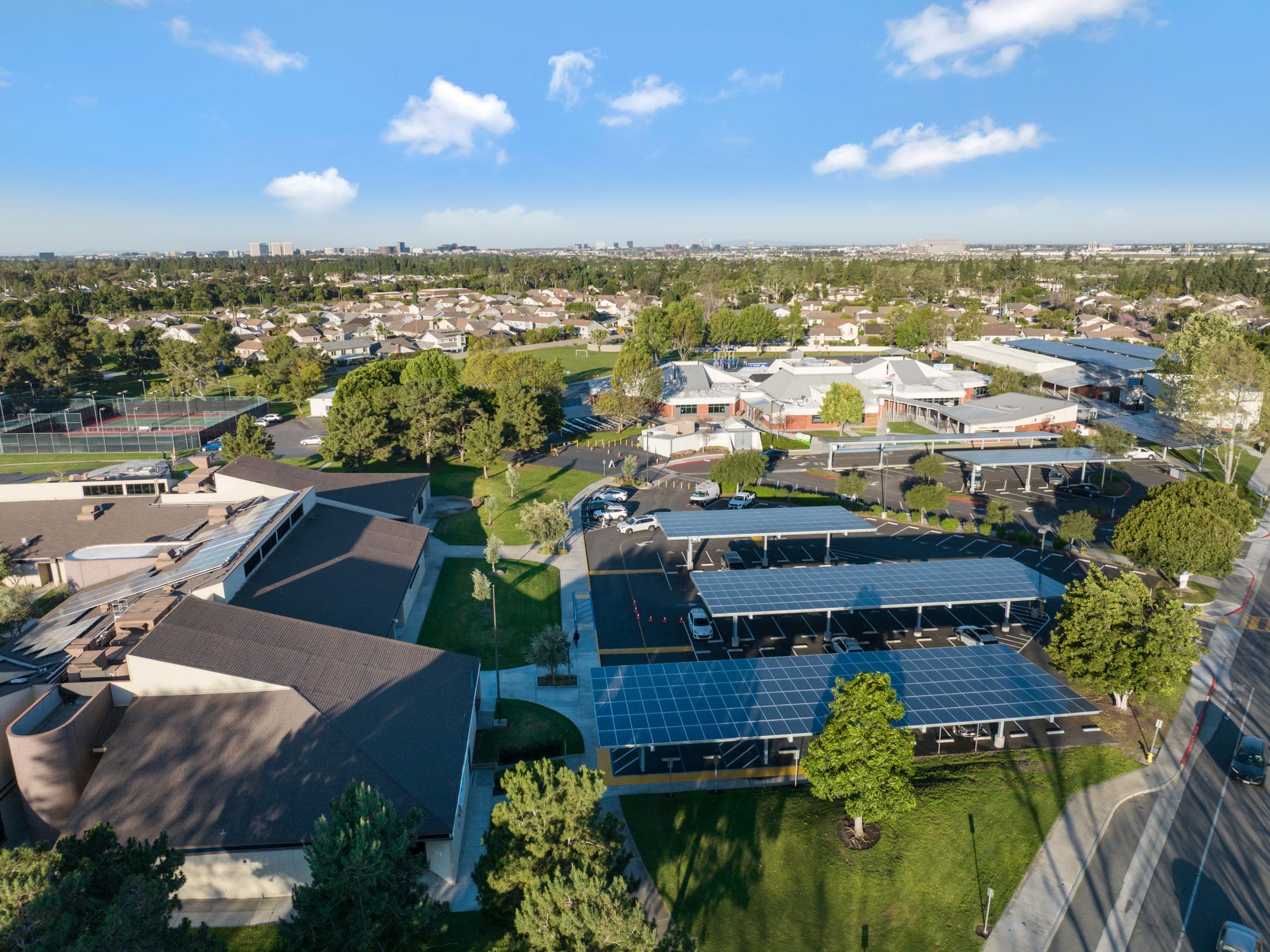
Aerial view of a rooftop solar array in San Diego County
Financial Incentives & Solar Financing

The California Solar Tax Credit in 2026

What ended, what survived, and who still gets 30%

The 30% federal tax credit for homeowners ended on 31 December 2025. It was not reduced or phased down — for new residential installations it no longer exists.

The commercial credit is a different provision, and it survived. Businesses, schools, churches and nonprofits across San Diego County still receive 30%, and most projects here qualify for the full rate automatically. Here is where the rules actually stand.

01

What Changed on 31 December 2025

For nearly twenty years, homeowners who bought a solar system could claim the federal Residential Clean Energy Credit — Section 25D of the tax code — worth 30% of the installed cost. That credit no longer exists for new installations.

Public Law 119-21, signed on 4 July 2025, terminated Section 25D. The statute is blunt about it: the credit "shall not apply with respect to any expenditures made after December 31, 2025." There is no phase-down and no reduced rate. For a homeowner installing solar today, the federal credit is simply gone.

This is the single biggest change to residential solar economics in California in two decades, and a great deal of information still online was written before it took effect.

If you are a homeowner reading this

Any article telling you to install before 31 December 2025 to claim 30% is out of date. That deadline has passed. What follows is where the rules actually stand now.

02

The Completion-Date Trap Most People Miss

A common assumption is that signing a contract or paying a deposit in 2025 is enough to lock in the credit. It is not.

Section 25D(e)(8)(A) states that an expenditure is treated as made when the original installation is completed — not when it was ordered, financed or paid for. A system contracted in late 2025 but switched on in 2026 falls after the cut-off, and the credit cannot be claimed.

Given that permitting, design and utility interconnection in San Diego County routinely add months to a project, a significant number of households who believed they had beaten the deadline did not.

03

What Homeowners Can Still Use

The federal credit is gone for new systems, but three things remain true.

Unused credit from an earlier installation still carries forward

If your system was completed on or before 31 December 2025 and your tax liability was too small to absorb the full credit that year, the unused portion can still be carried forward into later tax years. Expiry of the credit for new installations does not cancel a credit you already earned.

California programs are separate from the federal credit

State and utility programs, including the Self-Generation Incentive Program for battery storage, are administered by the California Public Utilities Commission and are entirely independent of what Congress did to Section 25D. Eligibility, budgets and rates change regularly — we check current standing on every quote rather than quoting a figure that may have moved.

The underlying economics did not disappear with the credit

San Diego Gas & Electric rates remain among the highest in the country. Solar still offsets that bill; the payback period is simply longer than it was in 2025. Anyone telling you the maths is unchanged is not being straight with you, and anyone telling you solar no longer works has not run the numbers.

04

Businesses, Schools, Churches and Nonprofits Still Get 30%

This is the part that gets lost in coverage of the homeowner credit ending. The commercial credit is a completely different section of the tax code, and it survived.

Section 48E — the Clean Electricity Investment Credit — applies to businesses and other organisations that install qualifying solar or energy storage. The headline rate is 30%, and on a $400,000 commercial installation that is $120,000 off the federal tax bill rather than $120,000 off taxable income.

So a San Diego business owner and a San Diego homeowner are now in genuinely different positions. The commercial case is stronger today than the residential one, which is the reverse of how most people assume it works.

05

Why Most San Diego Commercial Projects Qualify Automatically

There is an important detail in how the 30% is reached, and it works in favour of the sort of projects we install.

Under Section 48E the base credit is 6%. It rises to 30% when a project meets federal prevailing-wage and registered-apprenticeship requirements — a real compliance burden involving wage determinations, records and apprentice ratios.

But that requirement only applies to facilities of 1 megawatt or more. A qualified facility with a maximum net output below 1 MW AC is exempt, and receives the full 30% without any prevailing-wage or apprenticeship compliance at all.

Two bonus adders can push the credit higher still: an additional 10% where domestic-content thresholds for steel, iron and manufactured components are met, and a further 10% for projects sited in designated energy communities.

What that means in practice

Every commercial installation in our project portfolio sits below 1 MW — from a 109.6 kW school array to a 487.7 kW carport at the San Diego Unified School District Supply Center. All of them fall inside the exemption. For the overwhelming majority of San Diego commercial rooftops, 30% is the rate, with no labour-compliance paperwork attached.

06

Direct Pay: How Schools, Churches and Nonprofits Claim It

A tax credit is worth nothing to an organisation that pays no federal tax. That used to rule out exactly the institutions with the best rooftops — schools, churches, nonprofits and public agencies.

Elective pay, commonly called direct pay, changes that. Eligible tax-exempt and governmental entities can claim the Section 48E credit and receive its value as a payment from the IRS rather than as an offset against tax owed.

For a church or a school district weighing a solar project, this is the difference between a credit they cannot use and roughly a third of the project cost coming back. It is the single most under-discussed provision affecting the buildings we work on most.

A note on 2026

New restrictions took effect in 2026 preventing specified foreign entities and foreign-influenced entities from claiming these credits. This does not affect ordinary San Diego businesses, schools or congregations, but it does affect ownership structures involving foreign investment — worth raising with your advisor if that describes your situation.

07

Where This Leaves a San Diego Property Owner

  • If you are a homeowner: the federal credit is gone. Solar still reduces an SDG&E bill, but decide on the economics as they are now, not on a 30% credit that no longer applies.
  • If you completed a system in 2025: check with your accountant whether unused credit is carrying forward. It does not expire because the programme did.
  • If you own or operate a commercial building: 30% is still available, and if your system is under 1 MW you almost certainly qualify without prevailing-wage compliance.
  • If you run a school, church or nonprofit: direct pay means the credit is worth real money to you even with no tax liability. This is the strongest position of anyone on this list.
  • In every case: the credit is one input, not the whole decision. Roof condition, load profile, rate schedule and interconnection timing all move the answer.

Tax positions depend on individual circumstances and the rules described here are federal provisions as they stand in 2026. Nothing on this page is tax advice — we design and install the system, and we work alongside your CPA on how the credit applies to you.

Solar Tax Credit Questions We Are Asked in San Diego

For new installations, yes. Public Law 119-21 terminated the Section 25D Residential Clean Energy Credit for expenditures made after 31 December 2025. There is no reduced rate or phase-down for homeowners installing in 2026.

No. Section 25D(e)(8)(A) treats the expenditure as made when the original installation is completed, not when you signed or paid. A system completed in 2026 falls after the cut-off regardless of when the project started.

No. Unused credit from a qualifying installation completed on or before 31 December 2025 can still be carried forward to later tax years. The programme ending for new systems does not cancel credit you already earned.

Yes. The commercial credit sits under Section 48E, a different provision from the residential one, and it remains available at 30% for qualifying projects. Businesses, schools, churches and nonprofits are all in a stronger position than homeowners on this.

Only if it is 1 megawatt or larger. Facilities below 1 MW AC are exempt from the prevailing-wage and apprenticeship requirements and receive the full 30% automatically. Almost every commercial rooftop and carport project in San Diego County falls below that threshold.

No. Elective pay, also called direct pay, lets eligible tax-exempt and governmental entities receive the value of the Section 48E credit as a payment from the IRS instead of an offset against tax owed. Churches, schools and nonprofits can access roughly a third of project cost this way.

Energy storage is qualifying property under Section 48E, and the sub-1 MW exemption applies to storage capacity as well. Whether storage is best included in the same project or handled separately depends on your load profile and rate schedule — it is one of the first things we model.

Call us on 858-281-5110. We will look at the roof, the electrical service and your recent SDG&E bills, and give you a written assessment of system size, production and which incentives your organisation can genuinely claim.

Find out what your building actually qualifies for

The rules changed for homeowners and stayed put for everyone else. We will look at your roof, your electrical service and your recent SDG&E bills, and tell you plainly which incentives your property can still claim. Call 858-281-5110 for a free assessment.