
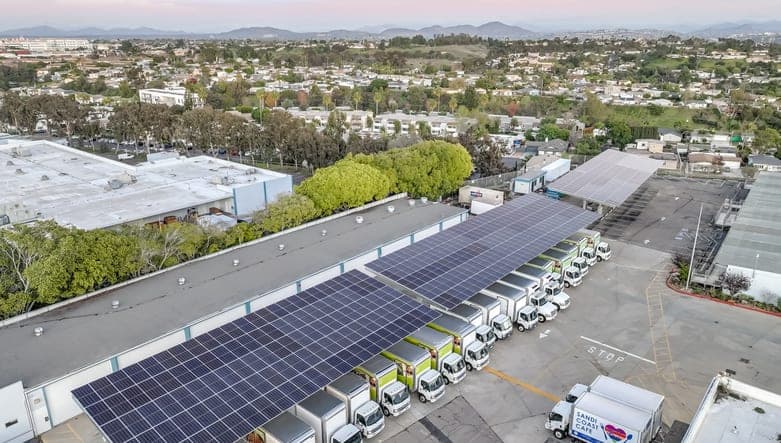
Rooftop solar installation at a San Diego elementary school
Industries We Serve

How Schools Turn Sunlight Into Savings and Science Lessons

Nine completed school installations across San Diego

Every month a school district writes a large cheque to the utility company, while teachers are asking for money for supplies and programmes. Solar is one of the few interventions that moves money from the first column into the second permanently.

It also happens to be the only building system a science class can go outside and look at. Both matter, and the funding position for schools changed significantly in the last two years.

01

Why the Funding Position Changed

For years the federal solar credit was worthless to a school district, because a district owes no federal tax and a credit only offsets tax owed. Districts either went without or used a power purchase agreement and let a third party take the incentive.

Elective pay, commonly called direct pay, changed that. Eligible tax-exempt and governmental entities can now claim the Section 48E credit and receive its value as a payment from the IRS rather than as an offset.

For a district weighing a capital project, that is roughly a third of the cost returning — and it makes district ownership competitive with a PPA for the first time.

At the full 30%

The 30% rate requires meeting federal prevailing-wage and apprenticeship rules, but facilities under 1 MW are exempt and receive it automatically. Every school array we have installed is well below that threshold. Federal tax rules changed in 2025 and 2026 and this page reflects the position as at August 2026. Nothing here is tax advice — we design and install the system and work alongside your accountant on how the credit applies to you.

02

What We Have Actually Built

Rather than describe a hypothetical district, here is our completed school work in San Diego. Nine installations, all below 1 MW:

  • San Diego Unified School District Supply Center — 487.7 kW solar carport
  • Washington Elementary School — 243.5 kW
  • John Adams Elementary School — 229.5 kW
  • Golden Hill Elementary School — 212.2 kW
  • Oak Park Elementary School — 182.5 kW
  • Normal Heights Elementary School — 152.5 kW
  • Dingeman Elementary School — 167.4 kW
  • Carson Elementary School — 144.4 kW
  • Rodriguez Elementary School — 109.6 kW

Institutional work — the approval processes, the roof types, the constraint of working around a school calendar — is the majority of what we do. Each of these has its own project page with photography.

03

The Budget Argument

Energy is one of the larger controllable line items in a school budget, and one of the least predictable. It spikes in the months when air conditioning runs hardest, which in San Diego is also when the district is planning the next year.

Solar reduces the total and, just as usefully, flattens it. A district that knows its energy cost twelve months out can commit that certainty to programme planning.

We will not put a percentage on your district without seeing your bills. Roof orientation, shading, building use patterns and whether your campuses run summer programmes all move the answer materially.

04

The Array as Teaching Material

This is the part administrators tend to under-rate and teachers tend to seize on.

A solar installation produces live, local, real data — generation against weather, seasonal variation, the relationship between irradiance and output. That is usable material in mathematics, physics, environmental science and data handling, and it is about the school itself rather than an abstraction.

Many districts put a display in a main corridor showing current generation. Students see the building working. Career and technical education programmes can go further, using the system as an introduction to electrical trades — which is a genuine pathway into a field that is hiring.

05

Resilience and Site Considerations

Battery storage paired with solar keeps designated circuits running through an outage. For a school, the list usually starts with communications, site lighting and refrigeration rather than comfort.

Carports deserve early consideration on school sites specifically. Most campuses have substantial parking and hard-standing, a carport array shades vehicles, and it avoids competing with roof-mounted plant or an ageing roof membrane.

06

How a District Project Runs

  • Twelve months of utility bills across all sites — the most useful starting document by a distance.
  • Assessment of roofs, parking areas, electrical service and usage patterns, written for a board rather than for an engineer.
  • Direct pay modelled with your business office so the funding picture is clear before any decision.
  • Board approval, with the numbers presented plainly.
  • Design, permitting and utility interconnection — the slowest phase, and worth starting well ahead of the summer window.
  • Installation scheduled around the school calendar, then commissioning and monitoring handover.

Questions from School Administrators

Yes. Elective pay, or direct pay, lets eligible tax-exempt and governmental entities receive the value of the Section 48E credit as a payment from the IRS rather than as an offset against tax owed. This is the single most important change for districts in recent years.

The 30% rate requires prevailing-wage and apprenticeship compliance above 1 MW. Below 1 MW a facility is exempt and receives the full rate automatically. Every school array we have installed is well below that threshold.

That depends on your buildings, usage pattern and rate schedule, and we will not guess. Twelve months of bills across your sites lets us model it properly instead of quoting an average.

Rooftop and carport work is largely separated from occupied space, and the disruptive moments — electrical tie-in and utility interconnection — are short and schedulable. We plan around the school calendar and, where possible, the summer window.

We assess roof condition before designing anything. If a roof is near end of life we will say so, because installing over it means paying to remove and refit the array later. On those campuses a carport array is often the better answer.

Yes, and it is one of the better reasons to do it. Live generation data supports work in maths, science and data handling, and many districts display current output publicly on site.

Direct pay has made ownership considerably more attractive for districts than it used to be, because the credit is now worth real money to you. Both are worth modelling; we will show you the comparison rather than steering you.

Start with twelve months of utility bills

That single document tells us most of what we need. We will assess the roofs, model production and set out what direct pay would be worth to your district, in writing. Call 858-281-5110.