
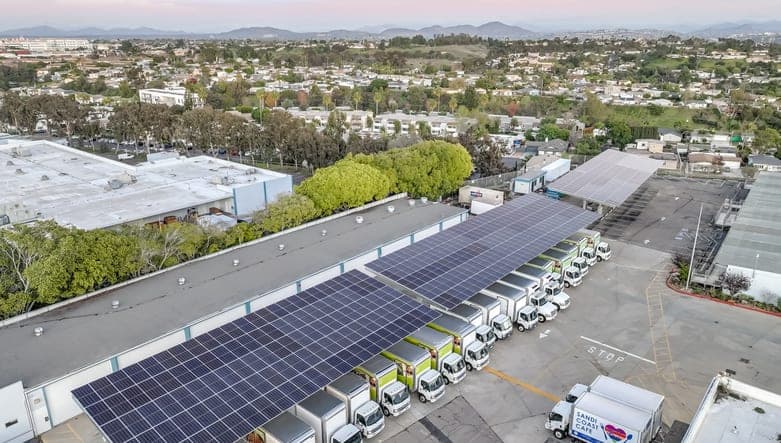
Rooftop solar installation on a community building in San Diego County
Industries We Serve

Faith-Based Solar: Where Stewardship Meets Sustainability

For congregations in San Diego County

Your congregation gathers each week to worship, learn and serve. The building it gathers in can carry some of that work too — and for most faith communities, the utility bill is one of the largest line items competing with ministry.

Solar changes that line item, and since 2023 there has been a mechanism that finally makes the federal incentive worth something to organisations that pay no federal tax. Most congregations still do not know it exists.

01

Stewardship of Two Kinds

Many faith traditions describe a duty of care over creation — tending and keeping what has been entrusted to you. A building that generates its own clean power is a straightforward expression of that.

There is a second kind of stewardship at work as well, and it is the one that usually decides the vote: careful management of money given by the congregation. Every dollar spent on electricity is a dollar not spent on ministry.

Solar sits at the point where those two obligations agree. That is unusual, and it is why this conversation tends to go differently in a church than in a commercial building.

02

Direct Pay: The Part Most Congregations Have Not Heard

A tax credit is worthless to an organisation that owes no federal tax. For decades that ruled out exactly the institutions with the best-suited roofs.

Elective pay — usually called direct pay — changed that. Eligible tax-exempt organisations can claim the Section 48E clean electricity credit and receive its value as a payment from the IRS rather than as an offset against tax owed.

For a congregation weighing a solar project, this is the whole difference. It turns an incentive you could never use into roughly a third of the project cost coming back.

And the rate is the full 30%

The credit reaches 30% when a project meets federal prevailing-wage and apprenticeship requirements — but facilities below 1 MW are exempt from those requirements and receive the full rate automatically. Essentially every congregation's rooftop in San Diego County falls below that threshold.

03

What Solar Does to a Church Budget

Utility costs for a congregation are lumpy and hard to plan around — heavy in summer, lighter in spring, and rising year on year in a way nobody controls.

Solar does two things to that. It reduces the total, and it makes what remains far more predictable. For a board planning a year ahead, the predictability is often worth as much as the saving.

We will not put a percentage on your building without seeing it. Roof orientation, shading, service capacity and how your building is actually used through the week all move the answer, and a congregation that meets twice a week has a different profile from one running a preschool five days.

04

Concerns Worth Taking Seriously

"Will it look wrong on our building?"

A fair question, particularly for older or architecturally significant buildings. Modern panels sit low and read as a dark plane rather than equipment. Placement can favour roof faces not visible from the street, and on some buildings a ground-mount or carport array is the better answer.

"Who maintains it?"

There are no moving parts. Practical attention is periodic inspection and cleaning, plus monitoring so a production drop is noticed by us rather than by you. We include monitoring on every installation.

"Can we afford the upfront cost?"

This is where direct pay matters most, and it should be modelled before the board decides anything. There are also financing structures built for nonprofits with extended terms. The honest answer is that it depends on your numbers, which is what an assessment is for.

"Is this a political statement?"

It does not have to be. Plenty of congregations approach it purely as good management of the building and the budget. Others frame it as creation care. Both are legitimate and the installation is identical.

05

A Visible Teaching Opportunity

A solar installation is one of the few building improvements a congregation can actually see working. Production data can be displayed in the foyer or shared in a newsletter.

Congregations use that in different ways — children's programmes, creation care groups, adult study, or simply as an annual note on what the building produced and what it saved. It makes an abstract commitment concrete.

It is also visible to the neighbourhood, which for some congregations matters as much as the saving.

06

How a Project Usually Proceeds

  • Gather twelve months of utility bills — the single most useful thing you can do before talking to anyone.
  • Assessment of the roof, electrical service and usage pattern, with a written summary your board can read.
  • Model the direct-pay position with your treasurer or accountant so the funding picture is clear before a decision.
  • Bring it to the congregation with real numbers rather than general enthusiasm.
  • Design, permitting and utility interconnection — the slowest part, and worth starting earlier than feels necessary.
  • Installation, commissioning and monitoring handover.

We have installed at nine schools across San Diego, including arrays from 109.6 kW up to a 487.7 kW carport at the San Diego Unified School District Supply Center. Institutional buildings — their approval processes, their roofs and their usage patterns — are the work we do most.

Questions Congregations Ask Us

No — this is the most important thing to know. Elective pay, or direct pay, lets eligible tax-exempt organisations receive the value of the Section 48E credit as a payment from the IRS rather than an offset against tax owed.

The 30% rate requires meeting federal prevailing-wage and apprenticeship rules, but facilities under 1 MW are exempt and receive the full rate automatically. Congregation rooftops are comfortably below that threshold.

That depends on your roof, your usage pattern and your rate schedule, and we will not guess at it. Bring twelve months of bills and we will model it properly rather than quoting an industry average that may not describe your building.

Roof condition is assessed before anything is designed. If your roof is near the end of its life we will say so — installing over a roof that needs replacing in three years is a false economy, and re-roofing first is usually the cheaper path.

Design and installation are the quick parts. Permitting and utility interconnection set the real timeline and vary by jurisdiction, so we build that into the schedule rather than promising a date we cannot control.

Take it slowly and lead with the building and the budget rather than the politics. In our experience projects go best where the numbers were presented plainly and the congregation had time to ask questions.

Yes, and most of our institutional work has been schools. The funding mechanism, the approval process and the roof types are closely comparable.

Start with a look at your building

We will review your recent utility bills, look at the roof and give your board a plain assessment of system size, likely production and what direct pay would be worth to you. Call 858-281-5110.