
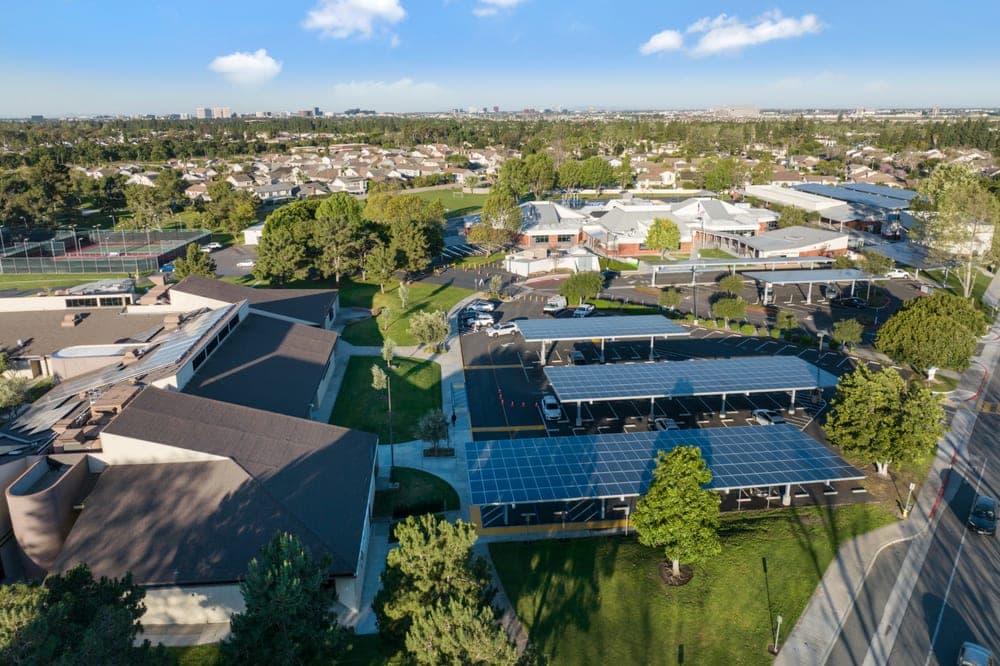
Commercial solar array on a San Diego business premises
Financial Incentives & Solar Financing

Leasing a Commercial Solar System

How the structure works, and what it costs you in return

This page is about leasing the equipment — installing solar on your building with little or no capital outlay, and paying monthly instead of owning the system.

If you are a landlord wondering how solar works on a building your tenants occupy, that is a different question — see solar on leased commercial property.

Leasing removes the barrier that stops most businesses going solar. It also costs you real money over the system’s life, and any honest explanation has to cover both.

01

What a Commercial Solar Lease Is

Under a lease, a provider installs and owns the system on your roof. You pay a fixed monthly amount to use it, and the electricity it generates offsets what you would otherwise buy from SDG&E.

A power purchase agreement works similarly but you pay per kilowatt-hour generated rather than a flat monthly fee. Both keep the capital cost off your books; they differ in how the payment is calculated.

  • Little or no upfront cost
  • A predictable monthly payment instead of a variable utility bill
  • Maintenance and monitoring handled by the system owner
  • No capital tied up, which matters if that capital has better uses
02

The Trade-Off Nobody Should Skip

Leasing is not free money. The provider funds the system, carries the risk and takes the return — and they claim the 30% federal credit, not you.

Over twenty-five years, ownership produces substantially more value than a lease. That is the whole reason leasing companies exist.

None of which makes leasing wrong. It makes it a trade: lower return in exchange for no capital outlay and no risk. Whether that trade is right depends on what else your capital could be doing and whether you have the tax appetite to use a credit at all.

The question that usually settles it

Does your business have federal tax liability large enough to absorb a 30% credit on the system cost? If yes, ownership is usually the stronger case. If no — or if capital is genuinely constrained — a lease may be the better structure even though the headline return is lower.

03

Why San Diego Businesses Consider It

SDG&E rates

Commercial electricity here is among the most expensive in the country. That is the underlying reason solar pencils at all, and it applies whichever structure you choose.

Capital preservation

For a growing business, a hundred thousand dollars of capital may be worth more deployed in the business than in a roof asset. A lease lets you take the energy saving without that trade.

Predictability

A fixed monthly payment against a rising utility rate is easier to budget than a variable bill. For organisations that plan a year ahead, that is worth something on its own.

Operating expense treatment

Lease payments are generally treated as an operating expense rather than a capital purchase. Confirm the treatment with your accountant — it depends on the lease structure.

04

A Worked Illustration

The following is illustrative arithmetic to show how the structure behaves, not a case study and not a quote. Your numbers will differ.

If a building's monthly electricity cost is materially higher than the monthly lease payment on a system sized to offset most of it, the business is cash-positive from month one — while the provider, not the business, holds the asset and the tax credit.

That is the whole mechanic. Whether it is true for your building depends on your consumption, your rate schedule and the terms on offer, which is what an assessment establishes.

05

What to Check Before Signing

  • Term length, and what happens at the end — purchase option, renewal, or removal.
  • Any annual escalator on the payment, and how it compares with realistic utility rate rises.
  • Who is responsible for maintenance, monitoring, insurance and repair.
  • What happens if you sell the building — is the lease assignable to a buyer?
  • Production guarantees, and what remedy exists if the system underperforms.
  • Roof condition, and who pays if the array has to come off for a re-roof.

The building-sale question catches people out most often. A lease that a buyer cannot or will not assume becomes a complication at exactly the wrong moment.

Solar Leasing Questions

The system owner — the leasing provider — not your business. If capturing the 30% credit matters to your case, ownership is the structure that does it.

Cheaper to start, more expensive over the system's life. You avoid the capital outlay and the risk; in exchange the provider takes the credit and a return. Both can be the right answer depending on your position.

A lease is a fixed monthly payment for the use of the system. A PPA charges you per kilowatt-hour actually generated. A PPA shifts production risk to the provider; a lease gives you a flatter, more predictable number.

This is the most important clause to check before signing. Most agreements allow assignment to a buyer, but the terms vary and a buyer is not obliged to accept. Read it before you need it.

Yes, though it may not be the best route. Direct pay now lets tax-exempt organisations receive the value of the federal credit even with no tax liability, which often makes ownership stronger than it used to be for them. Worth modelling both.

Generally treated as an operating expense, but the treatment depends on the structure of the agreement. Confirm with your accountant rather than assuming.

Partly, but the bigger question for you is who pays the electricity and who therefore benefits. See our page on solar for leased commercial property, which deals with that split directly.

See both structures modelled against your building

We will show you ownership and a lease side by side using your own utility bills, including what the tax credit is worth under each. Call 858-281-5110.