
A solar panel warranty is really two separate promises: a product warranty covering defects in materials and workmanship, and a performance warranty guaranteeing the panels will still produce a set percentage of their rated power years down the road. Product coverage typically runs 10 to 25 years, while performance guarantees commonly stretch to 25 years. The single most important action you can take right now is registering your equipment, saving every serial number, and confirming your installer’s workmanship coverage in writing.
TL;DR:
- Register your solar system immediately after installation, keep all serial numbers, and confirm your installer’s workmanship coverage in writing to ensure warranty validity.
- Manufacturer product warranties typically cover defects for 10 to 25 years, while performance guarantees usually extend up to 25 years and depend on the panel’s degradation rate.
- Component warranties for microinverters, inverters, and batteries are separate and often have different coverage timelines, requiring independent verification.
- The warranty start date varies, often based on manufacturing or interconnection dates, and failing to register can reduce your actual coverage period.
- A strong installer manages warranty paperwork, registration, and transfer terms to prevent coverage gaps and costly out-of-pocket repair bills later.
Table of Contents
- Solar Panel Warranty Basics You Need to Know
- What Is a Solar Panel Warranty, Exactly?
- What Your Warranty Covers, and Where It Stops
- How Warranty Start Dates and Transfers Actually Work
- Solar Panel Warranty Checklist Before You Sign
- How to File a Solar Warranty Claim
- Is Extended Solar Warranty Coverage Worth It?
- What Reliable Installers Do Differently for Warranty Protection
- Why Warranty Literacy Matters More Than the Panel Brand
- Protect Your Investment With an Installer Who Manages the Paperwork
- Where to Verify Solar Panel Warranty Terms
- Sources
- FAQ
Solar Panel Warranty Basics You Need to Know
Before you sign anything or file a claim, a few facts determine whether your coverage actually protects you when something goes wrong.
- Product warranties cover manufacturing defects and physical failures, usually for 10 to 25 years depending on the brand.
- Performance warranties guarantee a minimum output percentage, most commonly 25 years, with gradual expected degradation built into the terms.
- Labor and shipping are rarely included in manufacturer paperwork. That falls to your installer’s separate workmanship warranty.
- Registration and start dates matter. An unregistered system can have its coverage clock start from the manufacture date rather than your install date.
- Extended plans and maintenance contracts exist for a reason: they fill gaps manufacturers deliberately leave open, especially around labor and monitoring.
Keep these five points in mind while reading quotes from different installers. They’re the difference between a warranty that’s a marketing bullet point and one that pays out when you need it.
What Is a Solar Panel Warranty, Exactly?
A solar panel warranty is not one document. It’s two, sometimes three, and each covers something different.
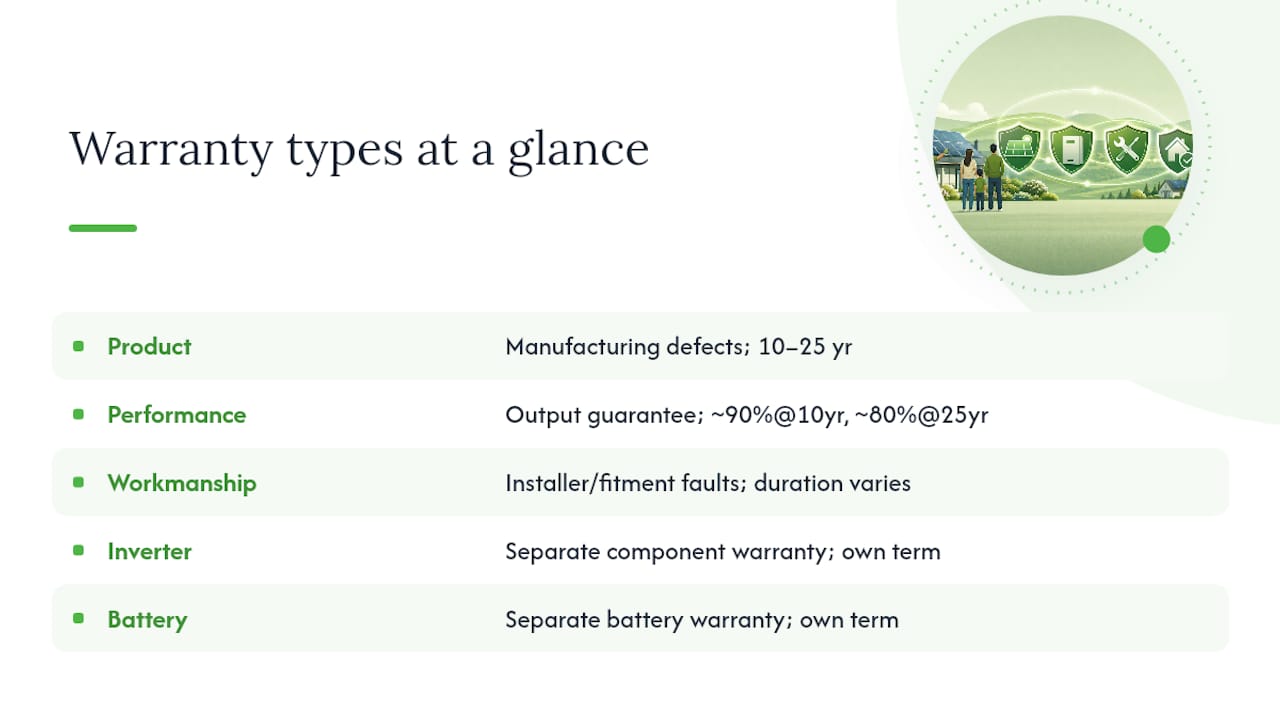
The product warranty (sometimes called a materials or equipment warranty) protects against manufacturing flaws: delamination, frame corrosion, junction box failures, glass cracking from factory defects. If your panel physically fails because of how it was built, this is the warranty that applies. Terms vary widely by manufacturer, with product warranties commonly running 10 to 25 years, and the remedy is usually repair, replacement, or prorated compensation, not a full refund.
The performance warranty (also called a power warranty) works differently. It guarantees your panels will still generate a minimum percentage of their original rated output after a set number of years. A typical structure guarantees something like 90% output at year 10 and around 80% output at year 25, reflecting an annual degradation rate that industry data pegs at roughly 0.25% to 0.8% depending on cell technology. Premium panels with lower degradation rates hold value longer, which matters more than most buyers realize when comparing quotes that look similar on price.
Here’s where marketing language gets slippery. When a brochure says “25-year warranty,” ask which warranty they mean. A 25-year product warranty is a strong promise about physical durability. A 25-year performance warranty is a promise about output, not about whether the panel itself will still be intact. Some manufacturers now offer 25-year coverage on both fronts, but plenty still split the difference, offering a 12 or 15-year product warranty stapled to a 25-year performance guarantee. Read the fine print for both durations separately, because a salesperson quoting “25 years” without specifying which type is giving you half the story.
Component warranties add another layer. Enphase and other manufacturers publish separate warranty terms for microinverters and inverters, which often run on entirely different timelines than the panels themselves. Battery storage components carry their own separate terms too, so check each piece of your system independently rather than assuming one warranty covers everything installed on your roof.
What Your Warranty Covers, and Where It Stops
Solar panel coverage options look generous on paper until you hit the exclusions list, and that list is where most disputes start.
Typical inclusions are straightforward: manufacturing defects, premature power degradation beyond the guaranteed curve, and certain component failures under normal operating conditions. What gets excluded is longer and more consequential.
- Labor costs for removal, diagnosis, and reinstallation are almost never covered by the manufacturer. EnergySage’s research on warranty terms confirms this is one of the most commonly misunderstood gaps in coverage.
- Shipping fees to send a defective panel back for testing often fall on the homeowner unless your installer’s contract states otherwise.
- Weather damage from hail, wind-driven debris, or falling branches is typically treated as an insurance matter, not a warranty claim.
- Improper installation voids manufacturer coverage entirely in most cases, which is exactly why installer quality matters as much as panel brand.
- Unauthorized modifications, including adding trackers or repositioning panels after install, can void remaining coverage.
- Coastal and high salt-air environments sometimes carry separate exclusion clauses or reduced terms, since corrosion accelerates faster near the ocean.
Pro Tip: Ask your installer directly whether their workmanship warranty covers labor for manufacturer-approved repairs. If the answer is vague, get it in writing before you sign, because a verbal promise won’t help you three years from now when a junction box fails.
This is the layer most homeowners underestimate. A manufacturer’s 25-year performance warranty is worthless in practice if you’re facing a $400 labor bill every time a truck needs to roll out to your roof. That cost sits with your installer’s workmanship warranty, which is a completely separate document from anything the panel manufacturer publishes.
How Warranty Start Dates and Transfers Actually Work
The clock on your warranty doesn’t always start when you’d expect, and getting this wrong can quietly shave years off your coverage.
- Delivery or manufacture-date triggers. Some manufacturers start the warranty clock from the date the panel left the factory, identified by its manufacture code, rather than your installation date. If your panels sat in a warehouse for six months before your install, you may have already burned through part of your coverage window.
- Commissioning and interconnection dates. Other manufacturers tie the start date to when your system passed utility interconnection and began producing power, which is more favorable to homeowners since it reflects actual system age.
- Registration requirements. Many warranty documents, including Tesla’s published solar warranty terms, limit coverage to the original purchaser unless the equipment is properly registered and transfer conditions are met. Skipping registration can mean forfeiting protection you paid for.
- Transfer fees and paperwork. When you sell your home, most manufacturer warranties require notification, sometimes a transfer fee, and updated ownership records. Buyers should request proof of registration and remaining warranty terms during escrow, and sellers should have serial numbers and original paperwork ready to hand over.
The practical lesson here is simple: register your system the week it’s commissioned, not months later. A warranty for solar energy systems that starts counting down before you even know about it is coverage you’re losing without realizing it.
Solar Panel Warranty Checklist Before You Sign
The strongest photovoltaic warranty terms in the world don’t help you if your contract with the installer doesn’t back them up. Before signing anything, run through these questions.
- Does the installer provide a written workmanship warranty, and for how many years?
- Who handles labor and shipping costs if a panel needs replacement, the manufacturer or the installer?
- Will the installer register your equipment with the manufacturer, and when?
- What happens to your workmanship warranty if the installer goes out of business? Some installers back this with third-party bonds; others don’t, which matters more than most buyers ask about upfront.
- Are serial numbers and commissioning records handed over to you directly, not just filed internally?
- What are the exact transfer terms if you sell the home within the warranty period?
Two elements affect your long-term return more than any other line item: the annual degradation rate baked into your performance warranty, and whether labor is covered under a separate workmanship agreement.
Pro Tip: Insist on a contract clause that explicitly states the workmanship warranty term in years, not just “industry standard” language. Vague wording is the first thing that falls apart in a dispute.
Get the installer to hand over your serial numbers and registration confirmation at project completion, not “on request.” If it’s not in writing, treat it as a promise that may not survive a change in staff or ownership down the line.
How to File a Solar Warranty Claim
Filing a claim is more procedural than most homeowners expect, and having the right documentation ready from day one saves weeks of back and forth.
- Contact your installer first. Most reputable installers coordinate the manufacturer claim on your behalf, since they understand the required documentation format and often have a direct account relationship with the manufacturer.
- Expect a review period. The manufacturer evaluates your claim against the warranty terms, comparing your monitored output data to the guaranteed degradation curve.
- Resolution comes in one of three forms: repair, full replacement, or a prorated refund based on how much of the warranty term has elapsed.
The evidence bar is real. If you can’t produce a serial number or show consistent monitoring history, your claim slows down or gets denied outright. This is exactly why saving your paperwork the day your system goes live matters more than it seems at the time. A missing document three years later can turn a straightforward defect claim into a drawn-out dispute.
Is Extended Solar Warranty Coverage Worth It?
Extended protection plans and operations and maintenance (O&M) contracts exist to fill the gap between what manufacturers guarantee and what actually keeps your system running smoothly.
- What they typically add: labor coverage for repairs, routine monitoring, cleaning, and sometimes coverage for theft or vandalism that standard warranties never touch.
- What they don’t replace: the underlying manufacturer product and performance warranties, which remain the manufacturer’s responsibility regardless of any add-on plan you purchase.
- When they make sense: older inverter systems approaching the end of their standard term, remote properties where a service call is expensive, or homeowners who simply want to avoid tracking warranty paperwork themselves.
- What to verify first: the provider’s financial stability and whether the plan itself is transferable if you sell your home, since a plan tied to a company that folds is worth exactly nothing.
Cost matters here too. If your installer’s standard workmanship warranty is comprehensive, an extended plan may just duplicate coverage you already have. Ask what specifically an extended plan adds before assuming it’s a smart purchase.
What Reliable Installers Do Differently for Warranty Protection
A warranty document is only as strong as the installer standing behind it. Goindigoenergy handles the details that keep manufacturer coverage usable years after installation, not just on the day the contract is signed.
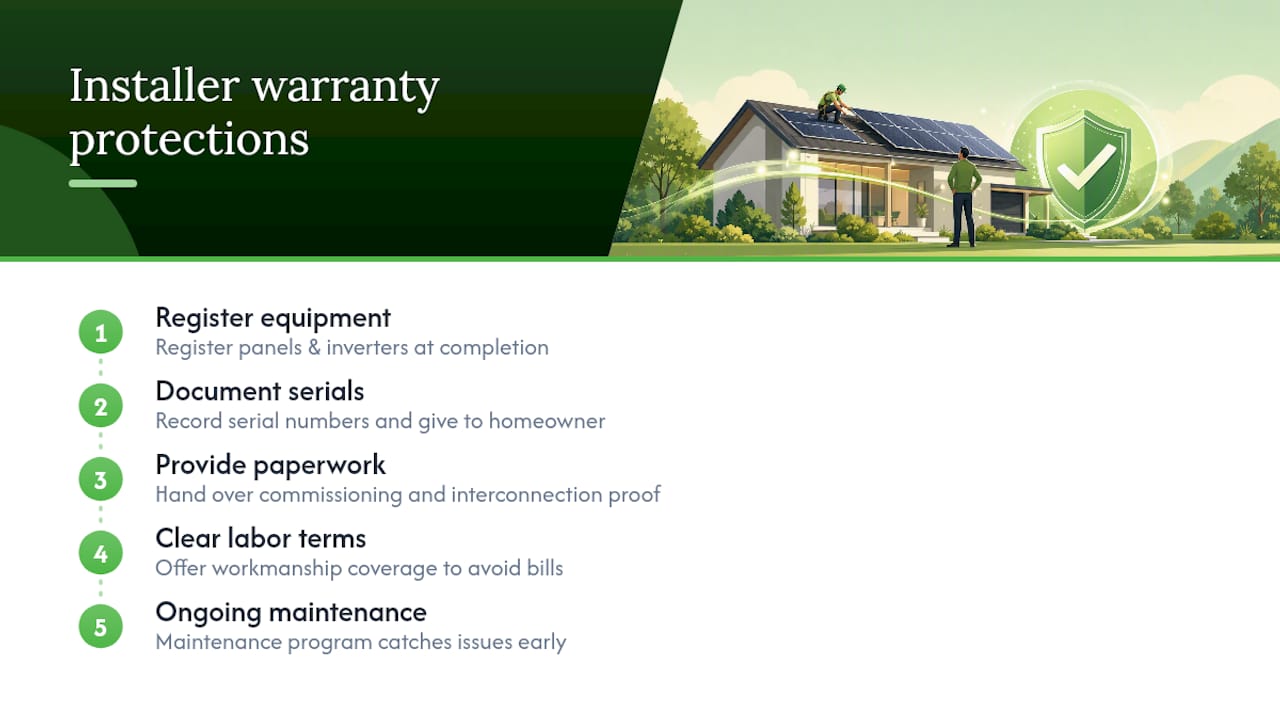
That starts with registering every panel and inverter with the manufacturer at project completion, so the coverage clock starts from commissioning rather than an unregistered manufacture date. Every serial number gets documented and handed to the homeowner directly, along with commissioning records and interconnection proof, the exact paperwork manufacturers request during a claim.
Workmanship coverage matters just as much as the manufacturer’s paperwork. A residential solar installation backed by clear labor terms means a defective component doesn’t turn into an out-of-pocket repair bill. Ongoing maintenance programs extend that protection further, catching performance issues early enough that a small problem doesn’t become a warranty dispute two years later.
Why Warranty Literacy Matters More Than the Panel Brand
Most homeowners spend weeks comparing panel efficiency ratings and almost no time reading warranty documents, which is backwards.
Your three actions matter more than brand comparisons: register your equipment immediately, get workmanship coverage in writing, and keep every serial number and commissioning record somewhere you can find it in a decade. Warranties genuinely do protect your investment, but only when someone manages the paperwork behind them. If your records are incomplete, contact your installer and ask them to reconstruct what’s missing before you need it.
— David
Protect Your Investment With an Installer Who Manages the Paperwork
Some installers handle warranty groundwork carefully, registering equipment, documenting serial numbers, and providing workmanship terms in writing before system activation.
That distinction shows up years later, when a manufacturer asks for commissioning records you’d otherwise have to hunt down yourself. Homeowners working with Goindigoenergy get their residential solar installation backed by direct paperwork handover and ongoing maintenance support designed to keep your system’s warranty usable, not just theoretical. If you’re planning a new install or want a second set of eyes on an existing system’s documentation, consider reaching out to a professional for a straightforward assessment of what your current coverage actually protects.
Where to Verify Solar Panel Warranty Terms
A few primary sources are worth bookmarking if you want to double check terms before or after installation.
- EnergySage’s solar warranty guide breaks down product versus performance coverage across manufacturers in plain language.
- Enphase’s homeowner warranty overview explains component-specific coverage expectations for inverters and microinverters.
- Representative manufacturer documents, like Tesla’s published solar warranty and Jinko’s limited warranty terms-V3.pdf), show real examples of start-date rules, claim evidence requirements, and remedy language.
Sources
- Solar Panel Warranties: What To Know - EnergySage
- Tesla solar warranty document (representative example)
- Understanding home solar system warranty coverage | Enphase
FAQ
What Voids a Solar Panel Warranty?
Improper installation, unauthorized modifications, and using unapproved third-party components most commonly void coverage. Skipping registration or failing to maintain documentation can also limit your ability to make a successful claim later.
How Many Years Do Solar Panels Usually Last?
Most solar panels continue producing usable power for 25 years or more, even after their performance warranty period ends, though output gradually declines according to the panel’s annual degradation rate.
What Happens After 20 Years of Solar Panels?
Many systems continue producing well beyond their warranty term, just at reduced capacity.
Do Solar Panels Come With a Guarantee?
Yes, solar panels typically come with two guarantees: a product warranty covering defects and a performance warranty guaranteeing minimum output over time. Installer workmanship warranties are a separate, equally important layer that manufacturer paperwork doesn’t include.
How Long Do Solar Inverters Typically Last?
Inverter life expectancy varies by type: string inverters commonly last 10 to 15 years, while microinverters often carry 25-year warranties matching the panels themselves. Inverter replacement cost is one of the most overlooked long-term expenses in a solar system’s lifetime, so checking this warranty separately from your panel warranty matters.