


If you plan to stay in your home for more than seven years, pay meaningful federal income tax, and can qualify for financing, buying almost always wins over the next 25 years. If you’re short on cash, credit-challenged, or expect to move within five to seven years, a lease or power purchase agreement (PPA) may make more sense now that the residential tax credit has ended. The rules changed in 2026, and the math below shows exactly why.
TL;DR:
- The removal of the 30% residential tax credit after 2025 means cash and loan buyers now face higher effective costs, narrowing but not eliminating ownership’s long-term savings advantage.
- Lease and PPA contracts often include escalator clauses of around 2% to 3% annually, which can significantly increase costs over 25 years and impact overall value.
- Ownership typically recoups the initial investment in six to nine years, while lease and PPA models never build equity, making buying more cost-effective for long-term homeowners.
- The 48E business credit that lease and PPA providers rely on may no longer be available for systems starting construction after July 4, 2026, potentially increasing lease prices.
- Selling a home with owned solar panels usually involves fewer complications, as the system transfers with the property, unlike leased or PPA systems that often require lease assumption or buyout.
Table of Contents
- Solar Lease vs. Buy: What Separates Cash, Loans, Leases, and PPAs
- What Does Solar Actually Cost Over 25 Years? A Worked Example
- How Ownership Affects Resale, Batteries, and Buyouts
- Your Pre-Contract Checklist: Questions Every Provider Should Answer
- Does Solar Lease vs. Buy Affect Your Home Insurance?
- Why the “Which Is Better” Question Is the Wrong One
- Get a Site-Specific ROI Model Before You Decide
- Where to Verify These Numbers Yourself
- Sources
- FAQ
Solar Lease vs. Buy: What Separates Cash, Loans, Leases, and PPAs
Four financing paths lead to a rooftop system, and each one changes who owns the equipment, who claims the tax credit, and who’s on the hook when something breaks.
Cash purchase means you pay for the system outright and own it from day one. A solar loan lets you buy the system with financing, usually through a solar lender or home equity product, while you still hold title to the equipment. A lease means a third party owns the panels and charges you a fixed (or escalating) monthly rent for the electricity they produce. A PPA is similar, but instead of a flat rent, you pay per kilowatt-hour generated, at a rate typically below your utility’s price.
Ownership status determines who claims the federal incentive, and this is where 2026 changed everything. The 30% residential credit under Section 25D expired December 31, 2025, so homeowners who buy in cash or with a loan no longer get a direct federal credit. Third-party owners, meaning lease and PPA providers, can still claim the business credit under Section 48E, and many pass a portion of that value through to customers as a lower monthly rate.
Monthly payment shapes differ sharply across the four models:
- Cash purchase: no monthly payment, but a large upfront outlay.
- Solar loan: fixed monthly payment, typically 10 to 25 years, similar to a car loan.
- Lease: fixed monthly rent that often rises 1% to 3% annually under an escalator clause.
- PPA: variable monthly cost tied to actual production and a per-kWh rate that usually escalates too.
Maintenance and warranty responsibility also splits by model. Owners (cash or loan) are typically responsible for their own maintenance, though most equipment carries 10 to 25 year manufacturer warranties. Lease and PPA providers, on the other hand, usually retain responsibility for maintenance and insurance on the equipment they own, which is one of the few real advantages of not owning the system outright.
What Does Solar Actually Cost Over 25 Years? A Worked Example
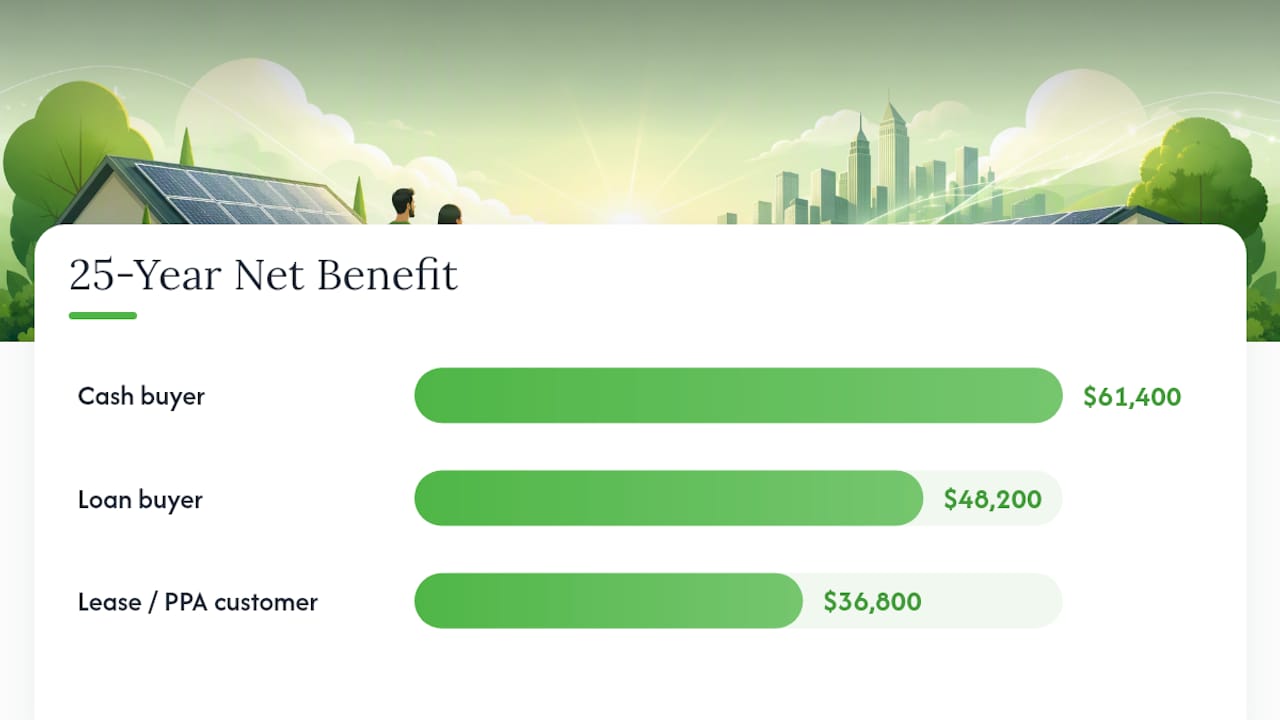
Numbers make this decision concrete faster than any explanation can. One widely cited example for an 8 kW residential system, illustrative rather than a quote for your home, shows a 25-year net benefit of roughly $61,400 for a cash buyer, about $48,200 for a loan buyer, and around $36,800 for a lease customer, according to SolarPriceList’s 2026 comparison. Other modeling puts the ownership advantage over leasing at roughly $24,600 over 25 years on a similarly sized system, with the exact gap depending heavily on local electricity rates, financing terms, and the specific escalator built into the lease.
Three things drive that gap:
- The lost 25D credit. Cash and loan buyers used to shave 30% off their upfront cost immediately. That credit is gone for systems installed after 2025, which raises the effective cost of buying and narrows, but doesn’t erase, the long-term ownership advantage.
- Escalator clauses. Lease and PPA contracts commonly build in annual increases of 1% to 3%, often clustering around 2% to 2.9% in real offers. A 2.9% escalator on a $150 monthly lease payment adds up to real money by year 20, and it’s the single contract term most likely to surprise homeowners who only look at the first year’s bill.
- Payback timeline. Cash buyers typically recoup their investment in six to nine years, after which every kilowatt-hour is nearly free. Loan buyers reach payback a bit later since financing costs eat into early savings. Lease and PPA customers never really “pay back” anything, since they never build equity in the system.
Here’s the wrinkle almost nobody explains clearly: the 48E credit that lease and PPA providers rely on isn’t a permanent feature of new contracts. It only applies to systems that began construction before July 4, 2026. Any lease or PPA signed after that construction-start deadline may not include a tax-credit passthrough at all, which could push lease pricing higher than what current online calculators and marketing materials still advertise. If you’re comparing a lease quote issued after that date, ask directly whether the pricing assumes 48E, and get it in writing.
Statistic to remember: the gap between owning and leasing narrowed considerably after 25D expired, but it didn’t close. EnergySage’s independent guidance still finds ownership delivers higher lifetime savings for most homeowners, just by a smaller margin than it did in 2024 or 2025.
How Ownership Affects Resale, Batteries, and Buyouts
Selling a home with solar panels attached raises questions buyers and agents don’t always know how to answer, and the answer depends entirely on whether you own the system or lease it.
- Owned systems generally add to a home’s appraised value and sell without complication, since the panels transfer with the deed like any other fixture.
- Leased systems require the buyer to either assume the lease and qualify with the lessor, or require the seller to buy out the remaining contract, which can run $10,000 to $25,000 depending on the term remaining.
- PPA contracts carry similar transfer requirements, and some buyers walk away from a purchase entirely rather than deal with a lease assumption process mid escrow.
Battery storage adds another wrinkle. Homeowners who own their solar system can typically add a battery later and, in many cases, claim credits on the battery itself. Third-party owned systems complicate this, since the lessor or PPA provider, not you, usually controls whether a battery can be added and who claims any associated incentive.
Pro Tip: Before signing anything, ask the provider for the exact buyout formula in writing, not just a verbal estimate. Buyout costs typically decline over the contract term, but the formula (straight depreciation vs. remaining payment total) changes the number substantially, and vague language here is the single biggest red flag in a lease contract.
Your Pre-Contract Checklist: Questions Every Provider Should Answer
Before signing anything, put these questions in front of every provider you’re comparing:
- What’s the exact annual escalator percentage, and is it compounding?
- What’s the buyout formula at any point in the contract, and does it decline over time?
- Does this contract include a passthrough of the 48E credit, and when did construction begin?
- Who carries insurance and handles maintenance if a panel fails or the inverter needs replacement?
- What happens to this contract if I sell my home before the term ends?
Match your own profile to the likely right answer. Short stayers, planning to sell within five years, usually do better leasing, since they avoid the resale complications tied to an unpaid loan balance. Low tax liability households, who wouldn’t benefit much from an ownership credit anyway, often find leases more attractive too. High bill, long stay homeowners almost always come out ahead buying, since they capture 15 to 20 years of nearly free electricity after payback. Credit challenged buyers, unable to qualify for a favorable loan rate, sometimes find leasing is the only realistic path to solar at all.
The single most predictive factor in whether a lease or PPA turns out to be a good deal isn’t the monthly rate you’re quoted today. It’s the escalator clause buried in the contract’s fine print, which compounds quietly for two decades while the headline number stays flat in your memory.
Does Solar Lease vs. Buy Affect Your Home Insurance?
Yes, and the difference is bigger than most homeowners expect. Owned solar systems typically need to be added to your homeowner’s policy as a covered structure or scheduled item, since your insurer treats the panels as part of your property that you’re financially responsible for repairing or replacing after a covered loss like hail or fire.
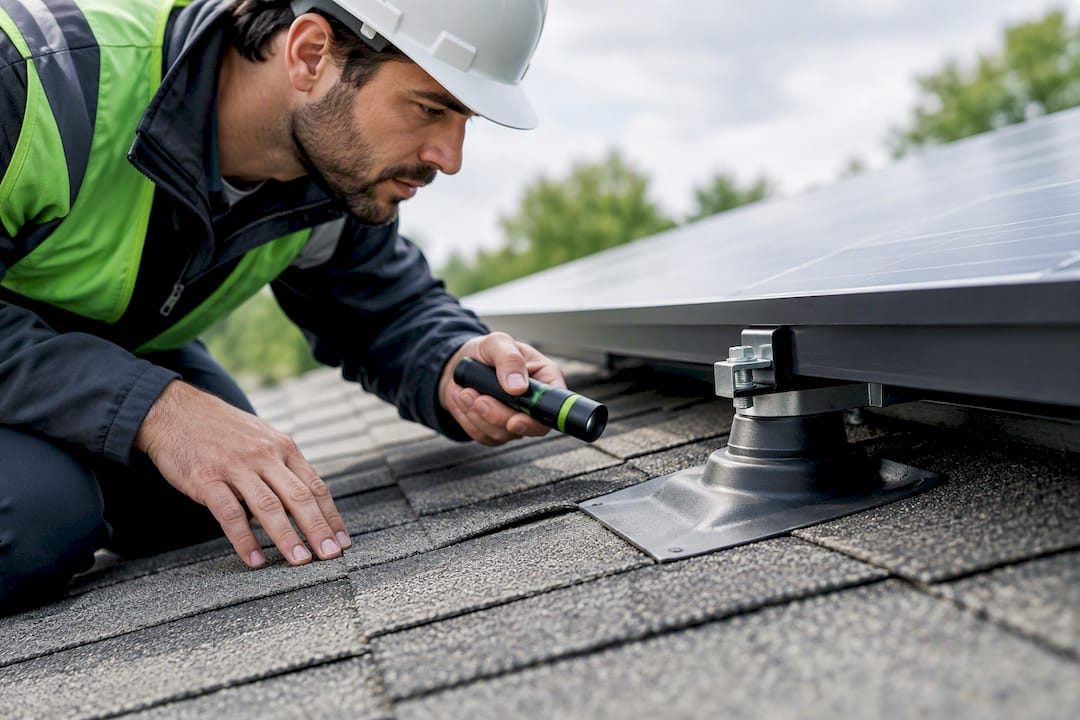
Leased and PPA systems work differently, because the equipment technically belongs to the third-party provider, not you. In most lease and PPA contracts, the provider carries its own insurance on the hardware, but your homeowner’s policy still needs to reflect that panels are attached to your roof, since roof penetration and structural changes can affect your coverage regardless of who owns the equipment sitting on top.
Either way, don’t assume your existing policy automatically covers a new installation. Call your insurer before the system goes live, tell them whether you own or lease, and ask specifically whether the panels are covered as “scheduled property” or require a policy endorsement. Homeowners who skip this step sometimes discover, only after a claim, that their insurer never knew the system existed and denied coverage on a technicality. If you’re financing through a loan, your lender may also require proof of adequate coverage on the equipment as a condition of the loan itself, so it’s worth confirming before your installation date, not after.
Why the “Which Is Better” Question Is the Wrong One
Most coverage of this topic treats leasing versus buying as a universal contest with one winner, and that framing has gotten worse, not better, since the 25D credit expired. The real story is that 2026 created two genuinely different “correct” answers depending on who’s asking, and pretending otherwise does readers a disservice.
The conventional advice, buy if you can afford it, still holds directionally, but it understates how much the escalator clause matters relative to the sticker price. Homeowners fixate on the first year’s lease payment and barely glance at the compounding rate, yet that number does more to determine whether a lease was a good decision than almost anything else in the contract.
What I’d prioritize differently: run the 25 year math before you run the monthly payment comparison, and get the 48E construction start date in writing before assuming any lease quote includes a passthrough discount. Skipping that step is how homeowners end up comparing a 2025 lease quote’s assumptions against a 2026 reality that no longer applies.
— Curtis Williamson
Get a Site-Specific ROI Model Before You Decide
Every scenario above uses illustrative numbers. Your roof, your utility rate, and your household’s actual usage will move those figures in either direction, making a customized ROI model important before recommending a financing path.
Whether you’re leaning toward a cash purchase, a solar loan, or want a second opinion on a lease offer someone else quoted you, Indigo Energy’s residential solar services start with a site assessment and a transparent breakdown of costs and projected savings. Before you sign anything with any provider, bring us your paperwork: we’ll help you compare the escalator percentage, check the buyout formula, and confirm the warranty documentation actually matches what was promised verbally. Request a customized ROI model and find out which path actually pencils out for your home.
Where to Verify These Numbers Yourself
- DOE’s Office of Energy Efficiency and Renewable Energy for federal program background.
- Independent calculators from EnergySage, Solar.com, SurgePV, and RenewEstimator for running your own scenario math.
- Current IRS guidance for the latest on 48E status and construction-start deadlines, since rules can shift.
Sources
- Solar Lease vs Buy 2026: ROI Calculator + Decision Tree | SurgePV
- Solar
- Solar Lease vs Purchase 2026: Full Financial Comparison Guide | SolarPriceList
- Solar Lease vs Purchase Calculator (2026): Cash vs Loan vs Lease/PPA Comparison | EnergyTools
- The Real Cost of Leasing vs. Buying Solar Panels | Consumer Reports
FAQ
What Is the Downside of a Solar Lease?
The biggest downside is that you never build equity in the system, and the escalator clause common in most contracts, typically 1% to 3% annually, raises your payment every year regardless of how much you actually save. Leased systems can also complicate selling your home, since buyers often must qualify to assume the lease or the seller typically must buy out the remaining contract at closing.
What Is the “33% Rule” for Solar Panels?
There’s no single, universally recognized “33% rule” in solar financing or system sizing, and definitions vary depending on who’s using the term. If you’ve seen it referenced regarding panel degradation, financing thresholds, or system oversizing, check the specific source’s context rather than assuming a standard industry meaning.
Is a 25 Year Solar Lease Worth It?
It depends heavily on how long you plan to stay in your home and your tax situation. A 25 year lease can make sense for short stayers or households with low tax liability, but ownership typically delivers higher lifetime savings for homeowners who plan to stay long enough to reach payback, generally six to nine years for cash purchases.
Is It Harder to Sell a House With Leased Solar Panels?
Yes, in most cases. Selling with a lease attached requires the buyer to assume the contract and qualify with the lessor, or the seller must buy out the remaining term, which can cost $10,000 to $25,000 depending on how much time is left. Owned systems, by contrast, typically transfer with the home like any other fixture and don’t require buyer qualification.
Does Indigo Energy Offer Financing for Buying Solar?
Indigo Energy helps homeowners explore financing options as part of its residential solar consultation, alongside site assessment, permitting, and ROI analysis. Current pricing and financing details are available directly through Indigo Energy’s services page, since costs vary by system size and site conditions.