
Yes, but with one major caveat: ownership. Homeowner-owned solar systems consistently add resale value, typically in the range of 4% to 7%, or roughly $15,000 to $30,000 depending on your market. Leased or PPA-financed systems, however, often add little value and can complicate a sale. System size, age, warranty coverage, and local electricity rates all shift where you land in that range.
TL;DR:
- Homeowner-owned solar systems can add between 4% and 7% to resale value, roughly $15,000 to $30,000 depending on location and system specifics.
- Leased or PPA systems generally do not increase home value and can make the sale process more complicated due to transfer requirements.
- Proven premium values, such as $2.66 per watt or about $14,500 for a 5.5 kW system, are supported by multiple studies and depend on ownership documentation.
- Having clear proof of ownership, production history, and warranty details is essential to maximize solar’s impact on property appraisal and sale price.
- Installing solar primarily for resale benefits only if you plan to stay long enough to realize energy savings and have reliable documentation to support its value.
Table of Contents
- Solar Home Value: What Homeowners Need to Know
- The Research Behind Solar Home Value
- Why Ownership Changes Everything at Closing
- What Actually Moves the Value Needle
- A Seller’s Checklist for Capturing Full Solar Value
- How Appraisals and Property Taxes Treat Solar
- Indigo Energy’s Approach to Resale-Ready Solar
- Should You Install Solar for the Resale Bump Alone?
- Get a Resale-Focused Solar Estimate From Indigo Energy
- Sources
- FAQ
Solar Home Value: What Homeowners Need to Know
Solar adds resale value when you own the system outright, and the effect is well documented across multiple independent studies. If you’re leasing your panels or paying through a power purchase agreement (PPA), the picture changes considerably, since buyers often see those arrangements as a liability rather than a perk.
- Owned systems: expect a premium in the 4% to 7% range, translating to $15,000 to $30,000 on a median-priced home.
- Leased or PPA systems: minimal to no resale bump, and sometimes a negotiation headache if the buyer has to qualify for the lease transfer.
- A 5.5 kW owned system carries an estimated contributory value near $14,500 based on LBNL’s multi-state analysis.
Pro Tip: If your system is financed with a loan rather than leased, you still own the equipment. That distinction, not the financing method itself, is what determines whether solar counts as an asset at closing.
Two things matter more than almost anything else here: who owns the panels, and whether you can prove it with paperwork. A home with unclear solar ownership status tends to stall in escrow while everyone figures out the contract terms. And resale value alone won’t always cover your installation cost. It gets you partway there, with the rest recovered through years of lower electric bills.
The Research Behind Solar Home Value
The strongest evidence comes from a multi-state analysis by Lawrence Berkeley National Laboratory, which compared thousands of home sales across eight states between 2002 and 2013. The study found buyers consistently paid more for homes with owned solar, at a rate of roughly $2.66 per watt, which works out to about $14,500 for an average 5.5 kW system. Critically, the premium tracked closely with the system’s net cost after incentives, not its sticker price.
Fannie Mae’s analysis of solar home premiums reinforces the ownership angle, finding that value gains are tied almost entirely to homeowner ownership rather than the mere presence of panels on a roof. A house with a leased system and a house with an owned system can look identical from the curb but sell for very different prices.
More recent data adds a sharper, current-market lens. SolarReviews’ 2025 study found homes with solar sold for about 6.9% more on average, translating to $20,000 to $30,000 in many markets. EnergySage cites a similar 5% to 10% range and stresses that financing structure shapes how buyers and appraisers perceive the system’s worth.
| Source | Headline Finding |
|---|---|
| LBNL | ~$2.66/watt premium; ~$14,500 for 5.5 kW system |
| Fannie Mae | Premiums tied to ownership status |
| SolarReviews (2025) | ~6.9% average sale premium |
| EnergySage | 5% to 10% value increase in sampled markets |
None of these numbers are universal. Geography, sample years, and local replacement costs all move the needle, and as installation costs fall, the gap between what you paid and what a system is “worth” to a buyer keeps shifting too.
Why Ownership Changes Everything at Closing
An appraiser can credit a homeowner-owned solar system with clear contributory value because it’s treated like any other fixed home improvement, similar to a renovated kitchen or a new roof. A leased or PPA system is a different animal entirely. It’s a contract, not an asset, and buyers have to qualify to take it over, prepay it, or ask the seller to remove it before closing.
Here’s how the mechanics typically play out:
- Owned systems appraise cleanly using comparable sales or contributory-value methods, and lenders count the home’s full value including the panels.
- Leased systems require the buyer to either assume the lease (subject to the leasing company’s approval) or the seller to pay it off, per guidance from SolarUnitedNeighbors.
- Financed-but-owned systems need a payoff quote early, since lenders generally want the solar loan settled or subordinated before they’ll credit the system’s value in the appraisal.
Pro Tip: Get your solar loan payoff quote the same week you list the house. Buyers move fast when they like a property, and a stalled payoff request is one of the most common reasons solar deals fall apart in escrow.
What Actually Moves the Value Needle
Not every solar installation adds the same amount at resale; understanding the details of residential rooftop solar panels can help maximize system value. A few measurable factors decide where your home lands within that 4% to 7% range.
- System size and output. Larger systems generally add more dollar value, but only up to the point where output starts exceeding typical household usage in your area.
- Age and remaining warranty. A five-year-old system with 20 years of warranty left reads very differently to a buyer than one nearing the end of its manufacturer coverage.
- Local electricity rates. Buyers in high-cost utility markets place a bigger premium on solar than buyers where electricity is already cheap.
- Local market appetite. Solar is a differentiator in some neighborhoods and simply expected in others, which changes how much it stands out to a buyer.
- Production history. Twelve to twenty-four months of documented output and utility savings give buyers real numbers instead of a sales pitch.
Recent industry analysis suggests presenting strong production and warranty data can shift buyer attention away from a system’s age and toward its ongoing savings, according to SolarReviews.
A Seller’s Checklist for Capturing Full Solar Value
Getting full credit for your system at sale time comes down to preparation, not luck. Buyers and appraisers respond to documentation, and sellers who show up with a thin folder tend to leave money on the table.
- Gather ownership proof. Original invoices, equipment specs, permits, and interconnection agreements all belong in one file.
- Pull your production data. Twelve to twenty-four months of monitoring reports paired with utility bills make your energy savings claim concrete instead of theoretical.
- Ask your agent about appraiser experience. Not every appraiser knows how to value solar correctly, so request one familiar with PV-specific methods or the PV Value® approach.
- Check lease transfer terms early if applicable. Know your prepayment options and disclose lease status to buyers upfront rather than in the middle of negotiations.
- Handle small maintenance issues before listing. Roof condition under the panels and inverter health both affect buyer confidence, according to Realtor.com’s guidance on selling homes with solar.
Pro Tip: Buyers trust numbers more than promises. A one-page summary showing two years of production data next to your utility bills does more to justify your asking price than any brochure.
How Appraisals and Property Taxes Treat Solar
Appraisers typically lean on comparable sales when enough solar-equipped homes exist nearby, and fall back on contributory-value or net-cost methods when they don’t. Either way, NAR’s guidance for real estate transactions involving solar notes that lenders usually require systems to be fully owned, or loans settled, before crediting that value in the final number.
- Get a mortgage payoff quote for any solar loan well before listing.
- Ask your local tax assessor whether your state offers a property tax exemption for solar, since many jurisdictions prevent assessed value increases from raising your tax bill, per DSIRE’s incentive database.
- Disclose ownership status upfront. Fannie Mae’s research notes that listings frequently omit this detail, which creates confusion right when a deal is closest to closing.
- Avoid surprises by looping your lender in early if the system is financed.
Indigo Energy’s Approach to Resale-Ready Solar
Indigo Energy designs and installs residential solar systems across San Diego County with resale value built into the plan from day one, not treated as an afterthought.
- Many projects include an ROI analysis so homeowners can understand their system’s net cost, a key figure for appraisers.
- Production monitoring can provide performance history useful to buyers and appraisers.
- Battery storage and EV charger integration may add functionality to enhance a listing’s appeal in some markets.
- Strong manufacturer warranties help support transferability, with relevant paperwork ideally organized.
- Ongoing system maintenance keeps equipment in the condition that supports a strong contributory-value appraisal years down the road.
The documentation package including spec sheets, permits, production reports, and warranty forms is useful to have ready during sale negotiations.
Should You Install Solar for the Resale Bump Alone?
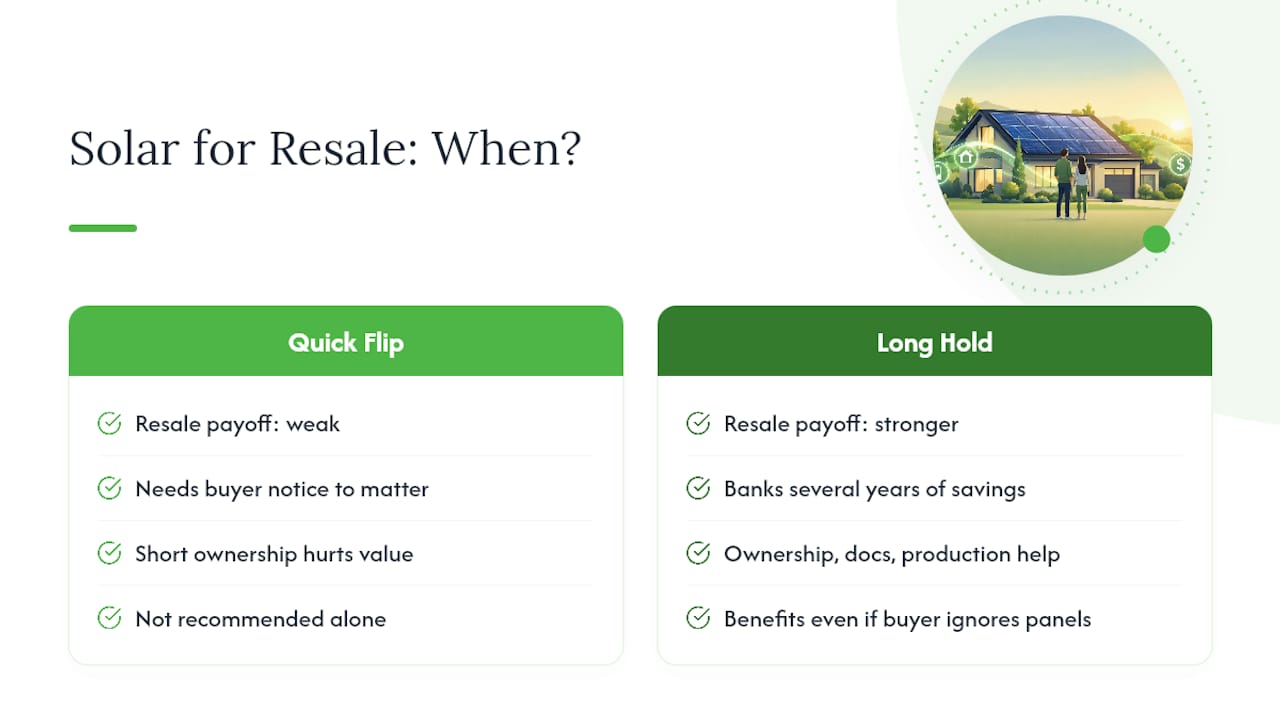
Installing solar purely to flip a home in the next year or two is a weak bet. The resale math favors homeowners who plan to stay long enough to bank several years of energy savings before the sale, letting ownership, documentation, and a mature production history all work in their favor.
If you’re weighing the decision on numbers alone, check your local market first. Some regions have so much solar penetration that panels barely register as a differentiator, while in others they’re still rare enough to turn heads. Either way, the energy savings and grid resilience solar provides hold up whether or not a buyer ever notices the panels on the roof.
Get a Resale-Focused Solar Estimate From Indigo Energy
A local solar company offers homeowner projects beginning with an ROI analysis showing the net cost figure used in appraisals, beyond rough estimates.
That same analysis becomes the foundation for the documentation package you’ll need at sale time: production data, equipment specs, permits, and warranty paperwork, all organized from the start instead of assembled in a panic during escrow. Whether planning to stay long term or sell sooner, a residential solar team can assist with sizing, financing, and battery or EV charger options that fit your goals. Visit the Indigo Energy services page to request a personalized ROI and resale-impact consultation.
Sources
- Price Premium Analysis of a Multi-State Dataset of Solar Homes (LBNL factsheet)
- Fannie Mae analysis on solar home premiums
- Do Solar Panels Really Raise Your Home’s Value in 2025? (SolarReviews)
FAQ
Does Solar Actually Increase Home Value?
Yes, when the system is homeowner-owned. Studies from LBNL and SolarReviews put the typical premium between 4% and 7%, though leased systems usually don’t produce the same effect.
How Much Does Solar Cost for a 2,000 Square Foot House?
Costs vary significantly based on system size, equipment, and local labor rates, and no published figure applies universally to every home. Indigo Energy provides a transparent, project-specific ROI analysis so homeowners can see real numbers for their own roof and energy usage before committing.
Why Is It Difficult to Sell a House With Solar Panels?
Selling gets complicated mainly when the system is leased or financed through a PPA, since the buyer has to qualify for or assume that contract. Owned systems with clean documentation typically sell without added friction, according to SolarUnitedNeighbors.
How Do I Increase Home Value by $50,000?
No single upgrade guarantees a fixed dollar amount, since results depend heavily on your market and home’s starting value. Solar can contribute a meaningful share of that goal in higher-cost electricity markets, particularly when combined with other improvements like updated roofing, efficient systems, or battery storage that appeals to energy-conscious buyers.