
Most multifamily buildings can support solar, and the incentives available in 2026 often make the payback faster than owners expect. The first move isn’t picking a panel brand. It’s pulling 12 months of interval utility data and getting a roof and structural assessment, so you know your real load shape, usable roof area, and whether federal or state incentives like SOMAH change the math before you commission solar for multifamily housing at all.
TL;DR:
- The choice of metering structure impacts who benefits from solar savings, with virtual net metering and community subscriptions providing tenant-level credits in complex setups.
- Incentive programs like SOMAH and NY-Sun can significantly reduce costs, especially when combined with technical assistance and strict compliance with current application and tariff rules.
- Technical assessments require 12 months of interval utility data, roof condition analysis, and electrical capacity checks to ensure project viability and proper system sizing.
- Financing options vary from direct ownership to third-party leases, PPA, C-PACE, and tax equity, with calculations needed to identify the best balance of incentives, risk, and long-term asset value.
- System maintenance is minimal but essential, with inverter servicing and routine inspections necessary to sustain energy savings and ensure system performance over time.
Table of Contents
- What Are the Main Solar Installation Models for Multifamily Properties?
- What Federal and State Incentives Apply to Multifamily Solar?
- How Do Metering and Crediting Structures Affect Multifamily Solar?
- What Technical Factors Determine Solar Feasibility for Apartments?
- Which Financing Options Work Best for Multifamily Solar?
- How Long Does a Multifamily Solar Project Take From Planning to Completion?
- How Do You Solve Split-Incentive Problems in Multifamily Solar?
- What Do Real Multifamily Solar Projects Look Like?
- What Ongoing Maintenance Does a Multifamily Solar System Need?
- What Legal and Regulatory Rules Apply to Multifamily Solar Installations?
- When Does Multifamily Solar Actually Make Sense?
- Ready to Move From Planning to Procurement?
- Where to Verify Program and Code Details
- Sources
- FAQ
What Are the Main Solar Installation Models for Multifamily Properties?
Multifamily solar installation splits into three basic models, and picking the wrong one is the single most common planning mistake owners make.
On-site common-area systems offset shared electrical loads (lighting, elevators, pool pumps, laundry) and sit behind the master meter. They’re the simplest to permit and finance because there’s no tenant crediting to manage. Tenant-benefit systems go further, distributing solar credits to individual tenant accounts, which usually requires virtual net metering or virtual net billing where the utility allows it. Community solar subscriptions work well when a roof is shaded, structurally weak, or too small. Owners subscribe residents to an off-site array instead of building on the property itself.
- On-site common-area: lowest cost and complexity, but only offsets shared loads
- Shared allocation (VNEM/VNBT): reaches individual tenants, adds administrative overhead
- Community solar: no roof constraints, but credits and savings depend on subscription terms
- Shared solar-plus-storage setups can extend equitable access to tenants while adding resilience value in low-income communities
What Federal and State Incentives Apply to Multifamily Solar?
The federal Investment Tax Credit under Section 48 covers a base rate for commercial and multifamily solar projects, with additional bonus adders under the Inflation Reduction Act for projects serving low-income housing or qualified low-income economic benefit projects. Who captures that credit depends entirely on ownership structure: a property owner who directly owns the system claims the ITC, while a third-party owner under a PPA or lease captures it instead and typically passes savings through as a lower energy rate.
State programs add another layer. SOMAH funds solar (and increasingly storage) for qualified affordable multifamily housing in California, pairing incentive dollars with technical assistance so projects with marginal private economics become close to free for the property. NY-Sun offers a similar mix for New York multifamily buildings: on-site incentives, remote crediting, community solar options, and targeted funding for disadvantaged communities.
- Section 48 ITC: base federal credit for commercial/multifamily systems, plus IRA bonus adders for qualifying low-income projects
- SOMAH: California-specific, targets affordable multifamily housing with incentives plus technical assistance
- NY-Sun: New York program combining on-site incentives with remote crediting and community solar
- Prevailing wage and apprenticeship compliance can change the effective credit amount, so model both compliance paths before choosing a contractor
Programs like these have shown that targeted incentives paired with technical assistance can turn a project with a marginal private return into a near-zero-out-of-pocket installation for qualifying affordable housing.
Confirm current application windows and funding caps directly with the program administrator before you build a budget around a specific incentive. Rules shift year to year, and a program that’s fully subscribed in one cycle may reopen in the next.
How Do Metering and Crediting Structures Affect Multifamily Solar?
How you structure metering determines who actually sees the savings, and it changes based on whether your building runs on a master meter or has separate meters per unit.
- Virtual net metering (VNEM) allocates solar credits across multiple accounts behind a single service, commonly used when common-area and tenant meters need to share one system’s output.
- Virtual net billing (VNBT) is the newer structure many California utilities are shifting toward, valuing exported energy at a different rate than net metering did, which changes long-term savings projections.
- Master-metered buildings are usually the simplest case: one account, one bill, no allocation math required.
- Individually-metered buildings need VNEM, VNBT, or a community solar subscription to reach tenants directly, since a rooftop system can’t otherwise credit separate accounts.
Setup fees for benefiting accounts in California VNEM arrangements run around $25 per account, often capped at a few hundred dollars total, which is manageable but worth budgeting for on larger buildings. CPUC decisions have repeatedly adjusted tariff terms and export compensation for VNEM/VNBT participants, including special provisions tied to SOMAH projects. Verify your utility’s current tariff and crediting rules before finalizing system size. It’s cheaper to find out early than after interconnection.
What Technical Factors Determine Solar Feasibility for Apartments?
Before anyone sizes a system, four technical checks separate a workable project from a costly redesign.
- Pull at least 12 months of interval utility data, not just monthly bills, to map when demand peaks and where solar output actually overlaps with that load
- Estimate usable roof area after fire setbacks: the 2024 International Fire Code can require 16 to 28 percent of gross flat-roof area be kept clear for access and ventilation
- Check remaining roof life; if it’s under 15 years, plan replacement before or alongside installation rather than after
- Assess electrical service capacity, interconnection limits, and shading from adjacent structures or rooftop equipment
Pro Tip: Order the interval-data pull and the roof assessment at the same time. Owners who wait on one before starting the other routinely lose two to three weeks off an already tight schedule.
Interval data isn’t optional paperwork. Practitioners consistently point to 12 months of load-shape analysis as the difference between a system sized correctly and one that either underperforms or gets built too large to pencil out.
Which Financing Options Work Best for Multifamily Solar?
Financing determines who captures the incentives and who carries the risk, and multifamily owners generally choose among four routes.
- Direct ownership captures the full ITC and adds asset value to the property, but requires upfront capital and full incentive-compliance responsibility
- PPA or lease lowers upfront cost sharply since a third party owns the system, though the owner gives up direct ITC capture in exchange for a lower energy rate
- C-PACE financing attaches repayment to the property tax bill rather than the owner’s balance sheet, which suits multifamily well because terms often run 15 to 20 years and transfer with the property at sale
- Tax-equity partnerships let owners without sufficient tax liability still benefit from ITC value, though prevailing wage and apprenticeship compliance can shift the final credit amount
Run the numbers through a commercial solar ROI calculator under more than one financing scenario before committing. The gap between direct ownership and a PPA often comes down to how much you value long-term asset upside versus near-term cash flow relief.
How Long Does a Multifamily Solar Project Take From Planning to Completion?
Expect feasibility work to take two to six weeks, design and permitting one to four months, and utility interconnection anywhere from a few weeks to several months depending on your service territory. Construction itself typically runs weeks to a few months once permits clear.
- Gather 12 months of interval usage data, roof and structural reports, current meter configuration, and target capital/operating budgets before issuing an RFP
- Sequence roof replacement or battery additions into the same project window rather than as a follow-on job
- Loop in tax counsel, the utility, HOA or board members, and the property manager early, since each can add weeks if consulted late
How Do You Solve Split-Incentive Problems in Multifamily Solar?
Split incentives, where the owner pays for solar but tenants get the utility savings, kill more multifamily projects than technical constraints do. A common-area offset approach sidesteps the problem entirely by only reducing shared-space costs the owner already pays.
- Offer VNEM allocations, a community solar subscription, or a straightforward rent/utility adjustment when tenant-level savings are the goal
- Loop property managers into board and tenant communications before construction, not after
- Update lease language to reflect any billing changes, and disclose crediting mechanics in writing
- Keep billing transparent. Tenants who don’t understand how their credit was calculated file complaints, even when the math is correct
What Do Real Multifamily Solar Projects Look Like?
Indigo Energy & Solar designs and installs solar, battery storage, and EV charging for commercial and residential properties across San Diego County, with a track record documented in its solar case studies. Their approach centers on transparent pricing and ROI analysis to help owners understand the financial picture before signing, often supported by partnerships with manufacturers for system durability and warranty coverage.
Project teams that size systems around common-area loads first, then model tenant allocations conservatively, avoid most billing disputes and produce more predictable cash flow than teams that promise full-building coverage from day one.
A one-page RFP checklist for owners:
- 12 months of interval utility data attached
- Roof age, remaining life, and structural report
- Meter configuration (master vs. individual)
- Target capital outlay and preferred financing model
- Confirmation of applicable state/utility incentive programs
What Ongoing Maintenance Does a Multifamily Solar System Need?
Solar systems on multifamily buildings need less maintenance than most owners assume, but “less” isn’t “none.” Panels themselves are largely passive, though performance monitoring catches problems long before they show up on a utility bill.
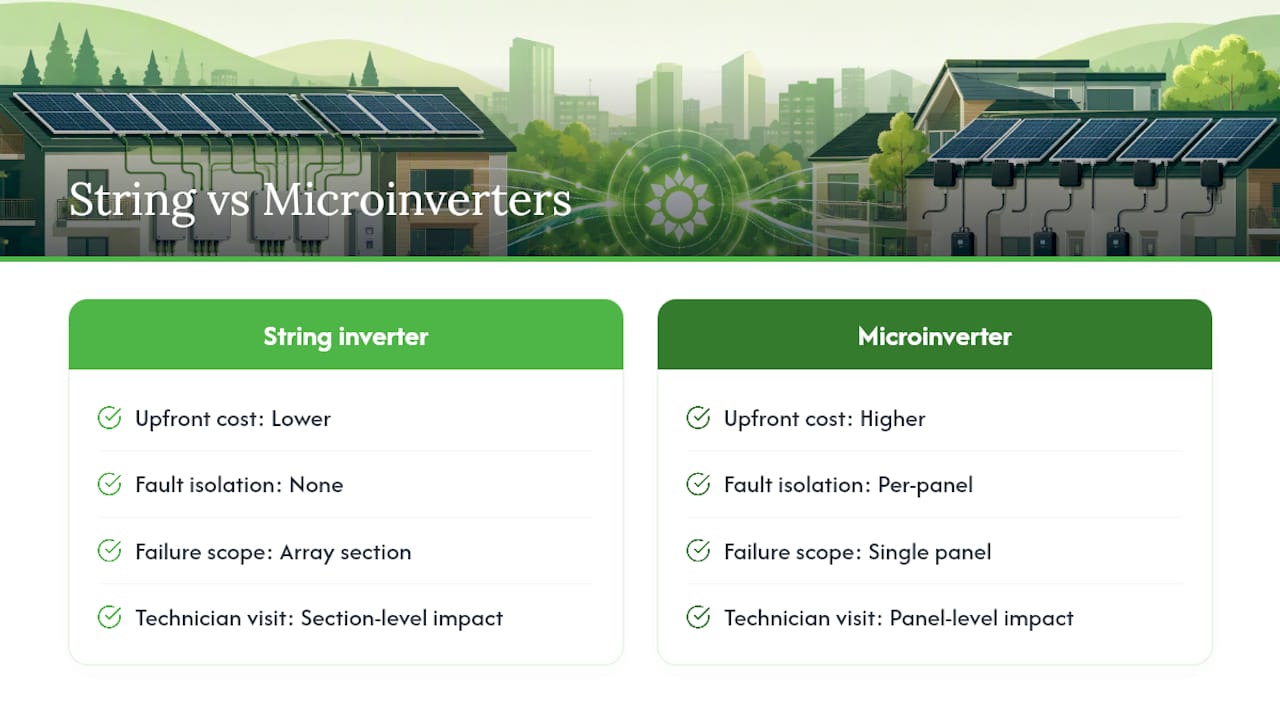
Inverters are the component most likely to need attention, typically requiring replacement or major service somewhere between year 10 and year 15 depending on the equipment class. String inverters are cheaper individually but create a single point of failure for a section of the array; microinverters cost more upfront but isolate faults to individual panels, which matters more on a large multifamily roof where a technician visit is expensive to schedule.
Remote monitoring should be part of any contract from day one. For shared-allocation systems using VNEM or VNBT, monitoring also matters for billing accuracy: if allocation percentages are based on projected output and actual output drifts, tenant credits and common-area savings both drift with it.
Build a maintenance line item into the operating budget rather than treating solar as a one-time capital expense with no ongoing cost. Annual visual inspections, periodic panel cleaning (more frequent in dusty or coastal environments), and inverter monitoring typically run a modest annual sum relative to the energy savings generated, but skipping them risks losing that savings gradually and invisibly. Warranty terms vary by manufacturer and installer, so confirm what’s covered and for how long before signing a contract, and ask whether the installer offers an ongoing solar maintenance plan or leaves monitoring entirely to the owner.
What Legal and Regulatory Rules Apply to Multifamily Solar Installations?
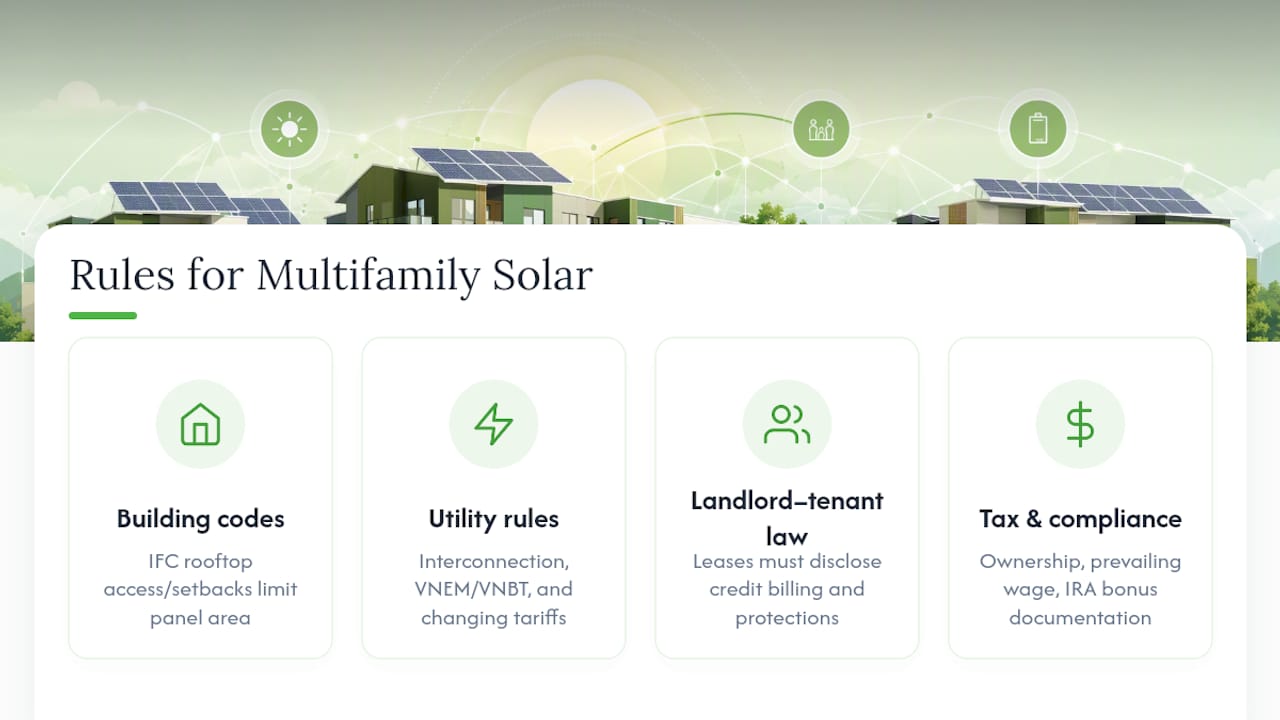
Multifamily solar sits at the intersection of building codes, utility tariffs, and, in many states, landlord-tenant law, and missing any one of them can stall a project after money has already been spent on design.
Fire and building codes govern physical installation. The International Fire Code sets rooftop access and setback requirements that determine how much of the roof can actually hold panels, which is why the feasibility assessment has to happen before final system sizing, not after. Local jurisdictions may layer additional requirements on top of the IFC baseline, particularly for high-rise or high-density buildings.
Utility interconnection rules govern whether and how a system can export power, and whether VNEM or VNBT allocation is even available in your service territory. These rules are set by the state public utilities commission or equivalent body and change periodically. California’s shift from legacy net metering toward net-billing structures is a case in point: a project modeled under old export-compensation assumptions can see materially different returns once the new tariff applies.
Landlord-tenant law matters most for buildings pursuing tenant-benefit allocation models. Lease language needs to disclose how solar credits are calculated and billed, and some states have specific consumer-protection requirements around community solar subscriptions or shared-system crediting. Ownership structure also carries tax and compliance consequences. Projects using prevailing wage or apprenticeship provisions to unlock IRA bonus credits must document compliance carefully, since the bonus is tied directly to meeting those labor standards. Bring in tax counsel and a solar-specific attorney early. The cost of that consultation is small next to the cost of restructuring a deal after a compliance gap surfaces mid-project.
When Does Multifamily Solar Actually Make Sense?
Solar is high-confidence on multifamily buildings with strong common-area loads, decent roof life, and clear metering. The real risk sits in interconnection delays and undersized roofs. Get the data first, budget conservatively, and treat storage as a second decision, not a first one.
— David
Ready to Move From Planning to Procurement?
A solar contractor can provide the full path from feasibility study to working system for multifamily owners, handling studies, incentive capture, permitting, installation, and ongoing operation and maintenance under one contract, with transparent pricing and ROI analysis at every stage.
If your building has mixed metering, an aging roof, or tenants who need to see savings directly on their bills, an independent feasibility study is worth ordering before you talk to any contractor, since it gives you leverage in every conversation that follows. Indigo Energy’s own commercial solar services cover exactly that groundwork, plus battery storage integration for buildings that want resilience alongside savings. Review the solar case studies to see how similar properties were sized and financed, then reach out for a proposal built around your building’s actual interval data, not a generic estimate.
Where to Verify Program and Code Details
- SOMAH and NY-Sun program pages for eligibility and application steps
- CPUC virtual net metering guidance for California VNEM/VNBT rules
- International Fire Code Chapter 12 for rooftop energy-system setbacks
- DSIRE incentive maps for state-specific programs
Sources
- International Fire Code 2024 — Chapter 12: Energy systems
- California Public Utilities Commission — Virtual net metering guidance
- SOMAH — Solar on Multifamily Affordable Housing
FAQ
What Is the 33% Rule for Solar Panels?
There’s no single industry-standard “33% rule.” The term shows up informally in different contexts, sometimes referring to roof-area coverage limits or shading tolerances, so confirm the specific meaning with your installer rather than assuming a universal figure.
Is the 30% Solar Tax Credit Going Away in 2026?
The federal Investment Tax Credit under Section 48 remains available for commercial and multifamily projects, with IRA bonus adders still in place for qualifying low-income housing projects; confirm current rates and deadlines with a tax professional before finalizing financing, since credit terms can change with legislation.
What Is the 20% Rule for Solar?
This isn’t a recognized industry standard either. Definitions vary depending on the source, so treat any “20% rule” you encounter as informal shorthand rather than a regulatory or engineering benchmark, and verify sizing guidance directly with your solar designer.
How Many Solar Panels Are Needed to Power an Apartment?
It depends entirely on the building’s load shape, which is why pulling 12 months of interval utility data matters more than a generic panel count. A common-area system might need far fewer panels than one designed to offset individual tenant usage across an entire building, and a feasibility assessment like the ones Indigo Energy & Solar performs will size the array to your actual demand rather than a rule of thumb.