
Most home solar batteries deliver useful service for roughly 7 to 15 years, with lithium iron phosphate (LFP) chemistries pushing toward the long end of that range. Lifespan really means capacity fade: the battery still works, but it stores less energy each year than it did on day one. Before you buy, check two things: the manufacturer’s warranty terms and the expected cycle count for your usage pattern, because those two numbers tell you more about real-world longevity than any marketing brochure.
TL;DR:
- Lithium iron phosphate batteries often last longer, with cycle counts exceeding 3,000 to 8,000, but proper installation and usage are critical to reach those durations.
- Heat exposure significantly accelerates capacity fade, with batteries in hot environments losing capacity up to 2% per year faster than those in cooler, controlled spaces.
- Warranties typically guarantee at least 70% capacity retention at the end of around 10 years, not full functionality, making capacity decline the key factor in replacement timing.
- Deep discharges, high charge rates, and improper system settings can shorten battery life, emphasizing the importance of correct siting, sizing, and maintenance.
- Installation quality, including inverter pairing and monitoring, often has a greater impact on battery lifespan than the battery chemistry itself.
Table of Contents
- Solar Battery Lifespan by Chemistry: What the Numbers Actually Mean
- What Actually Determines How Fast Your Battery Wears Out
- Reading Solar Battery Warranties: What They Actually Guarantee
- Signs Your Solar Battery Is Nearing Replacement
- How to Extend Your Solar Battery’s Life
- Why Installation Quality Is the Hidden Variable in Battery Longevity
- Get a Battery System Built to Last, Not Just to Sell
- Sources
- FAQ
Solar Battery Lifespan by Chemistry: What the Numbers Actually Mean
Chemistry drives everything about how long a battery lasts, and the differences between options are larger than most homeowners expect. According to pv magazine’s review of residential battery longevity, most home batteries fall in the 7 to 15 year range, with manufacturer warranties commonly set around 10 years or tied to a specific cycle count, such as 7,300 cycles.
Here’s how that breaks down by chemistry:
- LFP (lithium iron phosphate): Often rated for 3,000 to 8,000 or more cycles, according to Aurora Solar’s analysis of battery lifespan. This is the chemistry most installers now favor for home storage.
- NMC (nickel manganese cobalt): Typically good for 10 to 15 years, with a lower cycle count than LFP but still solid daily-use performance.
- Lead-acid: Usually lasts just 3 to 8 years. It’s cheaper upfront but degrades fast under regular cycling, which makes it a poor fit for daily solar use.
- Flow batteries: Can run for decades with minimal degradation, but the size and cost put them well outside typical residential installations.
Cycle ratings translate to calendar years depending on usage frequency. For example, a battery cycled daily may last over a decade in theory, though real-world factors like heat and deep discharges typically shorten this. Backup-use batteries cycling fewer times per year may exceed warranty durations.
There’s a second variable that rarely makes it into sales conversations: round-trip efficiency. AC-coupled battery systems typically deliver 85% to 94% round-trip efficiency, while DC-coupled LFP systems can reach 95% to 99%, according to SurgePV’s efficiency modeling. That gap means a “10 kWh” battery might realistically deliver closer to 8.5 kWh per cycle, and that efficiency loss compounds over the battery’s life as internal resistance increases with age.
What Actually Determines How Fast Your Battery Wears Out
Two batteries with identical specs, installed a mile apart, can age at completely different rates. The gap almost always comes down to four controllable factors.
- Cycle count and depth of discharge (DoD). Every charge and discharge cycle stresses the battery’s internal chemistry, and deeper discharges accelerate wear faster than shallow ones. Draining a battery to 20% remaining capacity puts more strain on it than stopping at 50%, which is why most manufacturers recommend keeping DoD in the 80% to 90% range rather than running it to empty on a regular basis.
- Temperature exposure. Heat is the single biggest environmental threat to battery longevity. Research from Griffith University on battery degradation found that batteries in very hot environments can lose capacity roughly 1% to 2% per year faster than those in moderate climates, and some field studies recorded non-cyclical degradation as much as 50% faster in extreme heat installations.
- Charge rates and the battery management system. Fast, aggressive charging generates more internal heat and stress than a moderate charge rate. The battery management system (BMS) is what protects against overcharge, over-discharge, and thermal runaway, and a properly tuned BMS is one of the most underappreciated factors in long-term performance.
- Calendar aging versus cycle aging. Batteries degrade even when they sit unused, simply from chemical aging over time. Poor installation choices, like mismatched inverter pairing or incorrect voltage set points, compound this baseline aging and are among the more avoidable causes of premature failure noted across industry reporting on residential battery performance.
Statistic to remember: A battery installed in a garage that regularly hits 95°F or higher can lose capacity noticeably faster year over year than an identical unit in a climate-controlled space, purely from heat stress. That single siting decision, garage versus conditioned interior wall, can shift your effective lifespan by years.
Reading Solar Battery Warranties: What They Actually Guarantee
Warranty language sounds reassuring until you read the fine print, and the fine print is where the real lifespan expectations live. Most warranties don’t promise the battery will function perfectly for a set number of years. They promise it will retain a minimum percentage of its original capacity for that period.
- Years-based warranties typically run around 10 years, covering defects and guaranteeing a capacity floor at the end of that term.
- Capacity-retention floors are the most important number to check. A common example, cited by ConsumerAffairs’ review of solar battery lifespan, guarantees the battery will retain at least 70% of its original capacity by the warranty’s end date.
- Cycle-based limits cap total throughput. Exceed the rated cycle count, even within the warranty period, and coverage can lapse.
- Common exclusions include improper installation, extreme ambient temperatures outside spec, and unauthorized system modifications, all of which can void coverage even during the warranty window.
When you’re building a lifetime-cost model for a solar investment, the warranty’s capacity floor matters more than its year count. A battery guaranteed at 70% capacity after 10 years is telling you it will lose meaningful storage capacity gradually, not suddenly, so you should plan replacement budgeting around that trajectory rather than assuming full performance right up until the warranty date.
Signs Your Solar Battery Is Nearing Replacement
A battery rarely fails all at once. It sends warning signs months or years ahead of a full replacement decision, and catching them early saves money.
- Usable backup hours shrink noticeably compared to when the system was new.
- Recharge times stretch longer than they used to, even on sunny days.
- Fault codes or error alerts on the monitoring app become more frequent.
- Capacity readings show a sudden drop rather than the usual gradual decline.
A battery at 70% remaining capacity, the common warranty floor, still works. It just runs your essential loads for roughly 30% less time than it did when new. If your system’s monitoring shows readings near or below that threshold, or if performance drops suddenly rather than gradually, it’s worth scheduling a professional diagnostic before assuming the battery needs full replacement. Replacement costs vary widely by chemistry and capacity, with homeowner estimates commonly ranging from about $5,000 to $30,000 depending on system size, according to Angi’s cost breakdown for solar battery replacement.
How to Extend Your Solar Battery’s Life
Where you install the battery, how you size it, and how you set its charge parameters all have a direct, measurable effect on how many years you get out of it.
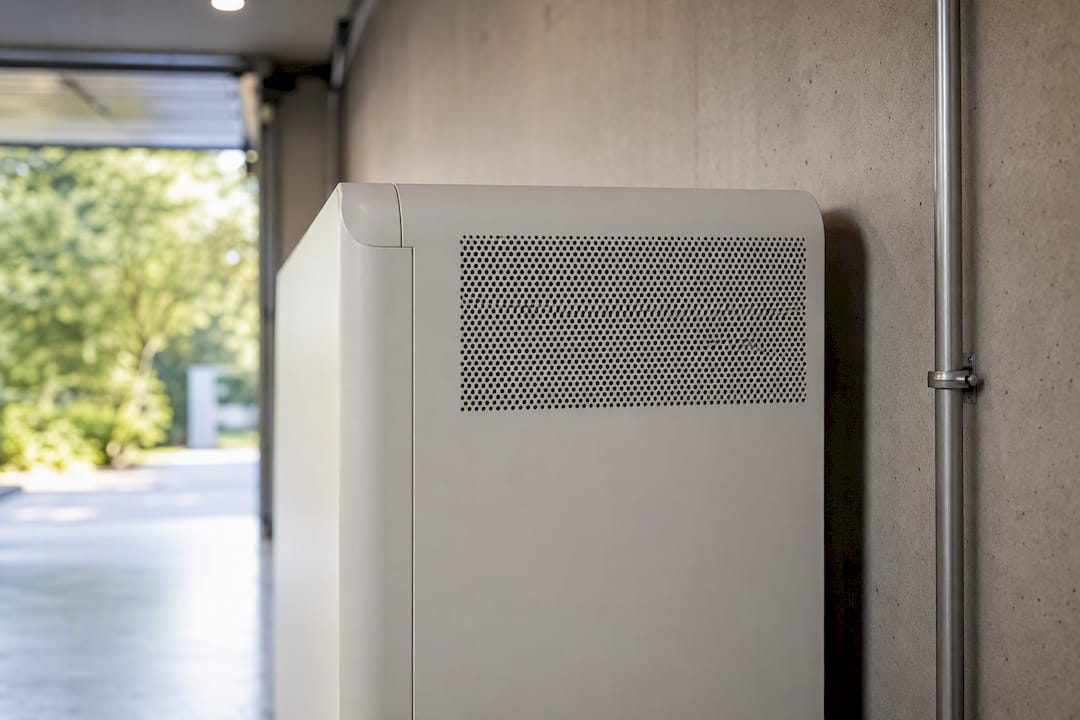
Siting matters more than most homeowners realize. NREL guidance summarized by pv magazine recommends installing batteries in cool, dry, ventilated spaces, ideally a garage or conditioned area, with adequate spacing around the unit for airflow. Avoid direct sun exposure, attics, and any space that regularly swings above 85°F.
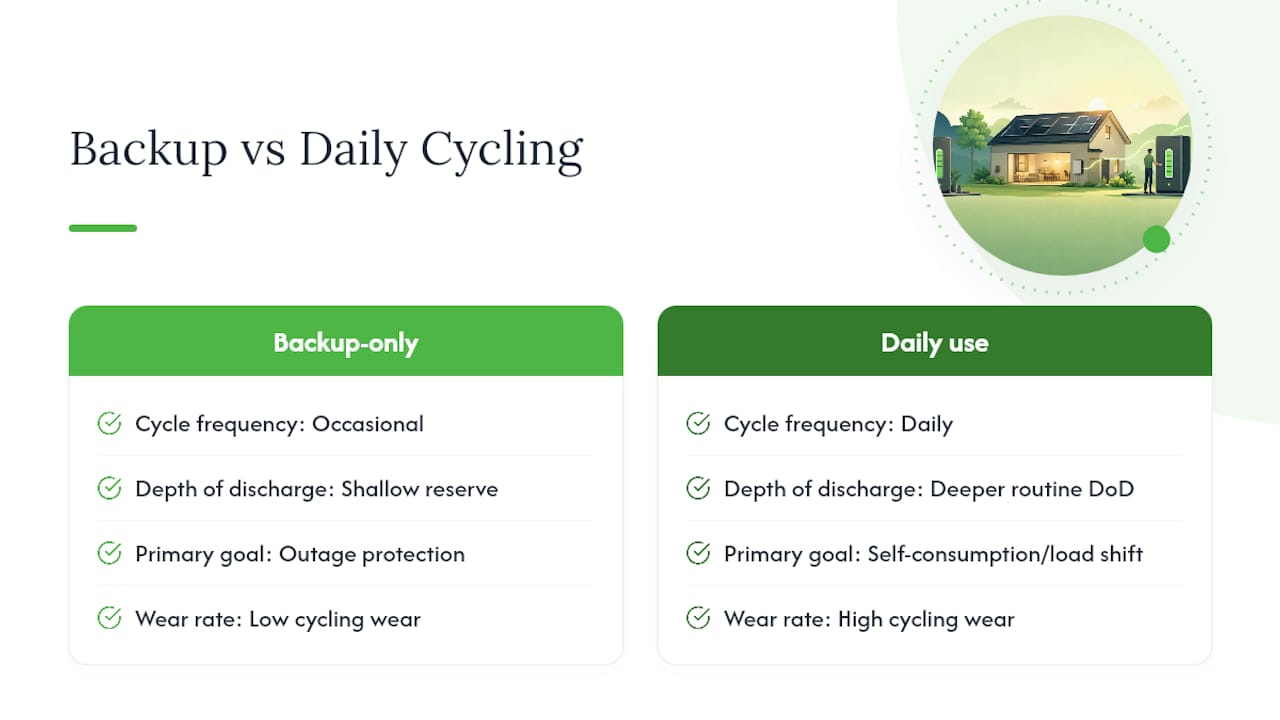
Size the system for your actual use case, not the sales pitch. If your primary goal is backup power during outages, a battery that only cycles occasionally will outlast one running daily solar self-consumption cycles. Chronic deep daily cycling on an undersized battery is one of the fastest ways to shorten its service life, so match the battery’s capacity to how you actually plan to use it, whether that’s backup-only or daily load shifting. A battery storage system built for outage protection is sized differently than one built for daily self-consumption, and that distinction should shape your purchase.
Settings and maintenance add years. Keep a reserve state-of-charge rather than letting the system run to near-zero routinely. Limit depth of discharge to the manufacturer’s recommended range. Keep the BMS firmware updated, and schedule periodic inspections through a solar maintenance program rather than waiting for a problem to surface.
Pro Tip: When you’re comparing quotes or building your own ROI estimate, model the battery’s round-trip efficiency and expected capacity fade over time instead of using the nameplate kWh rating. A battery advertised at 10 kWh with 90% round-trip efficiency delivers closer to 9 kWh per cycle on day one, and less as it ages. Skipping that adjustment is the single most common way homeowners overestimate their long-term solar savings.
Why Installation Quality Is the Hidden Variable in Battery Longevity
Two identical batteries can age at completely different rates depending on how they were installed, and that’s the part most buying guides skip. Correct inverter-to-battery pairing and proper BMS tuning during commissioning prevent a surprising number of early failures that homeowners later blame on the battery itself. Poor commissioning is an avoidable cause of shortened battery life, not a flaw in the hardware.
There’s also a paperwork dimension that matters more than it should. When an installer handles warranty registration and documentation at the time of installation, warranty claims move faster and with fewer disputes years later. And ongoing monitoring, the kind that flags a gradual capacity dip before it becomes a sudden failure, is what turns “the battery just died” into “we caught the degradation trend early and planned for it.” That’s the difference between a surprise expense and a scheduled one.
— Curtis Williamson
Get a Battery System Built to Last, Not Just to Sell
The advantage offered is transparent ROI analysis and local permitting expertise applied to systems sized for actual energy use. Every project starts with customer energy needs and is backed by manufacturer partnerships and warranty coverage.
If you’re evaluating a new solar and storage system, or wondering whether your current battery is aging faster than it should, Indigo Energy’s battery storage integration services cover design, installation, warranty coordination, and ongoing monitoring under one roof. Request a site assessment and an ROI-backed proposal to see what a properly sized, properly sited battery system looks like for your specific property, and get real numbers instead of a nameplate estimate.
Sources
- Griffith University research on battery degradation
- pv magazine — How long do residential solar batteries last?
- SurgePV — Round-trip efficiency: Why your 10 kWh battery delivers 8.5 kWh
- ConsumerAffairs — How long do solar batteries last?
FAQ
How long can a solar battery last?
Most home batteries last 7 to 15 years, with LFP chemistries often reaching the upper end of that range under moderate climate conditions and typical daily use.
How do I know when my solar battery needs replacing?
Watch for shrinking backup runtime, longer recharge times, frequent fault codes, or a sudden capacity drop rather than gradual decline; a professional diagnostic can confirm whether you’re near the warranty’s capacity floor.
How much does it cost to replace a solar panel battery?
Replacement costs commonly range from about $5,000 to $30,000 depending on chemistry and capacity, according to Angi’s cost analysis, though your exact cost depends on system size and installation complexity.
Does the battery brand affect lifespan more than chemistry?
Chemistry sets the baseline potential lifespan, but installation quality, siting, and BMS tuning often determine whether a battery reaches that potential or falls short of it.
Can Indigo Energy help me choose the right battery for longevity?
Yes. Indigo Energy designs battery systems around your actual energy use, warranty terms, and site conditions rather than a generic sizing formula, and current pricing is available on request through a site assessment.