


A typical San Diego home pays an average amount in the mid five figures for a 6 to 7 kW solar system before incentives, and solar usually pays for itself well within a decade given how high SDG&E rates have climbed. The catch: under NEM 3.0, a system sized for daytime production alone leaves real savings on the table. Pairing solar with battery storage is what makes the math work for most San Diego roofs today. Skip to the quote checklist below once you know your rough budget.
TL;DR:
- The typical 6 to 7 kW solar system in San Diego costs mid five figures before incentives, with payback usually within 10 years due to high SDG&E rates.
- Adding battery storage can increase total project costs by up to around fifteen thousand dollars but significantly improves savings under NEM 3.0.
- System size and roof complexity, along with soft costs like permits and electrical upgrades, drive installation prices, which vary considerably between homes.
- California incentives, including the federal tax credit and SGIP rebates, can reduce net costs, but rules differ for owner-occupied versus third-party owned systems.
- The highest savings are now achieved by a smaller, properly matched system combined with a battery, not necessarily the largest available system.
Table of Contents
- How Much Do Solar Panels Cost in San Diego?
- What Drives Your San Diego Solar Installation Cost?
- What Solar Incentives Are Available to San Diego Homeowners?
- How Do SDG&E Rates and NEM 3.0 Affect Solar Savings?
- Cash, Loan, or Lease: Which Solar Payment Option Fits?
- How to Get Accurate Solar Quotes in San Diego
- Indigo Energy & Solar: Local Cost Transparency Standards
- San Diego Solar Cost: What Homeowners Should Expect
- Get a Local Solar Quote Built Around Your Actual SDG&E Bill
- Verify These Numbers Yourself
- Sources
- FAQ
How Much Do Solar Panels Cost in San Diego?
San Diego homeowners pay about the typical regional average per watt installed, according to EnergySage’s local pricing data. That average sits close to figures reported by SolarReviews, which tracks San Diego pricing separately and lands in a similar band. Multiply that rate by system size and you get a workable budget range before any tax credit or rebate is applied.
Here’s what that looks like across common system sizes:
- 3 kW: approximately several thousand dollars
- 5 kW: approximately mid five-digit dollars
- 6 kW: approximately mid five-digit dollars
- 7 kW: approximately mid to high five-digit dollars
- 10 kW: approximately high five-digit dollars
These figures reflect equipment and installation only, not tax credits or utility rebates, and they assume a straightforward roof. A steep pitch, multiple roof planes, or an older electrical panel that needs upgrading pushes the number higher. Every quote you receive should show the assumptions behind it, not just a bottom line.
What Drives Your San Diego Solar Installation Cost?
Two homes with identical square footage can get wildly different quotes, and it usually comes down to a handful of factors installers price individually.
- Roof condition and shading: an older roof that needs work before panels go on, or a yard full of mature trees, adds cost or cuts usable space.
- System size and equipment tier: premium panels and inverters cost more upfront but often carry longer warranties and better output in partial shade.
- Mounting and electrical complexity: multiple roof faces, conduit runs, or an EV charger tie in add labor hours.
- Soft costs: permit fees, interconnection fees with SDG&E, and inspection costs vary by jurisdiction within San Diego County.
- Battery storage: adding a battery typically significantly increases the total project cost, sometimes by up to around fifteen thousand dollars, depending on capacity, but it changes the entire savings equation under current export rules.
What Solar Incentives Are Available to San Diego Homeowners?
Federal, state, and utility-level incentives still meaningfully reduce your net cost, but the rules shifted recently and it’s worth getting the details right before you sign a contract.
- Federal tax credit: IRS guidance issued after the 2025 tax law changes clarifies how the residential credit applies and who qualifies as the owner of record. Homeowners who purchase their system with cash or a loan generally remain eligible; the rules differ for third-party owned systems.
- SGIP battery rebate: California’s Self-Generation Incentive Program continues to offer rebates for battery storage, with higher incentive tiers for qualifying households.
- Lease and PPA structures: under a lease or power purchase agreement, the installer or a financing partner typically retains eligibility for federal incentives, which is one reason lease payments look different from loan payments for a system of the same size.
- Local programs: check with the City of San Diego and San Diego County for any active income-qualified solar programs or property tax exclusions tied to a system installation.
How Do SDG&E Rates and NEM 3.0 Affect Solar Savings?
Your savings depend far more on what SDG&E charges you than on the sticker price of your system. San Diego carries some of the highest residential electricity rates in the state, and SDG&E’s own solar calculator is the most direct way to see your specific rate plan’s impact on projected savings.
NEM 3.0, California’s current Net Billing Tariff, pays you an avoided-cost rate for power you export to the grid rather than the full retail rate you’d pay to buy it back. That avoided-cost rate runs well below retail, particularly during the hours when solar exports peak, which is exactly why storage has become central to San Diego solar planning rather than optional.
Consider a 6 kW system under current SDG&E rates and NEM 3.0 rules:
- Solar only: first-year savings often reach a few thousand dollars, with simple payback typically in under a decade depending on usage patterns.
- Solar plus battery: by shifting stored daytime production into expensive evening hours instead of exporting it at avoided-cost rates, homeowners often see first-year savings increased by several thousand dollars, which can shorten effective payback.
These figures assume average San Diego sun hours, a blended SDG&E rate, and typical household consumption patterns rather than a specific address. Local NEM 3.0 analyses consistently show battery pairing improving the outcome, though the exact swing depends on your rate plan and how much of your usage happens after sunset.
Pro Tip: Run two scenarios with your installer, solar only and solar plus battery, using your actual 12-month usage data rather than a generic estimate. The gap between the two numbers tells you whether storage pays for itself on your specific bill, not just in theory.
Cash, Loan, or Lease: Which Solar Payment Option Fits?
How you pay for a system changes both your upfront cost and which incentives you can claim.
- Cash: no interest costs, full ownership from day one, and you claim the federal tax credit directly, which usually delivers the best long-term value if you have the capital.
- Loan: spreads cost over 10 to 25 years; watch the APR closely, since a low rate can still cost more than cash over time once fees are factored in.
- Lease or PPA: lowers or eliminates upfront cost, but the third-party owner typically claims the tax credit and you’re paying for power rather than building equity in a system that adds home value.
Before signing anything, ask your lender or installer whether the loan is transferable if you sell your home, whether prepayment carries a penalty, and exactly how the APR compares across offers.
How to Get Accurate Solar Quotes in San Diego
Comparing quotes only works if you’re comparing apples to apples, and EnergySage’s marketplace data suggests getting multiple bids can meaningfully lower your final installed price in a competitive market like San Diego.
- Gather your documents first: 12 months of SDG&E bills, roof photos, your HOA’s solar policy if applicable, and notes on any shading issues.
- Compare on the same basis: line up each quote’s $/W, total kW, projected annual kWh output, equipment warranties, and what’s included, like monitoring or maintenance.
- Watch for red flags: vague performance guarantees, missing equipment specs, a price that’s dramatically lower than every other bid, or unclear answers about which company handles subcontracted labor.
- Understand the timeline: a typical San Diego residential project runs 6 to 10 weeks from signed contract to final SDG&E interconnection, covering site assessment, permitting, installation, and inspection.
Indigo Energy & Solar: Local Cost Transparency Standards
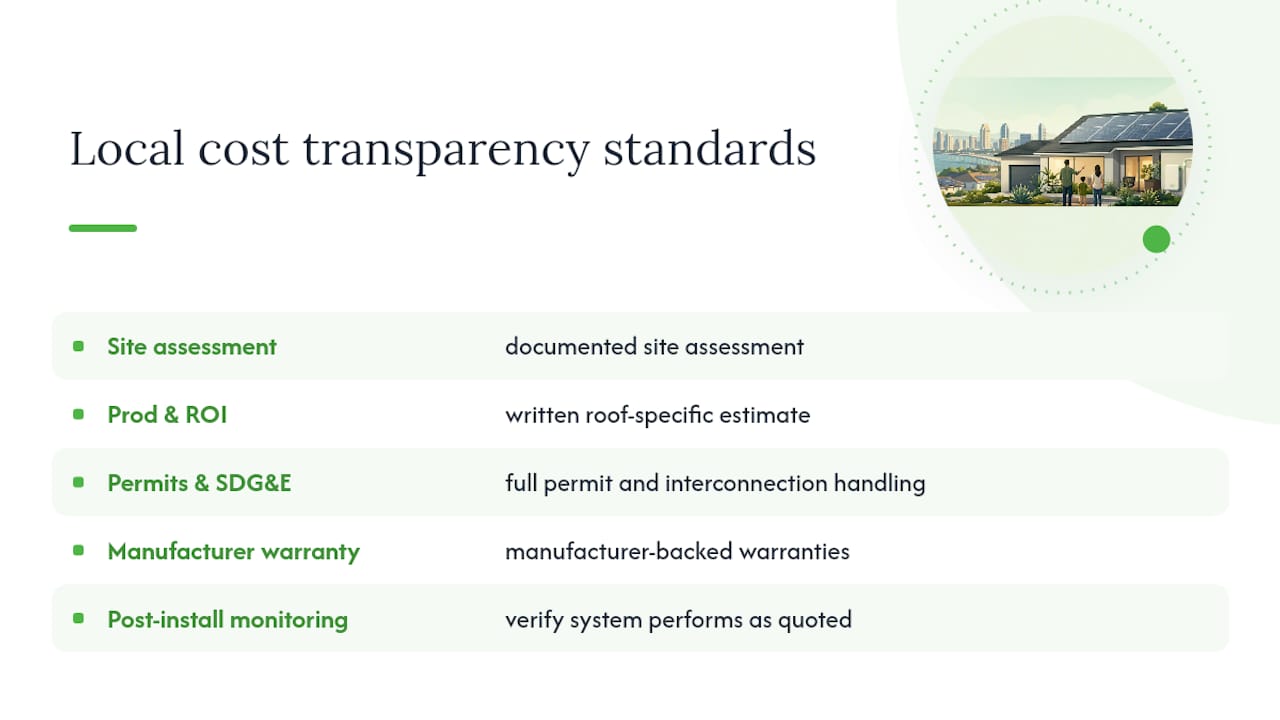
A full-service contractor in San Diego County handles design and installation of residential solar, battery storage, and EV chargers. A scope of work worth signing should include a documented site assessment, a written production and ROI estimate specific to your roof and usage, full permit and interconnection handling with SDG&E, manufacturer-backed warranties, and post-installation monitoring so you can verify the system performs as quoted. That level of detail is what separates a comparable quote from a guess, and it’s the standard Goindigoenergy applies to every residential project it designs.
San Diego Solar Cost: What Homeowners Should Expect
The conventional advice on solar payback, buy the biggest system your roof can hold and let net metering handle the rest, no longer fits how NEM 3.0 pays for exported power. That advice made sense under the old net metering rules. It doesn’t anymore.
What the numbers actually support is a smaller, better-matched system paired with a battery sized to your evening usage. A 6 kW system that covers your daytime load and shifts stored power into peak SDG&E hours will often outperform an oversized 9 kW system exporting most of its output at avoided-cost rates.
The other overrated factor is chasing the absolute lowest $/W quote. A price that’s dramatically below every competing bid usually means thinner equipment warranties, an undersized inverter, or a subcontracted install crew you never meet. San Diego homeowners should prioritize getting their real usage data into the hands of two or three installers, running solar-only versus solar-plus-battery scenarios side by side, and choosing based on the payback math for their own roof, not the sticker price. That’s the difference between a quote that works on paper and one that works on your bill.
— David
Get a Local Solar Quote Built Around Your Actual SDG&E Bill
Most online calculators give you a range. Goindigoenergy gives you a system sized to your roof, your usage, and your SDG&E rate plan, with an ROI analysis that shows the real payback math instead of a generic estimate.

A site assessment starts with your last 12 months of SDG&E bills, a look at your roof’s condition and shading, and a conversation about whether battery storage makes sense given your evening usage. From there, Goindigoenergy’s residential solar installation team handles permitting, manufacturer-backed equipment selection, and interconnection so you’re not managing multiple contractors. If storage is part of the plan, the battery storage options are built around the same NEM 3.0 economics covered above. Whether or not Goindigoenergy ends up being your installer, use the comparison checklist from earlier in this article on every quote you collect. Visit the services page to request a site assessment and see what a fully itemized, San Diego specific quote looks like.
Verify These Numbers Yourself
Run your own estimate using SDG&E’s solar cost calculator, cross-check pricing against EnergySage’s local data, and review LBNL’s Tracking the Sun report for national cost context. Google Sunroof offers a quick production estimate for your specific address.
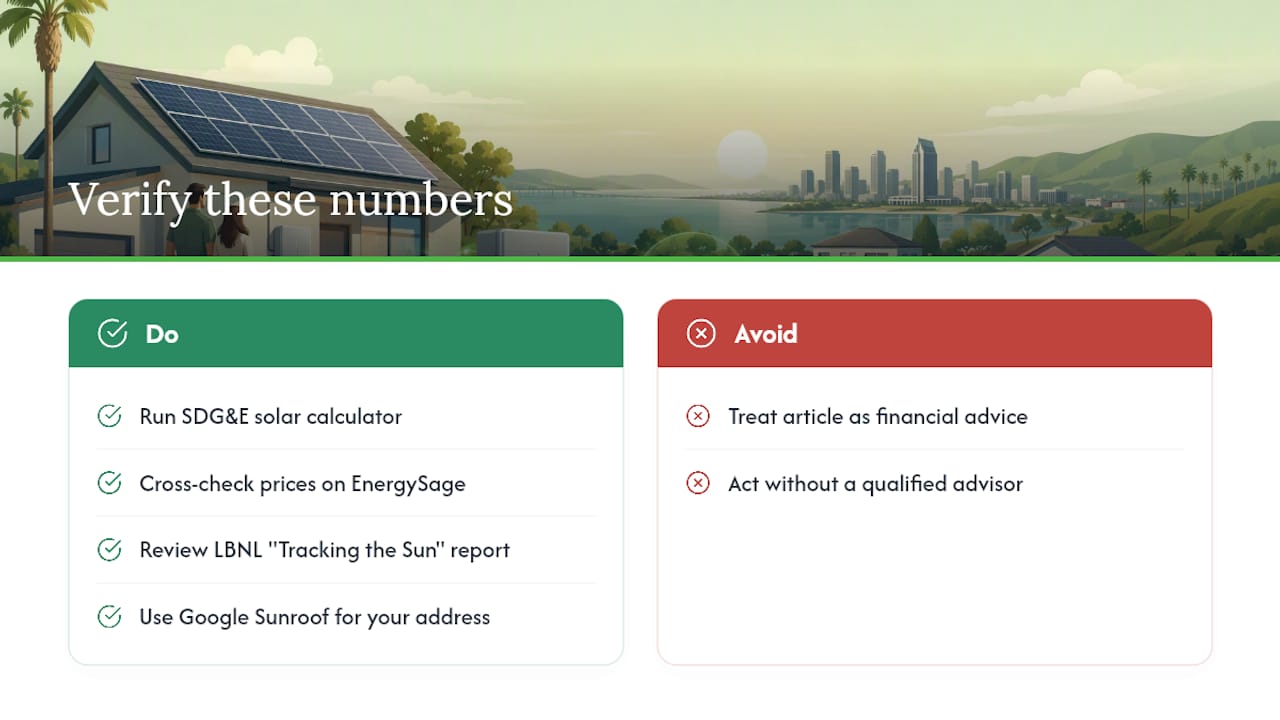
This article is general information, not a substitute for advice from a qualified financial advisor. Consult a qualified financial professional about your own circumstances before acting on anything here.
Sources
- San Diego, CA Solar Panel Cost: 2026 Prices and Savings | EnergySage
- Solar Cost Calculator | San Diego Gas & Electric
- FAQs for modification of sections under Public Law (IRS guidance)
- Tracking the Sun — Lawrence Berkeley National Laboratory
FAQ
Is It Worth Getting Solar in San Diego?
For most homeowners, yes. SDG&E’s rates rank among the highest in California, so the electricity you offset with solar carries a high value, and a well-sized system paired with storage typically pays back within 9 to 12 years.
How Much Is a Solar System for a 2,000 Sq Ft House?
A typical San Diego home typically needs a 5 to 7 kW system, which runs approximately mid to high five-digit dollars before incentives, based on current per watt pricing.
Is the 30% Solar Tax Credit Going Away in 2026?
The federal residential credit’s status changed under recent legislation, and IRS guidance issued after the 2025 tax law outlines the current rules and eligibility. Homeowners should confirm their specific eligibility with the IRS guidance or a tax professional before assuming a credit applies.
Can I Get Free Solar Panels From SDG&E?
No, SDG&E does not give away free solar systems. The utility offers a solar cost calculator and rate information, but installation, financing, and any rebates are handled through licensed installers like Goindigoenergy, not the utility itself.
What Does Goindigoenergy Charge for a Residential Solar Installation?
Pricing depends on system size, roof complexity, and whether battery storage is included, so Goindigoenergy provides a detailed quote after a site assessment rather than a flat rate. Current service details are available on the services page.