
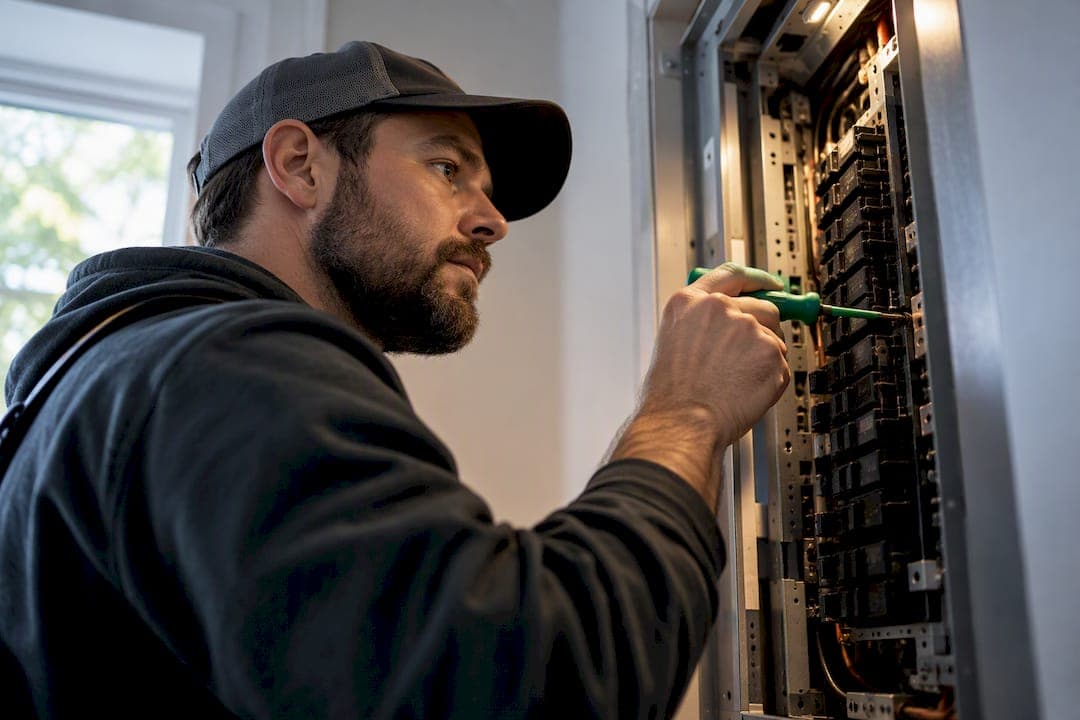

You need a main panel upgrade if your electrician’s load calculation shows your existing service can’t safely support your current or planned loads, most often triggered by an aging 60 to 100 amp panel, zero spare breaker slots, or a jump to solar, battery storage, and EV charging. Many homes can dodge a full upgrade through smart load management instead. Expect $1,000 to $5,000 for a straightforward swap, more if utility work is involved, and a federal tax credit that covers part of the bill. Your next move: call a licensed electrician for a load calculation under NEC 220.87.
TL;DR:
- A load calculation by a licensed electrician is essential to determine if your existing panel cannot support your current or future electrical demands, especially with additions like EV chargers or solar.
- The cost of a basic panel swap ranges from $1,000 to $5,000, but expenses can escalate to over $20,000 if utility work or service upgrades are required.
- Warning signs for a panel upgrade include repeated breaker trips, scorch marks, rust or corrosion, lack of spare slots, or a main breaker rated at 60 or 100 amps.
- Upgrading your panel can improve insurance coverage and resale value by replacing outdated or unsafe panels with modern, capacity-ready units.
- Waiting to upgrade increases fire risk and potential emergency repair costs, while a typical project takes one to three weeks without utility involvement and longer if utility work is needed.
Table of Contents
- What Does a Main Panel Upgrade Cost?
- What Are the Warning Signs You Need a Panel Upgrade?
- What Happens During a Main Panel Upgrade?
- Can You Avoid a Full Panel Upgrade?
- Does a Panel Upgrade Affect Home Insurance or Resale Value?
- What Are the Safety Risks of Waiting on a Panel Upgrade?
- How Long Does a Main Panel Upgrade Take From Start to Finish?
- Indigo Energy’s Take on Panel Upgrades and Electrification
- How Indigo Energy Handles Panel Assessments and Coordinated Installs
- Where to Verify These Numbers Yourself
- Sources
- FAQ
What Does a Main Panel Upgrade Cost?
A basic panel swap that boosts your amperage without touching the utility connection typically runs $1,000 to $5,000, according to guidance from Myenergy. That range covers straightforward jobs: same location, existing service line, no meter changes. The moment a project requires utility coordination or a full service upgrade, costs climb into the thousands and can reach $20,000 or more depending on the scope of transformer and conductor work involved.
What actually moves the needle on your invoice:
- Panel hardware. A 200-amp panel costs more than a 100-amp unit, and premium brands with smart monitoring add to the base price.
- Labor. Licensed electricians charge by complexity, not just hours. Rewiring 20 circuits into a new panel takes longer than a straight swap.
- Permits. Nearly every jurisdiction requires an electrical permit for panel work, and fees vary by city.
- Meter and service conductor changes. If your amperage increases, the wire feeding your panel from the meter often needs upsizing too.
- Added circuits. Each new dedicated circuit for an EV charger, heat pump, or induction range typically adds $250 to $750, according to a Department of Energy technical report.
- Trenching or relocation. Moving a panel to a new spot, or trenching for a new service line, adds significant labor and material cost.
Picture three homeowners. One just wants a 100 to 200 amp swap in the same spot, no meter change: budget the lower end of that $1,000 to $5,000 band. Another is adding a panel plus a new meter socket and three circuits for a kitchen remodel: expect the middle to upper end. A third needs a full utility service upgrade because their transformer can’t support the new load: that’s a multi-thousand-dollar project with a longer timeline.
Regional labor rates and local permit fees swing estimates by hundreds of dollars even for identical scopes. When you compare bids, check whether each one includes permit fees, whether the meter or service conductors need replacement, and whether the electrician has already confirmed utility approval. A bid missing those line items usually gets more expensive once work starts.

What Are the Warning Signs You Need a Panel Upgrade?
Your panel talks to you before it fails. Learning to listen saves you from an electrical fire or a failed solar inspection.
- Breakers trip repeatedly, especially when you run more than one major appliance at once. This usually means your panel can’t keep up with your household’s actual draw.
- You hear buzzing, smell burning, or see scorch marks near the panel. Stop investigating yourself and call a licensed electrician immediately. This is not a wait-and-see situation.
- Your panel shows rust, corrosion, or a manufacturer name like Zinsco or Federal Pacific. These older panel brands have documented histories of breaker failure and are widely flagged by electricians and insurers as safety risks.
- There’s no spare slot for a new circuit. If your panel is physically full and you want to add an EV charger, a hot tub, or solar, you’re already at capacity.
- Your main breaker reads 60 or 100 amps. Open the panel door and check the main breaker at the top. A 200-amp rating is the widely accepted modern standard for a home running electric appliances, an EV charger, or solar, according to This Old House.
You can safely check your amperage rating and count open slots yourself with the panel door open and the area dry. Anything beyond that, especially opening the dead front covering the actual wiring, belongs to a licensed electrician.
What Happens During a Main Panel Upgrade?
The process follows a predictable sequence, though the length varies a lot depending on whether your utility gets involved.
It starts with an inspection and load calculation. A licensed electrician evaluates your current amp draw against your planned loads and determines whether a new panel, a service upgrade, or an alternative approach solves your problem. Next comes the permit application, submitted to your local building department. Once approved, the electrician kills power, removes the old panel, installs the new one, and redistributes your circuits. If your amperage is increasing, this is also when meter socket or service conductor upgrades typically happen.
If your existing service line and transformer can’t support the new amperage, your utility has to get involved. That means scheduling a service disconnect and reconnect, sometimes upgrading the transformer on the pole or pad outside your home. This step adds real time to your project. A simple panel swap might take one day of on-site work. A project requiring utility coordination can stretch to several weeks once you factor in permit review and utility scheduling.
Before signing anything, ask:
- Does the estimate include permit fees and the final inspection?
- Has the electrician confirmed whether utility work is required, or is that still an unknown?
- What’s the projected timeline including permit approval, not just install day?
- Who is responsible for the transformer or service line: you, or the utility?
Pro Tip: Ask your electrician for a written estimate that separates “electrician scope” from “utility scope.” Utility delays are the single biggest reason panel upgrade timelines blow past initial estimates.
Can You Avoid a Full Panel Upgrade?
Sometimes. A full service upsize isn’t the only path to running an EV charger, a heat pump, and solar off the same panel.
Smart panels and load management devices sequence or pause high-draw circuits so your total demand stays under your existing service limit. Your EV charger might pause automatically when the dryer kicks on, then resume once the load drops. ENERGY STAR’s reporting on electric readiness identifies these load-control strategies, along with circuit sharing and subpanels, as viable ways to reduce or defer the need for a full upgrade.
Other tactics worth exploring with your electrician:
- Subpanels add breaker space in a new location without touching your main service.
- Tandem breakers fit two circuits into one slot where code allows, freeing physical space for new circuits.
- Combining underused circuits frees up slots that were tied to appliances you no longer run on dedicated lines.
- Choosing lower-power appliances (a smaller-capacity EV charger, a heat pump sized correctly) can reduce your peak demand enough to stay within your current service.
A contractor tactic worth knowing: taking your measured one-year peak load and multiplying by 1.25 gives a rough, code-informed estimate of how much headroom you actually have for new circuits. Whatever alternative you choose, ask your contractor for documentation showing the local inspector will accept it. Smart panels and load-shedding equipment need proper commissioning records, not just a device bolted to the wall, to pass inspection.
Does a Panel Upgrade Affect Home Insurance or Resale Value?
Insurance carriers pay close attention to your panel, sometimes more than homeowners expect. Panels branded Zinsco or Federal Pacific carry documented failure histories, and some insurers either raise premiums or decline coverage outright for homes still running them. Replacing a legacy panel with a modern one can lower your premium or resolve a coverage denial, depending on your carrier’s underwriting rules.
Resale value tells a similar story from a different angle. A home inspection during a sale routinely flags an outdated panel, a lack of spare breaker capacity, or unsafe wiring conditions. Buyers, especially those planning to add solar or an EV charger themselves, increasingly view panel capacity as a practical checkbox rather than a luxury upgrade. A 200-amp panel with room to grow reads as move-in ready for electrification. A maxed-out 100-amp panel reads as a project the buyer inherits, and buyers often negotiate the price down to cover it.
None of this means every seller needs to upgrade before listing. But if your panel shows any of the warning signs covered earlier, tackling it before a sale removes a negotiating point and a potential insurance headache for whoever buys your home next.
What Are the Safety Risks of Waiting on a Panel Upgrade?
An overloaded or outdated panel doesn’t just annoy you with tripped breakers. It creates a real fire risk that increases the longer you wait.
Breakers that trip repeatedly are doing their job, cutting power before wires overheat. The danger appears when a breaker stops tripping reliably, which is a documented failure mode in older Zinsco and Federal Pacific panels. A breaker that should trip but doesn’t lets a circuit keep drawing current past its safe limit, and that’s how electrical fires start in the wall, not at an outlet you can see.
Corrosion and heat damage compound the risk. A panel showing rust or discoloration around the breakers has likely been running hotter than it should, degrading the connections inside. Buzzing sounds mean arcing, electricity jumping a gap it shouldn’t be crossing.
Waiting also compounds financially. Every year you delay, you’re closer to needing an emergency electrician visit instead of a scheduled one, and emergency service calls cost more than planned work. If you’re planning solar or battery storage, an undersized panel can also delay or block the interconnection approval you need to go live, since installers commonly require confirmation that the panel can handle the new load before connecting a solar array, per Aurora Solar’s guidance for homeowners. Delaying a needed upgrade doesn’t remove the underlying risk. It just moves the timeline from a planned Tuesday afternoon to an unplanned Saturday night.

How Long Does a Main Panel Upgrade Take From Start to Finish?
A straightforward panel upgrade with no utility involvement typically moves through four phases over one to three weeks. A project requiring service or transformer changes can take four to eight weeks or longer.
Phase one: inspection and load calculation. Your electrician visits, evaluates your existing panel, and runs the load calculation referenced in NEC 220.87 to confirm whether you need a full upgrade or an alternative works. This usually takes one visit, though complex homes may need a follow-up.
Phase two: permitting. Your electrician submits the permit application to your local building department. Turnaround varies widely by jurisdiction, from a few days to a few weeks depending on how backed up the permit office is.
Phase three: installation. The actual swap, for a simple job, often happens in a single day with power off for a few hours. Jobs requiring meter or service conductor changes take longer and may require utility scheduling that adds days or weeks before the crew can start.
Phase four: final inspection. Most jurisdictions require a building inspector to sign off on the completed work before it’s considered code compliant. Scheduling this final inspection is often the longest wait in the entire process, particularly in busy permit offices during peak building season.
Indigo Energy’s Take on Panel Upgrades and Electrification
We rarely recommend a panel upgrade in isolation. If you’re already adding solar, a battery, or an EV charger, that’s the moment to solve your panel capacity question once, not three separate times over three separate projects.
Our approach starts with the same load calculation any responsible electrician runs, but we run it against your full electrification plan, not just today’s appliances. Sometimes that confirms your existing panel has room. Sometimes it points toward a coordinated upgrade bundled with your solar installation or battery storage project. Bundling avoids paying an electrician twice to open the same wall and gives you one clear ROI picture instead of three unrelated invoices.
We’d rather tell you upfront that you don’t need a full service upgrade than sell you one you don’t.
— Curtis Williamson
How Indigo Energy Handles Panel Assessments and Coordinated Installs
If you’re weighing a panel upgrade against solar, battery storage, or EV charging plans, a coordinated assessment beats guessing. Indigo Energy evaluates your existing panel capacity alongside your electrification goals, running the load calculation your project actually needs before recommending anything.
What that looks like in practice: a site visit to assess your current panel and service, a load calculation that accounts for solar, battery storage, or EV charging you’re planning, and a written estimate that separates panel work from solar and battery scope so you know exactly what you’re paying for and why. You’ll also get permit handling and an ROI analysis showing how the panel upgrade fits into your broader energy investment, not just a standalone expense.
A qualified vendor should never leave you guessing about scope, timeline, or cost. Visit Indigo Energy’s services page to schedule an assessment and get a clear picture of what your home needs before you commit to anything.
Where to Verify These Numbers Yourself
Before your contractor visit, save these primary sources. ENERGY STAR’s federal tax credit page confirms current incentive details, while its electric readiness guidance covers load calculations and NEC references. MyEnergy.NY.gov offers independent cost benchmarks worth comparing against any bid you receive.
Sources
FAQ
How Much Does It Cost to Upgrade a Main Panel?
A basic panel swap without utility involvement typically costs $1,000 to $5,000, according to MyEnergy.NY.gov. Projects requiring service or transformer changes can run into the tens of thousands depending on scope. You may also qualify for a federal tax credit covering 30% of the cost up to $600 on qualifying installations.
Is It Worth Upgrading My Electrical Panel?
It’s worth it if your load calculation shows your current panel can’t safely support your appliances, EV charger, or solar plans, or if you’re dealing with an outdated panel brand with known failure risks. A load-calculation review from a licensed electrician, following NEC 220.87 guidance, gives you a definitive answer rather than a guess.
Can I Upgrade My Electrical Panel Without Rewiring My House?
Yes, in most cases. A panel upgrade replaces the panel box and redistributes existing circuit wiring into the new unit. It doesn’t require rewiring the rest of your house unless an inspection reveals separate wiring problems unrelated to the panel itself.
Can I Upgrade My Electrical Panel From 100 to 200 Amps?
Yes, this is one of the most common upgrade scopes and typically falls in the standard cost range for a panel swap. Depending on your existing service line and meter setup, this upgrade may also require your utility to update the service conductors feeding your home, which can add cost and lead time.