
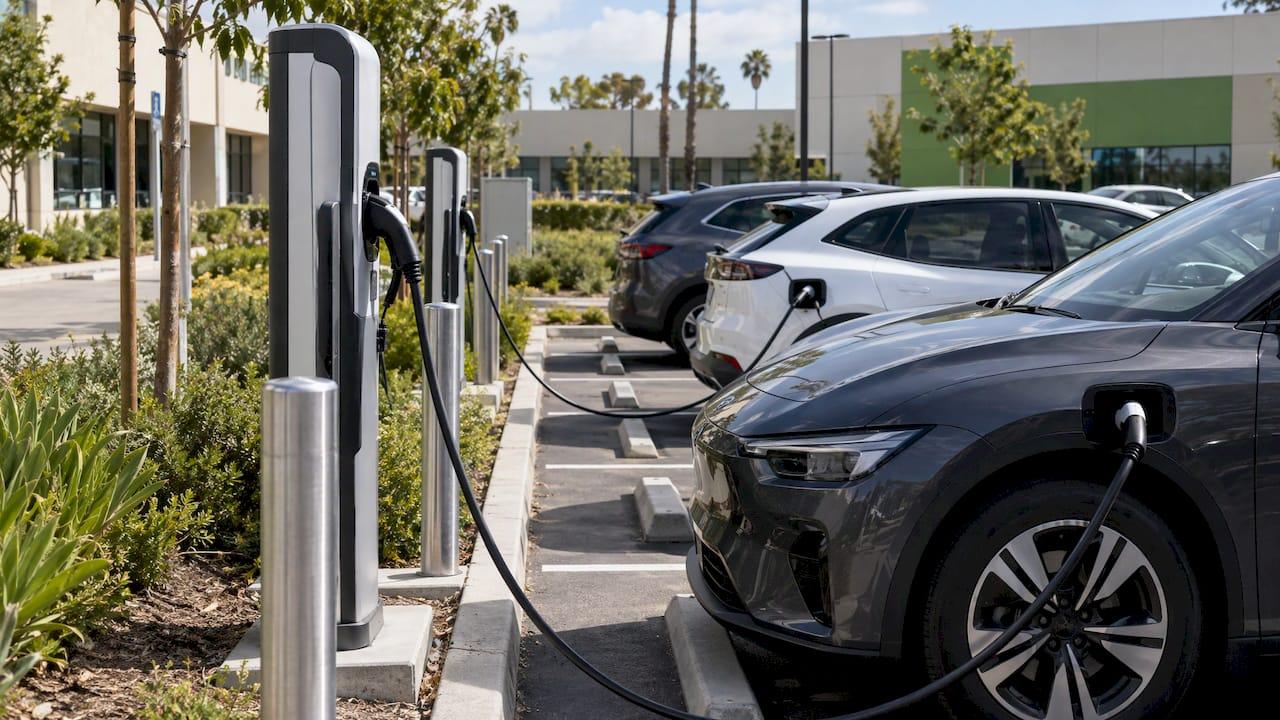

California has no single statewide EV charger rebate. The money comes from your electric utility, your community choice aggregator (CCA), a county air or energy program, or a regional program such as CALeVIP, and each one has its own rules about who can apply and when. The common thread is timing: many programs want your application before the charger goes in, or within a fixed window after purchase. The most reliable way to collect is to confirm eligibility first, then design and install the charger to match the program. That is how we plan every EV charging project at Indigo Energy in San Diego County.
TL;DR
- Residential rebates come from utilities: for example, PG&E pays up to 50% of one eligible charger, and LADWP pays up to $1,000.
- Business, multifamily and public sites can reach into the thousands per port through programs like CALeVIP, SMUD and Silicon Valley Clean Energy.
- In San Diego County, the county’s charger program covers unincorporated areas only and runs in funding rounds.
- Apply before you buy or install whenever a program says so. Missing that step is the most common way to lose a rebate.
- The federal charger tax credit has a mid-2026 cutoff, so check the status before counting on it.
Table of Contents
- Start with who serves your address
- Home charger rebates
- Multifamily, workplace and public charger rebates
- How to apply without losing the rebate
- Federal tax credit and other changes
- Pairing the charger with solar and rate planning
- Our perspective
- Plan your charger and rebate together
- FAQ
- Sources
Start with who serves your address
Your rebate options depend on three things: who delivers your electricity, whether a CCA buys the power for you, and where the charger will sit. A homeowner in Pasadena has different options from a property manager in Vista or a developer in Sacramento.
Three questions narrow it down quickly:
- Which utility bills you? PG&E, SDG&E, SCE, LADWP, SMUD and city-owned utilities such as Burbank Water and Power and Alameda Municipal Power each run their own programs, or none.
- What kind of site is it? Single-family home, multifamily building, workplace, public parking, or fleet depot. Programs are almost always written for one of these.
- Who owns the property? Many commercial programs require the site owner or an authorized agent to apply, not the tenant.
If you are in San Diego County, note that the county’s own Electric Vehicle Charger Program is limited to sites in unincorporated county jurisdiction. Chargers in single-family homes and at federal, state and tribal government sites are not eligible, and most sites must be publicly accessible at least 18 hours a day. Multifamily properties are the exception to the access rule.
Home charger rebates
Home programs are modest compared with commercial ones, but they can cover a meaningful share of a Level 2 charger and the electrician’s work. Two programs show how different the rules can be.
PG&E residential rebate
PG&E’s program is for active residential electric customers, including those whose power comes through a CCA, who own or lease a qualifying battery-electric or plug-in hybrid vehicle with current California registration. According to PG&E’s program page:
- The Standard Rebate covers one eligible item at up to 50% of its purchase price, and you apply within 180 days of purchase.
- Rebate Plus is income-qualified and offers up to $2,000 for installation, or up to $5,000 for a panel upgrade plus installation. You must apply before a Trade Ally Network contractor buys and installs the equipment.
- Gather your residential bill and service agreement ID, California vehicle registration, purchase receipt, installation photos and the electrician’s invoice, if applicable.
If your vehicle is a used EV, the same eligibility rule about owning or leasing a qualifying vehicle applies. A used EV battery health checklist is worth running before you buy, so the car you register is one you will keep charging for years.
LADWP residential rebate
LADWP’s Charge Up LA! program, per its residential FAQ, pays up to $1,000 toward a charger purchase or installation. It adds a flat $250 for a dedicated EV time-of-use meter and an extra $500 for EZ-SAVE or Lifeline customers. A few rules matter in practice:
- Only LADWP residential account holders with an active meter on a residential rate plan can apply.
- The charger must be a new, unused 240-volt Level 2 unit, certified by a nationally recognized testing laboratory such as UL, network-capable, with an SAE J1772 or SAE J3400 connector.
- Installation costs are claimable only when a licensed electrician does the work.
- The rebate cannot exceed your actual costs minus any third-party incentives. Stacking is possible, but the total cannot pay you more than you spent.
- Applications are due within 12 months of purchase, or six months for installation-only or meter-only claims.
Worked example
Say an LADWP customer buys a $600 charger and pays an electrician $1,100 to install it, for $1,700 total. The $1,000 maximum applies, because costs exceed it. If a separate incentive had already paid $900, the LADWP rebate could not exceed $800 (costs of $1,700 minus $900). Always add up what you have been promised before you sign a quote.
For what the project itself costs before rebates, see our breakdown of home EV charger cost.
Multifamily, workplace and public charger rebates
The larger numbers are here. Property managers, employers and developers can often recover a major share of equipment, labor and electrical upgrades.
| Program | Who it serves | What it pays |
|---|---|---|
| San Diego County EV Charger Program, Round 1 | Unincorporated county sites: retail, multifamily (4+ units), office, medical, school, hospitality, industrial | $5,000 per Level 2 charger or 75% of project costs, whichever is less; $50,000 per 50–99 kW DC fast charger; $75,000 per 100+ kW unit; equity-priority-area bonuses up to 100% of covered cost |
| SVCE EV Charging | Multifamily (4+ units), workplaces, public sites, new affordable housing in SVCE territory | $2,500 per L1/L2 outlet, $5,500 per Level 2 port (up to 18 ports), up to $5,000 for panel upgrades, $1,500 per pre-wired port; capped at 100% of project cost |
| SMUD business incentives | SMUD business customers | $2,500/$5,000 per low-power Level 2 handle, $3,500/$7,000 per high-power Level 2 handle, and higher tiers for non-public DC fast charging; stub-out, panel and transformer incentives too |
| LADWP commercial | Commercial, industrial and multifamily common-area customers | Rebate for new, hardwired chargers accessible to employees, customers, visitors or tenants |
| CALeVIP | California businesses, nonprofits, tribes and public entities that own the site or act as its agent | Project-based incentives for Level 2 and DC fast charging sites |
SMUD lists two amounts per tier; check its page to see which applies to your site. The San Diego County program ran Round 1 over the summer and fall of 2026, and the county expects a Round 2 at lower incentive amounts, so confirm the current round on its page rather than assuming the Round 1 figures still apply.
What counts as an eligible cost
This is where projects win or lose money. Under CALeVIP, eligible costs include EVSE (the charging equipment itself), installation labor and materials, electric panels, transformers, stub-outs, utility service costs, design and engineering, energy storage, demand management equipment, signage, required ADA upgrades and extended warranties. It also lists all-inclusive solar EV charging systems. Permits required by the local authority are not eligible there. See the eligibility page.
SVCE covers charging equipment, permit fees, installation labor, electrical and panel upgrades, load management equipment and warranties, with paid invoices required. Its Level 2 equipment must be UL 2594 certified, NEMA 3R rated, hardwired, carry at least a three-year warranty, and use SAE J1772 or NACS connectors. Burbank Water and Power’s commercial rebate, by contrast, excludes conduits and panels required by the Burbank Building Code.
So the same invoice can be fully reimbursable in one territory and partly excluded in another. The scope of work should be written around the program, not the other way round.
Public access and hours
Program definitions of “accessible” differ. CALeVIP requires DC fast charging sites to be publicly available 24/7 and not behind a fence or gated lot. The San Diego County program expects most sites to be open to the public at least 18 hours a day. A gated lot or an employee-only garage can change which program fits, or whether the project qualifies at all.

How to apply without losing the rebate
Most rejected applications trace back to sequence, not paperwork. A routine that works:
- Confirm the program and its funding status. Many are first-come, first-served, and funding rounds open and close. Check the program page for the current window.
- Check the equipment list. Certification, connector type, networking and warranty requirements are strict. A cheaper charger that fails the list can cost you the rebate.
- Reserve or apply before work starts where the program requires it. PG&E’s Rebate Plus and LADWP’s commercial reservation option both work this way.
- Use a licensed electrician and a pulled permit. LADWP’s commercial program, for example, requires a finaled permit and prior engineering approval for post-deployment claims.
- Keep every invoice and photo. SVCE requires invoices marked paid, and PG&E asks for installation photos.
- Submit within the deadline. Home programs commonly allow six to twelve months from purchase, with PG&E’s Standard Rebate at 180 days.
For commercial and multifamily projects, there is a sixth hidden step: sizing the electrical service. Adding several chargers to a building can trigger a utility upgrade that dwarfs the rebate. Our guide to EV charger load management for property owners explains how managing the load can keep a project within the existing service. Homeowners can read the equivalent load management guide for homes.
We handle site assessment, permitting and the financial ROI analysis for our San Diego County customers, so the rebate, the permit and the equipment choice are lined up before anything is purchased.
Federal tax credit and other changes
The federal charger credit (Section 30C, claimed on IRS Form 8911) was cut off for property placed in service after June 30, 2026, according to a tax-credit status summary. Qualifying pre-deadline home installations received 30% of cost up to $1,000 in eligible census tracts. That summary also reports that the federal credits for buying new and used EVs ended for vehicles acquired after September 30, 2025. If you installed a charger before the cutoff, talk to your tax preparer about Form 8911.
For installations going forward, the practical stack is utility, CCA, county and regional programs. If you are pairing a charger with solar, our overview of California solar incentives and the California solar tax credit page show what applies to the solar side, and business owners can see commercial solar incentives in San Diego.
Pairing the charger with solar and rate planning
A rebate lowers the upfront cost. What you pay each month for charging depends on your rate plan and where the electrons come from. Charging on an EV time-of-use rate is part of the equation; see our guide to SDG&E EV rates and plans for hours and how to choose. Solar can cover most of the load: our post on covering your EV with 7–12 solar panels walks through the sizing. Several programs also reimburse energy storage or solar-integrated charging as part of the project, as CALeVIP’s eligible-cost list shows.
Renters and tenants have a different path, since the landlord usually has to apply. Our apartment EV charging guide covers how to make that request.
Our perspective
Rebates reward the project that was planned for them. We have found that the best results come when the charger, the electrical panel and the solar system are designed together, early, with the incentive rules on the table before a single quote is signed.
For a homeowner, that means choosing a charger that meets the program’s certification and connector rules, and sizing the circuit so a panel upgrade is avoided where possible. For a property manager or developer, it means bringing us in during design, when load management, stub-outs for future ports and solar can be built into the plan at a fraction of the retrofit cost.
Our approach is transparent pricing and a custom ROI analysis, so you can see what the rebate, the permit and the equipment mean for your payback. We also handle local permitting across San Diego County, which keeps the paperwork the programs ask for in order.
Curtis Williamson
Plan your charger and rebate together
If you own a home, a commercial building or a development in San Diego County, Indigo Energy’s EV charging and solar integration service covers design, installation, permitting and ongoing monitoring, with the financial ROI analysis done up front. Tell us the site and the vehicles, and we will build the project around the incentives that apply to it.
You can also see the full range on our services page, including battery storage for sites that want backup power alongside charging.
FAQ
Does California have a statewide home EV charger rebate?
No single statewide home rebate exists. Home rebates are offered by individual utilities, such as PG&E and LADWP, and your eligibility depends on who serves your address. Regional and county programs focus mostly on businesses, multifamily and public sites.
Can I combine rebates?
Often yes, but programs set their own limits. LADWP’s residential rebate, for example, cannot exceed your actual costs minus third-party incentives. Check each program’s stacking rules before you apply, and keep invoices that show what each incentive paid.
Do I apply before or after buying the charger?
It depends on the program. PG&E’s Standard Rebate is applied for within 180 days after purchase, while its income-qualified Rebate Plus must be approved before a contractor buys and installs the equipment. LADWP’s commercial program lets you reserve a rebate before deployment.
Can a single-family home get a San Diego County charger rebate?
No. The county’s program excludes single-family home chargers and covers sites in unincorporated county jurisdiction, including multifamily properties with four or more units and commercial, office, retail and other accessible sites. Check your utility’s residential offerings for a home charger.
Sources
- PG&E Residential Electric Vehicle Charging Rebate
- LADWP Residential EV Charger Rebate Program FAQs
- LADWP Commercial EV Charger Rebate Program FAQ
- San Diego County Electric Vehicle Charger Program
- SVCE EV Charging Participation Agreement
- SMUD Business Electric Vehicles
- CALeVIP General Eligibility and Requirements
- Burbank Water and Power Commercial EV Charger Rebate FAQ
- Federal EV and Charger Tax Credits in 2026
- Used EV battery health checklist