
Apartment EV charging is realistic for most renters, and the fastest path usually starts with what is already there: a standard 120V outlet near your parking spot or an on-site charger you haven’t checked for yet. Before assuming you need a landlord fight or a costly install, verify what’s available now, then build your case using the common hybrid vehicle service needs guide and script below.
TL;DR:
- Most renters can use existing outlets or on-site chargers, with Level 1 charging providing 24 to 40 miles of range overnight without installation costs.
- A well-structured, written proposal including location details, installer info, and billing plans significantly improves the chances of landlord approval for personal chargers.
- Installation costs vary widely from $500 to over $2,500 for simple setups near existing panels, but longer wiring, panel upgrades, and trenching can raise expenses substantially.
- Utilities and state programs often offer rebates or make-ready funds, which can cover part of the infrastructure costs, especially for multifamily or shared installations.
- Load sharing and technical billing methods enable building-wide charging without costly service upgrades, making resident-funded solutions more feasible.
Table of Contents
- Apartment EV Charging Options, Ranked From Easiest to Hardest
- How Do You Ask Your Landlord for an EV Charger?
- What Does EV Charger Installation Cost, and Are There Rebates?
- Billing and Load Sharing: The Technical Fixes That Save Money
- Filling the Gaps: Public and Workplace Charging
- When Should You Bring in a Professional Installer?
- Charging Access Is an Equity Issue, Not Just a Convenience One
- How Indigo Energy Helps You Get Charging Installed the Right Way
- Where to Learn More
- Sources
- FAQ
Apartment EV Charging Options, Ranked From Easiest to Hardest
Most renters overthink this. You don’t need a dedicated Level 2 charger to make EV ownership work in an apartment. You need the option that matches your parking situation and your patience for paperwork.
- Level 1 charging from a standard outlet. A regular 120V outlet near your spot adds about 3 to 5 miles of range per hour, or roughly 24 to 40 miles overnight. For a lot of commuters, that’s plenty, and it requires zero installation if the outlet already exists.
- Existing on-site chargers. Many newer complexes already have shared stations. Check the level (Level 1 vs Level 2), whether reservations are required, and what the per-session or per-kWh cost runs before assuming none exist. (No specific figures to support)
- Tenant-funded Level 2 in a deeded or assigned space. If you have exclusive rights to a spot, you can often install your own charger following a defined permit and installer path, covered in the next section.
- Shared building stations with managed access. Some properties install a bank of chargers and recover costs through reservation systems or monthly fees, spreading the expense across residents who actually use them.
- Portable Level 2 units and NEMA outlet upgrades. A portable EVSE plugged into a 240V NEMA outlet gives you Level 2 speeds without a hardwired station, useful if you might move.
None of these are mutually exclusive. A lot of renters run Level 1 daily and supplement with a public fast charger once a week. That hybrid approach, not a single perfect solution, is often the realistic answer.
How Do You Ask Your Landlord for an EV Charger?
The biggest mistake renters make is asking for a charger instead of proposing a project. A landlord who hears “can I install a charger” thinks about cost and liability. A landlord who receives a one-page plan thinks about a solved problem.
Right-to-charge statutes in a growing number of states limit an owner’s ability to flatly refuse a tenant-funded install, though the protections usually apply to deeded or assigned parking rather than open common-area spaces. Even where no statute applies, a strong proposal moves the conversation forward.
Your one-page proposal should include:
- Exact parking space location and whether it’s deeded, assigned, or shared
- A licensed installer’s name and a preliminary quote
- Your permit and inspection plan
- Who pays for installation, maintenance, and electricity
- Proof of renter’s insurance or a liability rider if requested
A practical package that names the installer, the permit plan, an insurance certificate, and a billing method converts a vague request into a defined project the property manager can approve or forward to their board.
Pro Tip: Offer to cover submetering or accept networked billing before the landlord raises cost concerns. Boards approve tenant proposals faster when the financial risk is already off their plate.
What Does EV Charger Installation Cost, and Are There Rebates?
Expect a wide range depending on your situation. A simple tenant-funded install where the space sits close to an existing panel might run $500 to $2,500, while shared building installations serving multiple spaces cost considerably more per unit once you factor in commercial-grade equipment and management software.
Three variables drive most of the cost swing:
- Distance to the electrical panel. Long wire runs mean more conduit, more labor, and more permit scrutiny.
- Panel capacity. If the building panel is already maxed out, a service upgrade adds thousands before the charger itself gets installed.
- Trenching and permits. Outdoor parking often means trenching under pavement, which is the single most expensive line item in many quotes.
The federal 30C tax credit expired for chargers placed in service after June 30, 2026, so that incentive is off the table for new installs going forward. That shifts the leverage to state and utility programs. Many utilities run dedicated multifamily make-ready funds that cover a portion of electrical infrastructure costs, and state energy offices frequently maintain rebate directories worth checking before you finalize a quote. Search your utility’s website for “make-ready” or “multifamily EV” programs, since these are often underpublicized compared to residential rebates.
Billing and Load Sharing: The Technical Fixes That Save Money
How a building charges residents for electricity matters as much as the equipment itself. Three billing models dominate:
- Submetering: each charger gets its own meter, and residents pay actual usage. Fair, but adds equipment cost.
- Networked billing: a connected charger tracks sessions and bills through an app or account, common in shared-station setups.
- Flat fees: everyone pays the same monthly amount regardless of usage, simple but often unfair to residents who charge less.
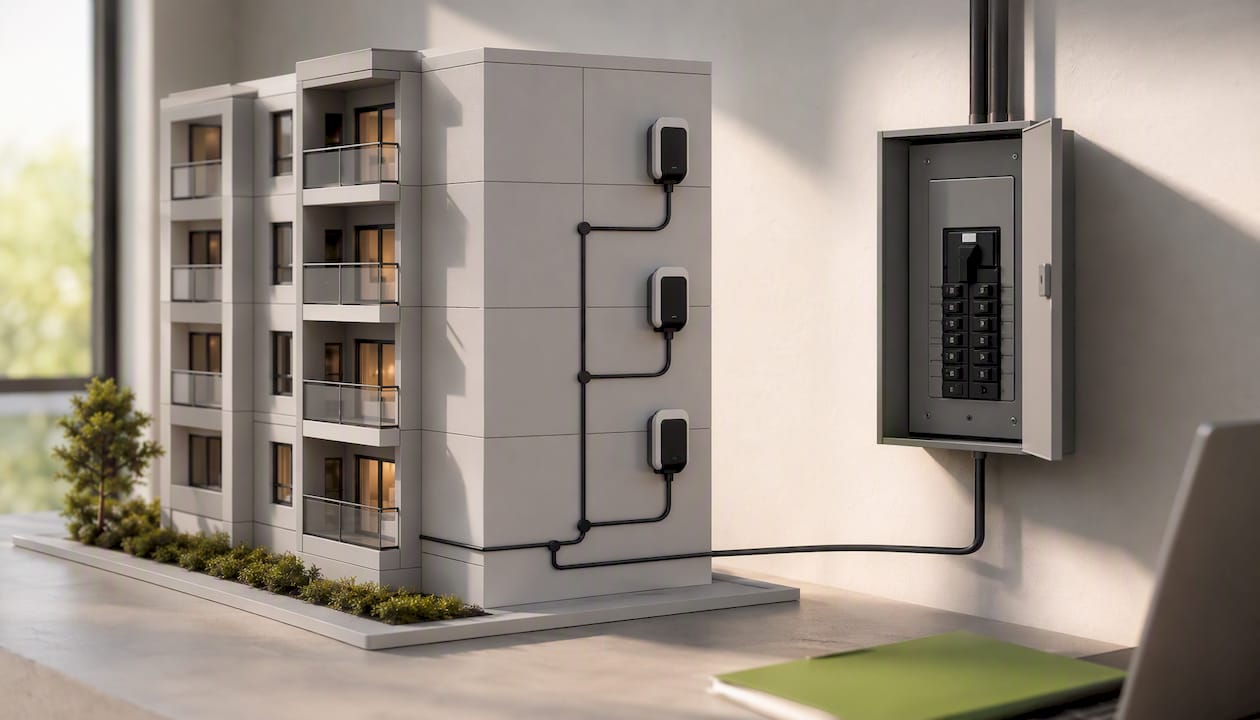
The technical objection that kills most building-wide proposals is service capacity, and it’s usually solvable without a costly panel upgrade. Load-sharing systems let multiple chargers split a fixed circuit, delivering less power to each vehicle when several are plugged in simultaneously but still replenishing typical daily commute range overnight. It’s the difference between needing a $30,000 service upgrade and installing a $2,000 to $5,000 management system.
A service upgrade only becomes necessary when the building’s existing capacity genuinely can’t support additional load even with sharing in place. In shared installs, that cost typically falls on the property owner or gets split across the capital improvement budget, not the individual resident requesting a charger.
Filling the Gaps: Public and Workplace Charging
Even with a great home setup, you’ll likely lean on public or workplace charging some weeks. Building a routine around it beats scrambling when your battery hits 10%.
- Map your options first. Use apps like PlugShare or ChargeHub to find nearby Level 2 and DC fast chargers, then confirm directly with your leasing office whether any advertised on-site amenities actually exist, since listings are frequently outdated or vague.
- Ask your employer about workplace charging. Many companies add Level 2 stations for a fraction of what a public network costs, and a simple request to HR or facilities sometimes gets one installed within a few months.
- Build a hybrid weekly schedule. A common pattern: nightly Level 1 at home for baseline range, plus one weekly stop at a public Level 2 or DC fast charger to top off before a longer trip.
This kind of layered approach means no single point of failure controls your ability to drive.
When Should You Bring in a Professional Installer?
Some situations call for an expert rather than a DIY conversation with your landlord. Panel capacity questions, wire runs longer than a typical garage stall, building-wide installations serving multiple units, and any permit navigation with your city’s building department are all triggers for professional help.
A qualified site assessment should cover:
- Current panel capacity and whether an upgrade is realistically needed
- A firm quote for wire runs, trenching, and equipment
- A realistic permit and inspection timeline for your jurisdiction
- Recommendations on submetering versus networked billing based on your building’s setup
Full-service installers who handle design, permitting, and post-install monitoring together, rather than passing you between subcontractors, tend to catch problems before they become change orders. Look for manufacturer partnerships and warranty coverage on both the charger and the electrical work, not just the hardware itself.
Pro Tip: Ask any installer you’re considering to walk through their permit timeline for your specific city before signing anything. A vague answer here usually means delays later.
Charging Access Is an Equity Issue, Not Just a Convenience One
Renters get left out of the EV transition more than any other group, mostly because the charging conversation assumes a garage and a driveway. That framing needs to change.
Collective action moves faster than individual requests. Petitions with several resident signatures carry more weight than one, and timing your ask around lease renewal season gives property managers a natural moment to say yes. Document every conversation with your leasing office in writing, and escalate to a written proposal only after informal requests stall.
— Curtis Williamson
How Indigo Energy Helps You Get Charging Installed the Right Way
Getting from “I want a charger” to “I have a working charger” usually means navigating permits, panel capacity, and billing decisions alone, unless you bring in someone who does this daily. Indigo Energy handles EV charging and solar integration as one coordinated project rather than a patchwork of separate contractors, which is where most apartment installs lose time.
A consultation with our team covers a full site assessment, a realistic cost estimate based on your building’s actual electrical setup, a permit and installation timeline specific to your jurisdiction, and an honest ROI discussion so you know what you’re paying for before any contract gets signed. If you’re a resident building a proposal for your landlord, or a property manager evaluating what an EV-ready building actually requires, our services page is the place to start. Request an assessment and get a real quote instead of a guess.
Where to Learn More
The AFDC’s multifamily housing toolkit walks through parking, electrical, and billing considerations step by step. State-level playbooks, like New Jersey’s MUD toolkit, offer a jurisdiction-specific model. The Energy Innovation report on multifamily charging covers policy gaps and right-to-charge details in depth.
Sources
- Electric Vehicle Charging for Multifamily Housing
- The State of Electric Vehicle Charging for Multifamily Housing
- Apartments With EV Charging: A Renter’s 2026 Guide - ChargeRight
- EV Charger Installation Cost 2026: $900 - $1,500 (Real Data) | ElectrifyHome
FAQ
How Do People In Apartments Charge Their EVs?
Most renters rely on a standard 120V outlet near their parking spot, an existing on-site charger, or a tenant-funded Level 2 install in a deeded space, often combined with occasional public or workplace charging.
Can You Charge An EV If You Live In An Apartment?
Yes, for the majority of renters, especially if a standard outlet is accessible near your parking space or your building already has shared charging infrastructure.
Is EV Charging At Apartments Free?
Rarely. Most buildings recover electricity costs through submetering, networked billing per session, or a flat monthly fee, so expect some charge even at on-site stations.
Can You Get An EV Charger Installed In An Apartment?
Often yes, particularly if you have a deeded or assigned parking space, since right-to-charge statutes in many states limit a landlord’s ability to refuse a well-documented tenant-funded proposal. Working with a full-service installer on the permit and electrical plan can make approval significantly more likely.